The French government has accused the far-left of stoking the riots that engulfed the nation on Saturday, resulting in widespread clashes with police, looting of shops, as well as vandalism and arson of government buildings.
What began last month as a small protest over teacher shortages at a school in the Créteil suburb of Paris has become a full-on national revolt, with various leftist unions and other organisations also taking to the streets in cities across the country on Saturday, with an estimated 550,000 demonstrators.
At a press conference in Paris, Minister of the Interior Laurent Nuñez said that unlike other protests, where rioters wait until the end of the event to turn violent, the violence on Saturday “started right from the beginning”, Le Figaro reported.
Nuñez specifically blamed the “radical left” for stoking the riots, saying that “groups of several hundred or thousands of rioters, clearly instigated by the far left, attacked the police,” leaving at least 60 officers injured. He said that around 400 people, mostly adults, have been arrested. However, the minister noted that “the day isn’t over yet.”
Prime Minister Sébastien Lecornu also pointed to “ultra-left groups” being behind the demonstrations and having “organised violence in several French cities”.
“Peaceful demonstrations have their rightful place in our Republic. Arson, looting, and attacks have no place whatsoever,” he said. “To those who clearly want to use these acts of violence as a ‘warm-up’ before the presidential election, I say this plainly: we will not be intimidated. No one will impose their political agenda through violence.”
Previously, the Paris Police have reportedly linked the student protests to far-left groups and political parties like La France Insoumise (France in Rebellion/LFI) of presidential candidate Jean-Luc Mélenchon, agents of whom allegedly infiltrated and manipulated the youth movement.
Prime Minister Lecornu expressed his support for the so-called vandals pay legislation, which would force those involved in rioting to pay for the damage caused, whether they personally engaged in destruction themselves or not. “Public money is scarce: it must fund our public services, not endlessly repair what vandals destroy. It is up to them to bear the cost,” he said.
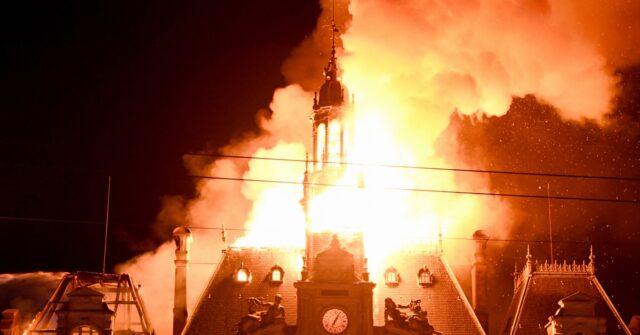
However, it is unlikely for the government to recoup the entire cost of the riots on Saturday, which saw historic buildings burnt to a crisp by arsonist rioters, including the Limoges City Hall. The building, inaugurated in 1883, saw its famous tower collapse in a conflagration on Saturday as fire ravaged its mostly wooden frame. According to the prefect of Haute-Vienne, the building was “largely lost”.
Several thousand people had taken part in a local demonstration on Saturday, which ultimately devolved into violent scenes, including the burning of a municipal police car in front of the town hall. Le Figaro reported that “hooded individuals” were seen approaching the building, smashing the windows, and setting it on fire. At the time of this report, it is unclear whether historic works of art in the building were saved, including works by French painter Henri-Paul Motte.
Mayor of Nice Éric Ciotti lamented that the fire which ravaged Limoges town hall was an “allegory of our republic”. “We will not let our country die without reacting. We are millions who refuse chaos. We will prevail!” he vowed.
Other buildings suffered a similar fate, with rioters setting fire to the tourism office in Lyon on Saturday during another demonstration, which saw around 20,000 people gather.
Indicating the far-left nature of the riots, vandals broke into the Town Hall in Marseille and painted the Anarchist symbol on the walls of the government building.
Meanwhile, the official residence of the Prefect of Gironde in Bordeaux was also “ransacked” by rioters, forcing specialist police units to be deployed to recapture the building.
In Nantes, widespread looting occurred in the city centre, with around 100 hooded individuals setting fires on the streets and then bursting into shops, looting televisions and other tech items. One young man was heard shouting: “It’s Christmas, I’m treating everyone!”
Looting and vandalism were also seen in cities such as Nice and Lille, where rioters smashed out the windows of a local middle school, despite the protest movement supposedly being about the underfunding of the education system.
The Socialist Mayor of Paris, Emmanuel Grégoire, also complained of violence and looting in his city, saying that “entire streets” were “methodically ravaged”. Mayor Grégoire said he was “very angry” but stressed that people should distinguish between protesters in the youth “social movement” and the “rioters”.
For his part, outgoing President Emmanuel Macron said that there is “no room for violence” in France.
“Those who have broken, attacked the prefectures as well as businesses, looted even our town halls, will be prosecuted and punished,” he vowed.
“To the law enforcement forces, guarantors of the right to demonstrate, I express the support of the Nation. We will all stand united against the sowers of chaos, who seek only to bring down our institutions and prevent those who peacefully express their demands from doing so.”
Frontrunner in the race to replace Macron, National Rally leader Marine Le Pen said that “legitimate social demands have once again been held hostage by the far left and the speeches of Jean-Luc Mélenchon’s deputies, who, by legitimizing violence, viewing order as oppression and disorder as a right, seek to plunge the country into chaos.”
“Faced with this incendiary strategy, the French people, who can no longer bear being caught between the austerity and fiscal hammering of those in power and the insurrectionary activists, must hold out for a few more months,” she said. “We will free them from Macronist toxic policies and protect them from the violence of the far left.”