
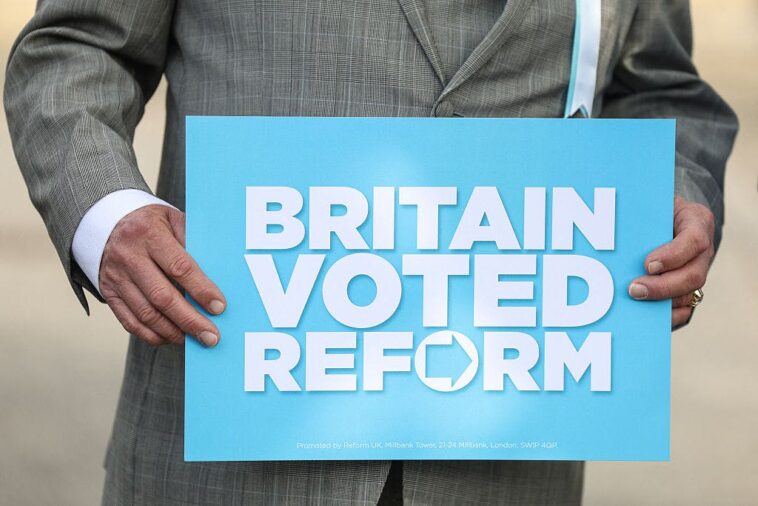
Britain’s political establishment woke up this morning in a state of shock. Across England in the local council elections — the rough equivalent of a “midterm” on that side of the Atlantic — voters abandoned both Labour and the Conservatives in droves, handing huge gains to Reform U.K. in what commentators are already calling a political earthquake.
The Westminster class will spend days analyzing swing percentages, demographic shifts, and campaign strategies. But the reason ordinary Britons revolted is much simpler than the experts would like to admit.
Whether in rural towns or urban centers, people are sick of a political elite obsessed with policing speech, policing thought, and policing “offense” while failing to police actual crime. The message was clear: “Enough.”
Enough of watching violent crime spiral in major cities while police forces spend their time monitoring tweets and recording “non-crime hate incidents.”
Enough of hearing endless lectures about “harmful language” while grooming gang scandals continue to haunt communities across the North of England, with victims still waiting for justice and accountability.
Enough of watching peaceful Christians being dragged through the courts for expressing their faith, while ordinary citizens increasingly feel unsafe in their own streets.
And nowhere is that national frustration more vividly embodied than in the conviction this week of retired Northern Irish pastor Clive Johnston — on the very same day that Brits took to the polls. A 78-year-old grandfather now has a criminal record because he preached from the Bible outdoors.
Not for harassment. Not for violence. Not for obstruction. Not even for mentioning abortion.
His crime? Preaching a message from John 3:16 at a small outdoor Sunday service held near a hospital, where a large “buffer zone” is in place covering several streets, banning anything the police interpret to be “influence.”
That is modern Britain in a nutshell.
The authorities insist these buffer zone laws are designed to prevent intimidation outside abortion facilities. Of course, nobody should be harassed anywhere on British streets, and legislation already exists to prevent that. But Johnston’s case revealed something much bigger — and much darker. Police bodycam footage shown in court captured officers telling the pastor he should share the Gospel only inside a “safe area” like a chaplaincy, not on the public street where passers-by might hear him, and potentially take offense.
Think carefully about what that means. Britain now has areas of public space where peaceful Christian expression can effectively become criminal if somebody decides it might “influence” another person.
Christianity, apparently, is acceptable only when carefully confined to approved spaces.
Meanwhile, in city after city, police forces that somehow lack the resources to tackle shoplifting epidemics, anti-social behavior, knife crime, or organized exploitation networks can apparently still find the time and manpower to prosecute elderly pastors quoting Scripture, or individual women stopping to pray in their own heads.
It is difficult to imagine a clearer example of institutional priorities gone mad.
This is precisely why voters are abandoning both establishment parties. The Conservatives spent years talking tough on culture war issues while presiding over the steady erosion of free speech and public order alike. Labour, meanwhile, has abysmally failed to restore confidence in basic law enforcement. Ordinary people look around their communities and see disorder tolerated, borders abused by criminal traffickers, anti-social behavior normalized, and public institutions increasingly hostile to traditional values — especially Christian ones.
Then they watch a pensioner being prosecuted for preaching the Gospel.
They conclude, quite rationally, that the people running the country no longer share their instincts about right and wrong.
The revolt we witnessed in the elections was not simply economic, but moral and cultural. Across Britain, there is a growing sense that the authorities have become harsher toward the decent than toward the dangerous. They certainly seem more comfortable targeting peaceful Christians than confronting genuinely difficult social problems.
A nation cannot function when millions of ordinary citizens begin to believe there are effectively two systems of policing: one lenient toward chaos, and another aggressively punitive toward citizens who hold unfashionable beliefs.
Britain birthed America with all her understandings of liberty and democracy. This parental nation was not built on the idea that faith belongs hidden away in private rooms while the public square is handed over entirely to secular bureaucracies and activist-approved ideology. Britain was shaped by Christianity — culturally, morally, legally, and politically. From the abolition of slavery to the creation of charitable institutions, Christian belief has always shaped public life openly and unapologetically.
What voters increasingly reject is not merely “wokeness” as a slogan. They reject a governing philosophy that treats traditional values and Christian beliefs as suspect while excusing failure everywhere else. The election results show that the old political consensus is breaking apart. People want order restored. They want police focused on violent criminals, traffickers, gangs, and repeat offenders — not elderly pastors preaching John 3:16.
***
Lois McLatchie Miller (@loismclatch) is a writer and social commentator from Great Britain, focusing on the state of free speech, faith, and family across the globe.