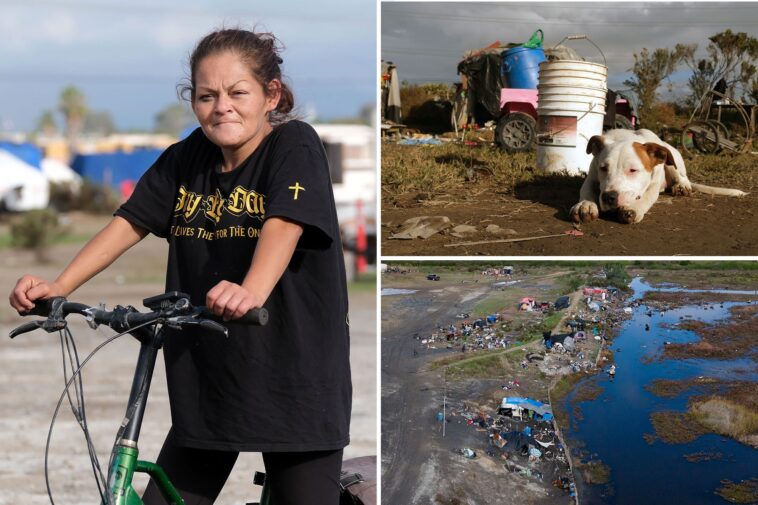
Hordes of homeless have been flocking to a radioactive waste dump in an idyllic Southern California beach town — despite orders to leave and the cancer-causing chemicals polluting the ground beneath them.
About 135 people, including children, live in tents and RVs at the former site of the Halaco Engineering Company smelting and recycling plant in Oxnard, where dangerous heavy metals and radioactive isotopes leach from the dusty ground into the air.
City officials on Oct. 30 ordered the homeless to vacate the 11-acre site by Nov. 16. But when the California Post visited the encampment that day, the dwellers remained — with no plans to leave.
Sign up for the California Morning Report newsletter
The biggest news, opinion and culture shaping California right now.
Thanks for signing up!


“I’m going to stand my ground for sure,” said squatter Maria Fuller, 51. “We’re not bothering anybody. I can’t tell any difference from the radioactive stuff.”
Fuller lives with her dog George in a makeshift tent constructed from discarded tarps and wood. She fashioned a bedroom, a kitchen area with a gas stove, a bathtub she fills with water brought in by hand and a plastic basin she uses for doing laundry.
Fuller’s dwelling is well-appointed by the site’s standards. The former metal plant sits just a few hundred yards inland from Ormond Beach in an industrial neighborhood that abuts a nature preserve. The marshy area is served by a dirt road that washes out when it rains.


About half the site’s residents live in makeshift tents like Fuller’s, with the other half living in RVs and cars. There is no electricity service or sewage; residents dump their waste in ditches or buckets. A well provides fresh water that Fuller and other residents boil before it’s used.
The area smells of pollutants and the ground itself is toxic. Soil there covers industrial waste containing poisonous lead, mercury, and arsenic, as well as ammonia, and radioactive thorium and radium, according to reports published by the Environmental Protection Agency.
The EPA reports found that the chemicals presented the potential for causing lung cancer, stomach cancer, kidney cancer, brain damage, heart disease, birth defects and other illnesses.


“We’re all worried about human health risk,” Karmen King, an EPA consultant, told residents at a town hall meeting regarding the site in 2022, according to a transcript of the meeting published by the EPA.
The toxins were left behind by Halaco when the company closed in 2006, following its bankruptcy in 2004, according to the EPA. EPA officials deemed the site an emergency in 2007 and that year added it to the Superfund program for the nation’s most severely contaminated lands.
The federal agency has completed some limited cleanup efforts at the site, but most of its work remains in the planning stages. The agency is set to present its latest plans for the area to the public early next year.


The land at the Halaco site is owned by private parties, including members of the Haack family, who are the heirs to the family-owned company. The site is fenced in, but the residents of the encampment have cut through the fence to gain access.
John Haack, who was identified as one of the property’s owners by the EPA, didn’t respond to a request for comment on the matter.
Many of Halaco’s inhabitants blame the dust there for coughing sickness, prompting some to wear masks when it’s windy. But most, like Fuller, are more concerned with finding a place to sleep than they are with the possibility of being slowly poisoned by toxic waste.
“I’ve been out here for years and I’m fine,” she said. “For most people here, there’s nowhere else to go.”
Download The California Post App, follow us on social, and subscribe to our newsletters
California Post News: Facebook, Instagram, TikTok, X, YouTube, WhatsApp, LinkedIn
California Post Sports Facebook, Instagram, TikTok, YouTube, X
California Post Opinion
California Post Newsletters: Sign up here!
California Post App: Download here!
Home delivery: Sign up here!
Page Six Hollywood: Sign up here!


The tents at the Halaco site are arranged in a rough circle around a courtyard where two rusting cars are used as targets by residents who drive golf balls for fun. Others toss footballs or ride bikes or four-wheelers for recreation. Many locals work jobs during the day.
The Halaco homeless watch out for each other, said Fuller, who conducted a headcount of the area with a friend. If someone spots a fire, they rush to put it out, she said. Thieves are banished from the encampment, and locals share food and other items with those who need it.
About half the residents are addicts and most have mental health issues, according to outreach workers from the Ventura County Believe Center, but the dump’s dwellers said violence is rare.


“We’re pretty much like family here,” said resident Bailee Hope, 32, who lives in a truck with her boyfriend. “We’re helping each other through a rough time, and that’s what family does.”
The Halaco site has been a magnet for the homeless for more than a decade, with city officials attempting to rid the space of squatters once in 2017 and again in 2021. Oxnard’s official homeless population in 2026 was 532, reflecting three straight years of declines.
But the size of the Halaco encampment exploded about six weeks ago, encampment residents and city officials said, after police rousted about 80 RVs owned by the homeless from a nearby street, driving most of them to resettle at the relatively remote site.


Authorities took notice, posting a sign at the Halaco site warning residents that the presence of RVs there constituted a “public nuisance” that violated city ordinance against using vehicles as a dwelling.
But as of Monday, the homeless remained. Oxnard Deputy City Manager Katie Casey said the city has not received permission to remove trespassers from the site, even though local officials have received numerous complaints about the encampment.
“The city regularly receives calls from adjacent property owners and requests for public safety services at the Halaco site,” Casey said.

Local homeless advocate Doug Partello said the area around the encampment is “extremely dangrous,” both due to the toxic dust there and because of rampant crime, including prostitution and drug dealing. “This is a place that’s not fit for human habitation,” Partello added.
Oxnard City Councilman Aaron Starr said that dealing with the homeless has become a game of “whack-a-mole,” with vagrants setting up camp in a new site as soon as they’re removed from a previous location. He wants to enforce a ban on camping that would discourage them from the city.
“As long as California is willing to tolerate people being in homeless encampments, we’re going to continue to have them,” he said.

Former City Councilman Bryan MacDonald, who testified before US Congress in favor of Halaco’s cleanup in 2015, said that authorities have failed to decontaminate the space because of the cost of removing and transporting the radioactive materials there.
He said the greatest hazards at the site come from poisonous radiation, which can be unleashed if the earth is disturbed. “Would I live on the site there? Probably not,” he said.
MacDonald said convincing the residents of Halaco to leave would be a tall order for the city. “It’s one thing to move people out of an area where they shouldn’t be living, but you have to offer them alternatives to make it palatable to them,” he said. “Otherwise, they just don’t want to go.”


Bradley Arend, an outreach volunteer with the Ventura County Believe Center who works at the Halaco encampment, said the homeless there can’t afford housing in Oxnard, where average home prices hover around $775,000.
“The majority of them work and want a permanent place to live, but it’s just not affordable for them,” Arend said. “They’re doing what they can to be out of the elements.”