
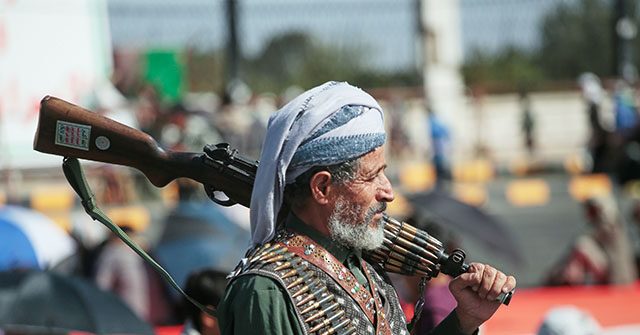
The Iran-backed Houthi insurgents of Yemen, who have been in the news lately for bombing civilian airports and oil facilities in Saudi Arabia, launched a deadly missile attack Thursday against the presidential palace in Yemen’s port city of Aden, headquarters of the internationally recognized Yemeni government.
Yemeni Information Minister Moammar al-Eryani said the Al-Maashiq Palace was hit by five ballistic missiles during the attack. Five people were killed and 16 injured in what Eryani described as a “terrorist” attack, but Prime Minister Shasya al-Zindani and his cabinet ministers were safe.
“The Houthis’ brutal ballistic missile attack on Al-Maashiq Palace in Aden is yet another example of their criminal targeting of civilians and attempts to undermine state institutions,” Zindani said on social media.
“Our government remains determined to restore state authority, end the Houthi coup, and extend state control across all of Yemen. These attacks will not deter us from our mission,” he said.
Health minister Qasim Buhaibeh said the casualties were “guards and civilian employees” of the palace complex. A further statement from the Yemeni government said two of the fatalities were bodyguards of the prime minister.
Al Jazeera News described the attack as an “indication that the escalation is going to intensify between both sides,” possibly into an “all-out civil war” between the government and the Houthis.
The Yemeni government, known as the Presidential Leadership Council (PLC), was forced out of the capital city of Sanaa when the Houthis captured it in 2014. Aden has been the seat of the government since 2015, although many of the government’s executive functions are conducted from Riyadh, Saudi Arabia.
Al-Maashiq Palace has, at various times in Yemen’s history, served as a royal residence, a reception center for the Democratic Republic of Yemen after the monarchy fell in 1962, a presidential residence, and now the headquarters of the deposed national government. It was damaged during the early days of the Houthi insurgency, renovated in 2015, and is now treated as a high-security complex under military protection.
The Yemeni government said the Houthis also launched “several ballistic missiles” at the city of Marib, located in a central oil-rich area of Yemen.
Houthi state media claimed the missile attack on the palace was targeted at a nearby “military operations base” staffed by officers from Saudi Arabia. Houthi military spokesman Yahya Saree said the attack was part of the group’s policy to “target Saudi reinforcements wherever they are located.”
A Yemeni government minister told Agence France-Presse (AFP) on Thursday that the palace compound in Aden does include command centers for both Yemeni and Saudi coalition forces, and both were hit by Houthi missiles, with both Yemeni and Saudi casualties.
According to AFP’s source, Prime Minister Zindani was present at the palace during the attack, but “was not harmed in any way.”
In a virtual briefing with journalists on Thursday, Saudi Arabian Deputy Minister for Public Diplomacy Dr. Rayed Krimly said that Iran “continues to arm, train and support the Houthi militia in violation of U.N. security council resolutions.”
“We think that the escalation by the Houthis at this latest stage of the conflict is encouraged by Iran,” he said.
Krimly said the Houthis refused an offer to meet in Oman to de-escalate the conflict, and he said Iran’s backing of the Houthis is causing Saudi Arabia to rethink the rapprochement with Tehran that was brokered by China in 2023.
Saudi coalition spokesman Maj. Gen. Turki al-Maliki said at his own news conference on Thursday that the Houthis have now launched over 1,000 ballistic missiles and 1,100 drones at Saudi Arabia since March 2016.
Maliki said the Houthis were the first insurgent militia in the world to obtain advanced weapons like ballistic missiles and explosive drones, thanks to the “assistance of regional parties,” a phrase Saudi officials generally use to refer to Iran.
Maliki noted the Houthis are putting countless civilian lives at risk by targeting Saudi Arabia’s airports and oil facilities.
“These brutal terrorist attacks, including the one that occurred during peak hours, do not only target the Kingdom’s airports, but also threaten the safety of travelers, including citizens and pilgrims to the Two Holy Mosques from all corners of the earth,” he said.
Maliki said the Saudi coalition retaliated against the Houthis on Thursday with airstrikes against 127 mountain storage facilities and launch platforms used by the Houthis.
“We reaffirm our support for Yemen’s legitimate government and armed forces on all fronts, and our commitment to providing air support to units on the ground around the clock,” he said.
“As a final message, the terrorist Houthi militia must stop its attacks on civilians in the kingdom of Saudi Arabia. It must read the coalition’s statement carefully and read between the lines,” he added.
Yemeni Foreign Minister Afrah al-Zouba sent a letter to the United Nations on Wednesday warning of a humanitarian crisis in the southwestern city of Taiz, which is currently under siege by the Houthis. The European Union (EU) subsequently called on the Houthis to allow food, water, medicine, and fuel into the city.