QatarEnergy, Qatar’s state-owned energy company, is actively lobbying U.S. trade groups on the Qatari government’s behalf, a Daily Wire investigation has found.
The company, which exports tens of billions of dollars’ worth of liquefied natural gas and petrochemicals each year, including urea and ammonia, sent letters to major U.S. agricultural and chemical trade groups to lobby the Office of the U.S. Trade Representative (USTR), a federal agency that sets tariff policy, for tariff exemptions on Qatar’s behalf. The USTR did ultimately exempt ammonia just as Qatar requested.
Typically, any person or group lobbying on behalf of a foreign entity must register under the Foreign Agents Registration Act (FARA) and disclose when, who, and how it is lobbying. However, by lobbying U.S.-based non-governmental entities, and asking those groups to make the asks on their behalf, Qatar can muddy that process.
The groups QatarEnergy reached out to made their requests to the U.S. government before QatarEnergy ultimately disclosed its lobbying efforts, creating the possibility that the USTR did not know it was indirectly being subjected to a foreign lobbying effort. It is likely those American organizations would have made the requests to USTR regardless of the Qatari lobbying, but USTR did not clarify whether it knew Qatar had reached out to the groups, or whether that knowledge would’ve affected its decisions.
QatarEnergy’s own Foreign Agents Registration Act (FARA) filing notes, “[t]he Board of Directors, appointed by H.H. the Emir of the State of Qatar, is accountable to the Supreme Council for Economic Affairs and Investment, which stewards the nation’s petroleum resources and oversees the energy sector. The Board is also accountable to the Council of Ministers, which may exercise general oversight authorities. Currently, the Chief Executive Officer of QatarEnergy, H.E. Saad Sherida Al-Kaabi, serves as Minister of State for Energy Affairs. Other Board members also hold senior government positions.”
When the FARA-registered Texas branch of QatarEnergy contacted these trade groups to lobby the federal government on Doha’s behalf, it did not identify itself as a registered agent. Normally, under FARA rules, agents must identify themselves as a foreign agent when contacting members of the government and distributing materials on behalf of a foreign principal.
A letter from QatarEnergy’s Doha headquarters forwarded by its Texas-based office to the American Soybean Association (ASA) asked the groups to use their “influence” with U.S. lawmakers “with the goal of ensuring that Urea imports from the State of Qatar remain exempt as a part of the final USTR decision and that Ammonia imported from the State of Qatar is also, similarly granted an exemption.”
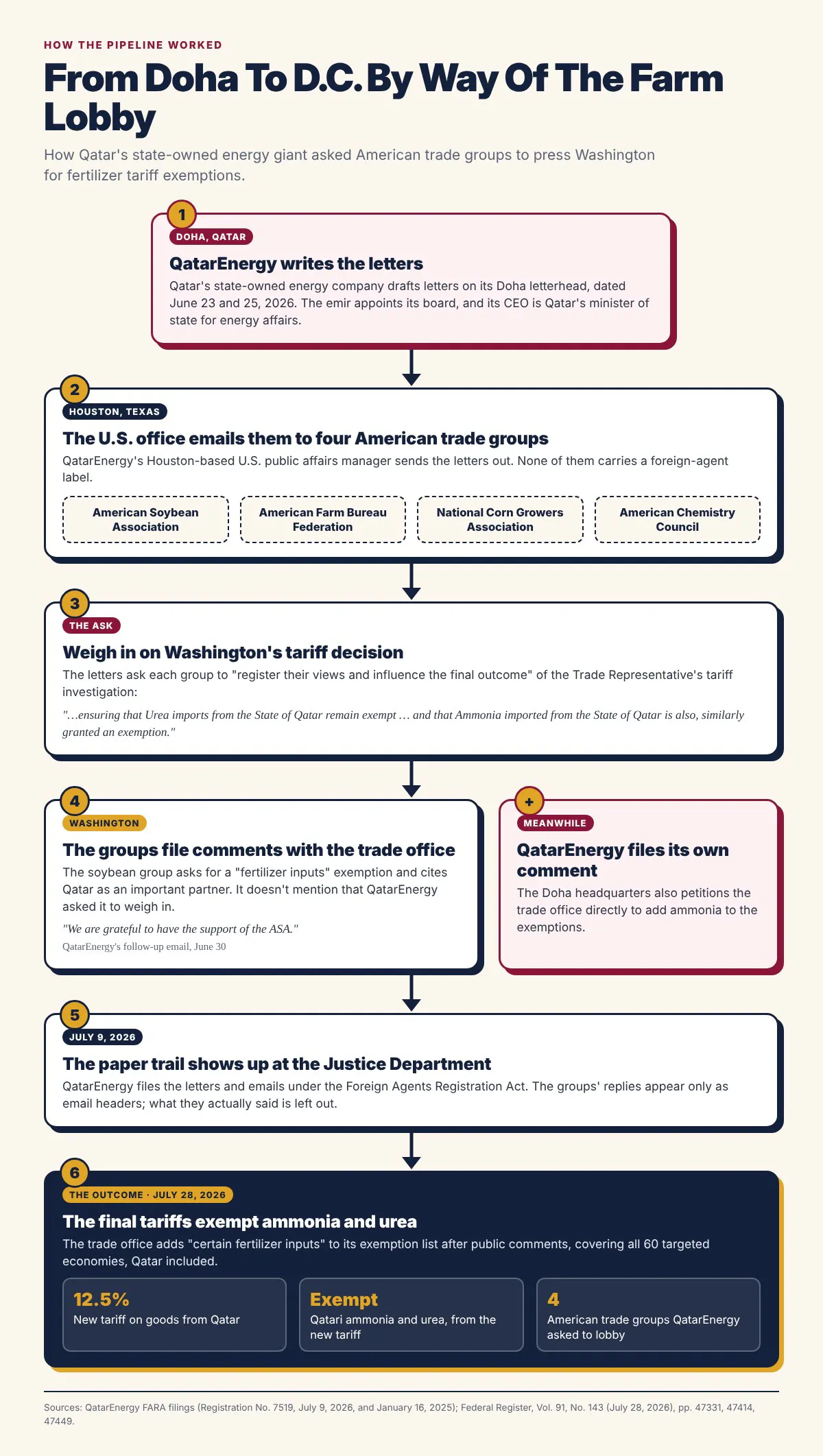
The ASA then sent a letter to the federal government requesting the tariff exemption for these same “fertilizer inputs,” citing Qatar as an important partner in its members’ production. The American Soybean Association did not tell the government that QatarEnergy asked the association to petition the government on Qatar’s behalf. QatarEnergy’s legally mandated filings redacted the association’s response to their request for assistance.
“The position of ASA regarding tariff exemptions for critical agricultural inputs has not changed due to correspondence with outside companies,” an ASA statement to The Daily Wire said.
“Thank you again for the great support that ASA has provided to QatarEnergy on recent tariff matters,” a June 24 email from QatarEnergy’s Marcus Lee to Alexa Combelic, the association’s executive director of government affairs, says.
QatarEnergy contacted several other groups to contact the federal government on Qatar’s behalf, including the American Chemistry Council, the American Farm Bureau Federation, and the National Corn Growers Association.
The American Farm Bureau Federation and the National Corn Growers Association did not specifically ask for a Gulf-based or Qatar-based fertilizer exemption. QatarEnergy thanked them for their support.
QatarEnergy also directly petitioned the government to include ammonia in the exemptions. Several other countries petitioned the USTR as well.