
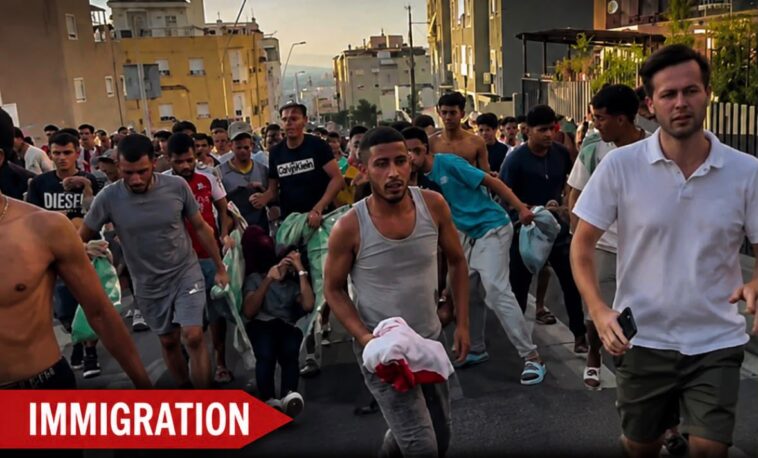

Following the invasion and mass irregular entry of more than 70,000 people into the Spanish cities of Ceuta and Melilla a couple of weeks ago, a new diplomatic front has intensified between Rabat and Madrid, centered on illegal unaccompanied immigrant minors.
Morocco, through its Justice Minister Abdellatif Ouahbi and diplomatic sources, has publicly demanded the return of all illegal unaccompanied Moroccan immigrant minors currently in Spain. This includes both those who recently entered Ceuta illegally and those already residing in reception centers elsewhere in the country.
Ouahbi stated that Morocco “maintains its determination to recover its children and minors” and will pursue their return “through legal and political channels.” He argued that the family environment and country of origin are the most suitable for them, particularly with the start of the school year approaching.
But Spain says NO.
Spain has responded that immediate or collective returns are not possible. Spanish and European legislation requires that any repatriation respect the best interests of the child and follow an individualized procedure.
A bilateral agreement exists between Spain and Morocco on the prevention, protection, and coordinated return of Moroccan minors. However, this agreement does not allow either side to bypass Spanish and European legal safeguards.
It’s worth remembering that the EU’s Migrant Pact came into force on June 12 2026
It means that when there’s a sudden big influx of illegal migrants arriving in a country (Spain), that country can use the EU’s Solidarity Mechanism.
It obliges other EU states taking in quota… pic.twitter.com/r9MitIZnVS
— Visegrád 24 (@visegrad24) July 30, 2026
The Extradition Treaty Threat
In recent statements, Ouahbi raised the stakes by indicating that Morocco is considering suspending its extradition agreement with Spain.
The minister cited problems of reciprocity and linked the issue to delays in the repatriation of minors, warning of possible measures if delivery and repatriation procedures are not respected.
Did you know that Morocco signed an agreement with Spain in 2007 to return minors to Morocco? This agreement remains frozen by Spain, which is unable to implement its provisions because the Spanish Supreme Court repeatedly rules these returns unlawful. Therefore, Spain not… pic.twitter.com/NvGpk5gpfO
— Hatim el mourabit (@HatimelMourabit) August 10, 2026
What Are Spain’s Political Parties Saying?
The political reaction in Spain has been sharply divided. Vox has taken one of the strongest positions, calling for the return to Morocco of illegal unaccompanied immigrant minors who entered Ceuta irregularly and criticizing the government for failing to enforce existing agreements with Morocco.
The People’s Party (PP) has also called for the minors to be returned to their countries of origin, while demanding stronger border controls and greater accountability from the Spanish government.
Meanwhile, the Socialist-led government says it is working with Morocco to facilitate returns to families, but insists that any repatriation of illegal unaccompanied immigrant minors must comply with Spanish and European law.
READ NOW: Report: Spanish Govt Estimates 5,000 Potential ‘Asylum Seekers’ Remain in Ceuta — Spain’s socialist government estimates more than 5,000 illegal migrants still present in Ceuta are potentially eligible for…https://t.co/SESPFKPbLK
— Top News by CPAC (@TopNewsbyCPAC) August 13, 2026
Chaos in Ceuta and Reports of Sexual Assaults
The situation in Ceuta has been described as an emergency, with reception centers saturated and minors living in conditions of extreme vulnerability.
Since the invasionl, multiple reports of sexual assaults have emerged. Police, judicial, and health sources are investigating several cases, including alleged abuses involving minors.
Spanish media have also reported several complaints of rape involving Spanish young women allegedly perpetrated by Moroccan immigrants.
Organizations on the ground have additionally warned of the risks of trafficking and exploitation, noting that some victims may not come forward to file complaints.
Ouahbi has cited these reports to strengthen Morocco’s call to recover the minors and to demand clarity on their situation.
This episode once again highlights the complex immigration relationship between Spain and Morocco.
Madrid insists it cannot disregard the legal protections afforded to minors, while Rabat demands their return and accuses Spain of obstructing the process.
Any resolution will depend on the ability of both governments to coordinate individual returns that fully respect the rights of the minors, even as pressure continues to mount on Ceuta’s reception resources.
About The Author

Maria Herrera Mellado
María Herrera Mellado es una abogada y analista política muy respetada. Licenciada en Derecho en EE.UU. y España, también tiene un doctorado en Ciencias Jurídicas y varios títulos de la Universidad de Granada (España), de la Universidad de Arizona y de la Florida International University. Con amplia experiencia en derecho internacional, asesoría en inversiones, representación en inmigración, y protección de la privacidad y lucha anticorrupción, ha asesorado a organizaciones y políticos europeos, estadounidenses e hispanoamericanos. Ha escrito sobre seguridad nacional e inmigración, protección de datos, derecho constitucional, consumo financiero y derecho bancario en revistas internacionales y coescribió libros publicados en Perú y Colombia. Es reconocida por su servicio comunitario en EE.UU. y es considerada una de las mujeres más influyentes de Florida. Es experta en varios idiomas y participa frecuentemente en debates en canales como Univisión, Fox, France 24, Telemundo y es la Editora Jefe de Gateway Hispanic.