
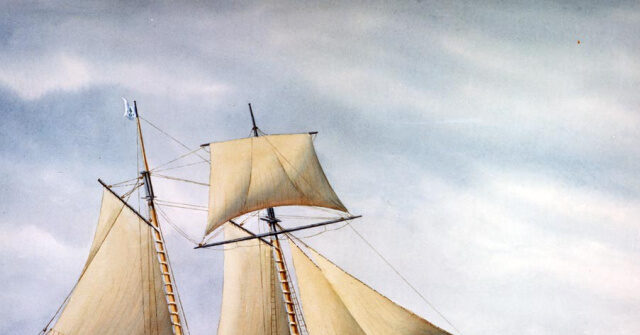
On October 13, 1775, the Continental Congress authorized the establishment of the Continental Navy, marking the birth of what would become the United States Navy. What is today the most powerful navy in the world had humble beginnings—as a single fishing boat.
In August 1775, driven by desperation for gunpowder and inspired by American ingenuity, George Washington directed Marblehead merchant and fishing captain, as well as regimental commander, John Glover to outfit his schooner, the Hannah, for war.
Challenging the British Royal Navy, the greatest navy in the history of the world at that time, by transforming a fishing schooner into a man of war seemed as preposterous then as it does now. But British disarmament and a lack of crucial gunpowder in the colonies led to American innovation.
Whether the idea of using privateers to intercept British ships originated with Glover or Washington is lost to history, but Glover and his Marblehead Regiment had been hand-picked to guard Washington’s headquarters in Cambridge at the time. Undoubtedly, Washington’s confidence in Glover and his proximity to these seasoned sailors played a role in his decision to arm American ships, since he chose them to outfit the first one in service of his army.

Portrait of General John Glover of Marblehead. (Creative Commons)
Many, including Marbleheader Elbridge Gerry and John Adams, had previously tried to persuade Washington that the intimidating British Royal Navy was not quite as insurmountable an obstacle as feared. Presumably influenced by his experience in defending Marbleheader Michael Corbett for harpooning a British officer attempting to impress him into British service, Adams cited the fighting spirit and morale of American sailors compared to the poor sailors who powered the British warships. Adams wrote, “We can easily take [American] Sloops, schooners and Cutters, on board of whom are all their best Sea-men, and with these We can easily take [British] large Ships, on board of whom are all their impress’d and discontented Men… the Men would not fight on board the large ships with their fellow subjects, but would certainly kill their own officers.” Adams encouraged Washington to at least experiment with the idea, but as late as August 11th, Washington flatly refused.
Only days later, however, driven by the army’s dire need for powder, Washington would enlist Glover’s help in forming his own navy, starting with the 78-ton Hannah. The idea was that the armed schooner might be able to pick off one of the many unescorted British ships sailing into Boston Harbor to supply General Thomas Gage’s trapped forces. If the venture failed, it would be a significant liability, as only Congress, not Washington, had the authority to create a navy; therefore, the wise commander-in-chief kept the project a secret.
At Glover’s Wharf in Beverly, teams of carpenters sawed and hacked gun ports into the sides of the fishing vessel, likely named for Glover’s wife, and strengthened her main deck to accommodate the weight of four 4-pound guns and their cartridges. They also mounted several swivel guns to ward off potential enemy boarding parties or small boats and installed topsails and a flying gib to give additional speed. They completed the transformation from fishing boat to vessel of war when her hold was filled with precious powder and shot.
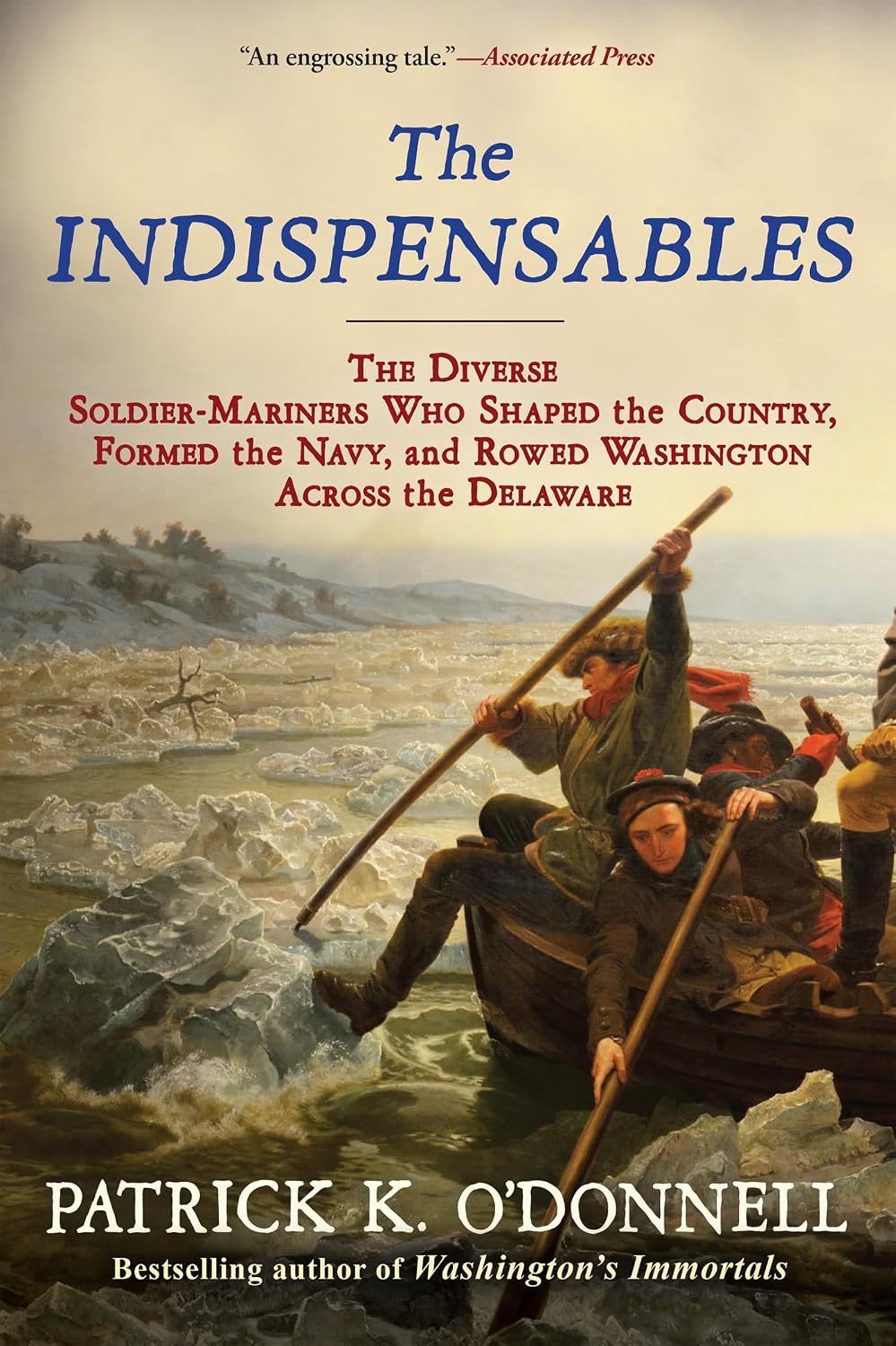
This remarkable story is told in The Indispensables: The Soldier-Mariners Who Shaped the Country, Formed the Navy, and Rowed Washington Across the Delaware.
Captained by 50-year-old Marbleheader Nicholas Broughton, the fourth in a long line of sea captains, and crewed by 38 eager Marblehead volunteers, motivated at least in part by the promise of one-third of prizes captured, the Hannah set sail on September 15th from Beverly Harbor into the open waters of the Atlantic. On her maiden voyage as a ship of war, she encountered two British war ships, the 20-gun Lively and the 8-gun Savage, which immediately gave chase. Expertly maneuvering the treacherous waters around Cape Anne, the tiny 4-gun Hannah was able to escape being blown out of the water.
Two days later, they thought they had captured their first prize. The enormous 260-ton Unity crossed paths with the Hannah. She was an American-owned merchant ship that had been captured by the British and was sailing toward the occupied port of Boston. Broughton hailed the ship and threatened to fire upon her if she did not go into the harbor at Cape Anne instead. The overjoyed crew thought they had seized a legitimate prize.
After examining the ship’s papers, however, Washington realized to his horror the truth–that his covert navy, whose existence was unknown to Congress, had recaptured an American ship owned by Congressman John Langdon. The commander in chief swiftly ordered the ship and crew immediately released. Broughton objected, and one of his crew violently protested, triggering one of America’s first mutinies as the other members of the crew seized arms to free and defend their fellow crewman after he was arrested.
Despite the botched first capture and subsequent mutiny, Washington nevertheless saw the tremendous value in taking the battle to sea—how capturing a single ship could potentially alter the course of the war, which Washington’s Navy would later do. The general ordered Broughton to raise a new crew and get Hannah back out to sea.
On October 10, Hannah, with her new crew of Marblehead men, went back on the prowl. The Royal Navy immediately sent the 16-gun Nautilus after the nettlesome ship. Broughton made a hasty retreat back to Beverly Harbor, which the British had been avoiding because of its narrow channel and many sandbars. In her flight, Hannah grounded on mud flats in a cove outside the harbor where the townspeople ran to strip her of her guns and carry them to shore.
Meanwhile, the Nautilus pounded the stranded ship, forcing the captain and crew to abandon her. Nautilus captain John Collins ordered part of his crew into small boats armed with incendiaries to burn the Hannah. As they approached, however, the tide went out, leaving the Hannah high and dry in a sea of quicksand-like mud and completely inaccessible.
The assembled townspeople, along with Glover’s Marblehead regiment, started peppering Nautilus from the shore with musket fire, and when they began to use the 4-pound cannon dragged off Hannah, the British gave up hope of destroying the American ship and began to retreat. But they soon found themselves in the same dire situation—grounded. Under fire and suffering casualties, Collins cut cables and abandoned his anchor, and when the tide returned that evening, the battered British ship floated back to sea to fight another day.
The damaged Hannah, however, would never sail again as a man-of-war. Her story, however, marked the origins of the U.S. Navy, and the rise of Glover and his The Indispensables would save Washington’s army multiple times—first at the Battle of Brooklyn, evacuating the Continental Army under the cover of a providential fog that created an “American Dunkirk,” and later rowing Washington’s force across the Delaware on Christmas Day at Trenton.
Patrick K. O’Donnell is a bestselling, critically acclaimed military historian and a leading authority on American elite and special operations units. The author of fourteen books, including Revolutionary Snipers: Washington’s Frontier Commandos Whose Marksmanship Forged a New Way of War and Helped Win the Revolution, The Unvanquished, The Indispensables, The Unknowns, and Washington’s Immortals, he is a senior fellow at Mount Vernon and has received numerous national awards. O’Donnell served as a combat historian with a Marine rifle platoon during the Battle of Fallujah. He is a director and the historian for The OSS Society and is a professional speaker who frequently lectures on America’s conflicts, espionage, special operations, and the Revolutionary War. He has provided historical consulting for DreamWorks’ award-winning miniseries Band of Brothers and for documentaries produced by the BBC, the History Channel, and Discovery. Follow his work at PatrickODonnell.com and @combathistorian.