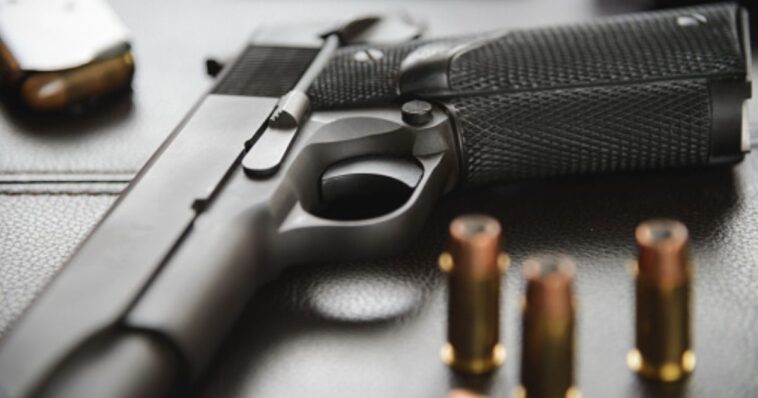

A black gun sits on a black table. (Pratchaya / Getty Images)

By Harold Hutchison October 25, 2026 at 5:00am
Two jurisdictions defending bans on modern semiautomatic firearms cited centuries-old prohibitions on obscure weapons to justify the measures in briefs filed Wednesday with the Supreme Court.
The justices agreed on June 30 to hear Viramontes v. Cook County, a Second Amendment challenge to the Illinois locality’s ban on modern semiautomatic firearms, consolidating the case with Grant v. Higgins, a challenge to a similar law passed in Connecticut after the mass shooting at Sandy Hook Elementary School. In briefs filed Wednesday, Connecticut and Cook County cited prohibitions on launcegays and slungshots to support keeping the AR-15 and similar firearms illegal.
“Launcegays were eventually banned following their use in a series of well-publicized murders and their ‘responsib[ility] for fatalities’ in numerous ‘personal quarrels, brawls, and street fighting,’” Connecticut argued in its brief. “In a 1441 dispute involving officers of the archbishop of York, ‘[s]everal men were killed and wounded with [launcegays] used by both sides.’”
“At common law, English Parliament enacted outright bans on dangerous weapons including the launcegay,” Cook County asserted. “The early colonies followed suit with prohibitions on indiscriminate killing that could be accomplished by trap guns or with armed assemblies. During the Reconstruction era, bans on Bowie knives and slungshots were enacted to protect the public from their exceptional lethality.”
Launcegays were light lances that were ubiquitous among military forces in medieval times, according to Cambridge University. Slungshots were weights of metal (usually lead) attacked to flexible handles or even just a cord, and were used as impact weapons, according to the Schwarz Cohen Law Firm.
“While the arguments levied in support of the assault weapons bans we’ve challenged in these cases lack legal support, they weren’t unforeseen,” Second Amendment Foundation Senior Director of Litigation William Sack told the Daily Caller News Foundation. “What we saw from the opposition briefs was more of the same ill-conceived arguments that were adopted at least in part by the Second and Seventh Circuits.”
“Since SCOTUS has already made clear that arms in common use are protected by the Second Amendment, the defendants here are left to argue that either these rifles – owned by the millions – aren’t commonly owned by law-abiding Americans, or that the Supreme Court’s test itself is flawed,” Sack continued. “We look forward to responding in our reply.”
Connecticut and Cook County argued that launcegays and slungshots, along with crossbows and Bowie knives, were among weapons historically banned due to their lethality and for being “dangerous.” The jurisdictions also argued that the AR-15 represented a technological advance that warranted being accounted for.
“The danger is acute because the AR15 platform has effectively collapsed the destructive power of an armed battalion into a single pair of hands, making this weapon the equivalent of an armed assembly,” Cook County argued. “Significantly, Cook County has chosen to ban an unusually dangerous platform of weapons while leaving other arms available for lawful self-defense— including ordinary rifles, shotguns, and handguns.”
“Petitioner Khaya, for example, owns a .22 caliber semiautomatic Rossi rifle and a Smith & Wesson handgun,” Cook County continued. “The arms that remain available to the public were not created to cause the same level of destruction to the human body as AR-15 platform weapons and were not designed for the same superior lethality.”
The Supreme Court ruled in Caetano v. Massachusetts, a 2016 case decided in an unsigned opinion that overturned the Massachusetts Supreme Court’s ruling upholding the state’s ban on stun guns, that the Second Amendment didn’t just cover technology at the time of the founding, reiterating a finding in the court’s 2008 Heller decision.
“The court explained that stun guns are not protected because they ‘were not in common use at the time of the Second Amendment’s enactment,’” the unsigned opinion says. “This is inconsistent with Heller’s clear statement that the Second Amendment ‘extends . . . to . . . arms . . . that were not in existence at the time of the founding.’”
Several of the Founding Fathers also expressed awareness about the likelihood of technological advances.
“Furnish’d as all Europe now is with Academies of Science, with nice Instruments and the Spirit of Experiment, the Progress of human Knowledge will be rapid, and Discoveries made of which we have at present no Conception,” Benjamin Franklin, who invented bifocal lenses and the Franklin stove, wrote in a 1783 letter to Sir Joseph Banks. “I begin to be almost sorry I was born so soon, since I cannot have the Happiness of knowing what will be known 100 Years hence.”
Former President Thomas Jefferson also was aware of the potential for technological innovations. During Jefferson’s presidential administration, the Lewis and Clark Expedition took along an air gun that had a 22-shot magazine and operated as a repeater.
“It is impossible for a man who takes a survey of what is already known, not to see what an immensity in every branch of science yet remains to be discovered, & that too of articles to which our faculties seem adequate,” Jefferson wrote to William G. Munford in 1799.
The Supreme Court is expected to issue its decision on the case in summer 2027.
All content created by the Daily Caller News Foundation, an independent and nonpartisan newswire service, is available without charge to any legitimate news publisher that can provide a large audience. All republished articles must include our logo, our reporter’s byline and their DCNF affiliation. For any questions about our guidelines or partnering with us, please contact licensing@dailycallernewsfoundation.org.
Advertise with The Western Journal and reach millions of highly engaged readers, while supporting our work. Advertise Today.
Founded by Tucker Carlson, a 25-year veteran of print and broadcast media, and Neil Patel, former chief policy adviser to Vice President Dick Cheney, The Daily Caller News Foundation is a 501(c)(3) non-profit providing original investigative reporting from a team of professional reporters that operates for the public benefit. Photo credit: @DailyCaller on Twitter