
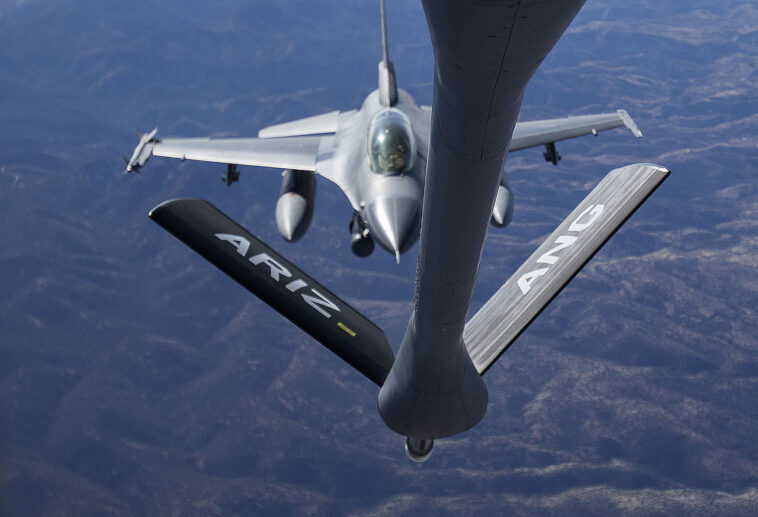

The troubling experience of a seasoned instructor fighter pilot highlights the critical challenges faced by the U.S. Air Force as it grapples with a significant pilot shortage while simultaneously pushing out seasoned instructors.
After 28 years of dedicated service, Stephen Pinchak, serving as a Lieutenant Colonel in the Arizona Air National Guard (ANG), was confronted with a Mandatory Separation Date (MSD) he was not ready to accept.
Thankfully, there was an encouraging aspect: the ANG offers a way to pursue extending service beyond the established MSD. The experienced F-16 Fighting Falcon instructor was eager to explore this option and continue serving.
The Gateway Pundit interviewed the Lieutenant Colonel, who has now been forced into retirement, about his experiences. Pinchak served as a Drill-Status Guardman (DSG) and dedicated five to seven days each month to teaching in the F-16 after leaving a full-time job.
He achieved the highest qualification ratings on all his required checkrides, flew more sorties than typically required for a DSG, and maintained a perfect score of 100 on fitness tests for four consecutive years (2021–2024). According to his senior officer reviewer, he fulfilled all of his commanders’ expectations throughout his 28 years of service as a Lieutenant Colonel, and his officer performance reports noted that he was a “seasoned instructor” and a “go-to instructor pilot.”
In November 2024, Pinchak asked to continue serving, citing 10 U.S.C. § 14701 and Department of Defense Instruction 1320.08. He submitted a formal request to extend his MSD, which included the necessary checklist, his performance history, and a justification based on the Air Force’s acknowledged shortage of F-16 instructors.
The U.S. Air Force is facing a persistent shortage of pilots, with F-16 pilots representing a large part of this gap. Last year, there was a deficiency of over 1,000 fighter pilots in total, and the absence of fighter personnel continues to be a challenge for the force.
“Not only is the Air Force short of fighter pilots, but the cost to create an F-16 instructor pilot is staggering,” Penchak noted. “Initial pilot training, fighter fundamentals training, F-16 training, pilot seasoning for several years, and instructor training all add up to more than $25 million and seven years.”
“Keeping trained pilots costs even more with full-time pilot bonuses running into the hundreds of thousands of dollars,” he added. Interestingly, part-time Drill Status Guardsmen are not eligible for bonuses and are only paid on the days they fly and train, costing less than 1/5 of a full-time pilot.
This alarming shortfall and replacement costs not only jeopardize the operational readiness of the Air Force but also place increased stress on the existing pilots, potentially compromising national security. In this crisis of readiness, is Pinchak really the kind of individual one would expect to be forced into retirement, while the U.S. Air Force is paying significant dollars to keep similarly situated pilots in the service?
For the Adjutant General of Arizona and the National Guard Bureau’s Director of the ANG, the answer is, sadly, a resounding yes. In March 2025, both officials “signed a one-line disapproval without providing any reasons for their decision, offering no chance for rebuttal, and lacking any written findings for a Board to examine later.”
Need anyone be reminded the U.S. Air Force is dealing with a continuous and well documented, shortage of pilots?
“On 2 June 2025, I received a text message informing me that I was no longer allowed to drill or receive payment,” Pinchak shared. Coincidentally, on July 18, 2025—the very day he reached out to the Secretary of the Air Force Inspector General’s office—his Air Force email account was disabled and his other cyber credentials were revoked. A day later, TRICARE—the War Department’s (DOW) healthcare program—issued a disenrollment letter that was retroactive to May 31, 2025, terminating coverage for his family.
Six days later, he said, the DOW Office of Inspector General initiated “a reprisal case” and designated it to SAF/IGS, the Senior Official Inquiries division within the IG Office of the Department of the Air Force, which mainly handles investigations into allegations of misconduct involving high-ranking military officials. The Gateway Pundit is aware of several other F-16 DSG pilot complaints regarding the 162d Wing to SAF/IGS in the same time frame. In August 2025, he was retroactively placed in the Retired Reserve with a backdating of 80 days, effective June 1, 2025.
Why was this Pinchak’s experience as a fighter pilot instructor with multiple decades of experience, who wanted to continue to serve? Why do full-time pilots like the 162d Wing Commander frequently receive extensions while Drill Status Guardsman do not?
It was said to be part of a “force management plan, which asserted that the 162d Wing had planned for Pinchak’s retirement at his MSD and that recruitment of new pilots did not account for his retention.”
According to Walk The Talk Foundation (WTTF), “The underlying manpower data tells a different story.” The AZ ANG’s manpower report from March 1, 2025, indicated there were 29 authorized and 24 assigned F-16 Instructor Pilots at the 162d Wing. However, after Pinchak questioned these numbers, the state’s Military Personnel Management Office released a revised memo on April 15, 2025, revealing a different account: 82 authorized and 46 assigned. This meant the Wing was functioning at approximately 56 percent of its authorized instructor-pilot capacity.
“Air Force headquarters staff confirmed the gap,” Penchak shared, and as noted in the WTTF report, “A 12 March 2025 memorandum from an Air Education and Training Command air staff officer documented unfilled F-16 Formal Training Unit requirements of 96 pilots in fiscal year 2026 and 107 pilots in fiscal year 2027. The 162d Operations Group’s own flying schedules showed 30 of 106 sorties cancelled in a single February 2025 week for lack of instructor pilots — a 28 percent loss rate.”
On March 5, 2025, a personnel official from Arizona state revealed that the flight schedules had been removed from Pinchak’s MSD extension package, allegedly “for OPSEC reasons,” meaning Operational Security reasons. The weekly schedules for September 2025 indicated that 33 to 50 percent of mission flights were unscheduled. In calendar year 2025, the Weapons and Tactics office of the 162d OG/195 Fighter Squadron reported that the base canceled an astonishing 1,316 out of 6,518 scheduled flight missions, which is 20.2%. On April 21, 2025, after the denials, the Air National Guard’s advisor to the Air Force’s Training Command agreed with the fundamental issue that Pinchak had been highlighting: the F-16 instructor program is “critically undermanned.”
At the same time, the 162d Wing, which referenced a force management plan to refuse Pinchak’s extension, was granting extensions to fellow F-16 instructor pilots. The underlying notion—that this career field is crucial to the mission—contradicts the reasoning used for his retirement.
Pinchak disclosed that “they’ve covered up a lot in order to keep a narrative that the manning is correct when in fact it’s not.” Both he and WTTF believe the pattern is systemic, well beyond just this single instance.
As stated by WTTF:
“Lt Col Pinchak’s petition before the Air Force Board for Correction of Military Records is in preparation. The relief sought includes rescission of the separation, extension of his Mandatory Separation Date, restoration of pay and benefits including TRICARE, reinstatement of his flying status and DoD system access, removal from any “non-retain” list, and referral of the disparate-treatment allegations to the Air Force’s Equal Opportunity machinery. For a service that says it cannot afford to lose experienced instructor pilots, voiding this separation — and examining how it was produced — would cost less than letting it stand.”
“If you’re undermanned, then stop pushing away DSGs,” Pinchak offered. What troubles him the most about the future of the Arizona ANG is his belief that “you can’t bring anything to light that’s unfavorable to the organization, because then you are the pariah, regardless of whether the facts of the matter true or not.”
“We will do anything to protect commanders, regardless of how bad their decisions are,” he lamented.
For him, it’s past time to “place God, country, and family above nameless, faceless toxic leadership and a bureaucratic organization.”
Pinchak’s case raises pressing questions about the decision-making processes within military leadership and the treatment of dedicated service members. Through his story, it has become increasingly clear that the Air Force needs to consider prioritizing the retention of experienced personnel, especially during a pilot shortage, to ensure that the needs of the force align with the realities on the ground.
Ad block users: Some site features may not work correctly while an ad blocker is enabled, because they break scripts and content this website depends on. If you can’t see comments below, for example, please disable your ad blocker.