exclusive details
See more of our coverage in your search results.

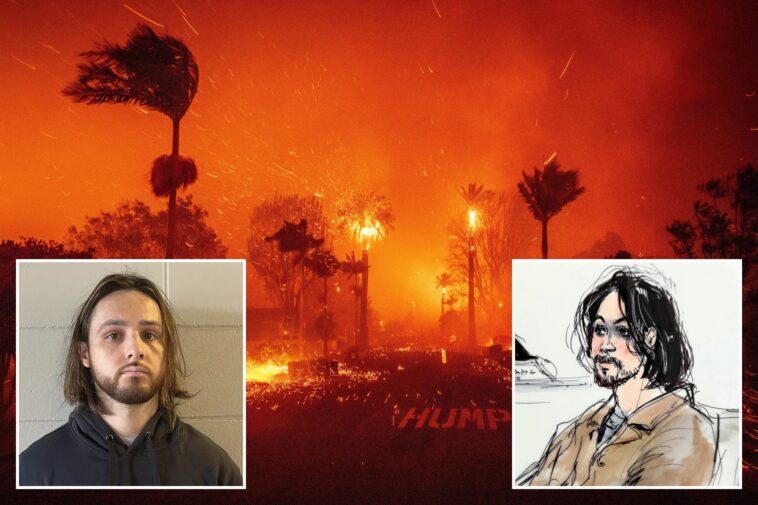
The man accused of igniting the deadly Palisades Fire was found guilty Friday in his second federal trial.
A jury found Jonathan Rinderknecht, 31, guilty on both felony counts of destruction of property by means of fire and arson affecting property used in interstate commerce.


Rinderknecht appeared pale, nervous and stared straight ahead as the verdict was read Friday afternoon, showing no emotion in the tense courtroom. His brother and father, who appeared in court to support him, hugged each other as the verdict was read.
Rinderknecht’s sentencing is expected on March 17, 2027.
“We followed the facts and evidence,” the jury’s foreman told the California Post as she rushed from the courthouse.
Another juror named Cameron said he was the only hold-out for a not-guilty verdict before changing his mind.

Rinderknecht’s defense attorney, Steve Haney, told The Post: “We are disappointed in the verdict, but respect the jury process. After a lengthy deliberation, they clearly gave this case a great deal of consideration.”
Rinderknecht’s father, Joel Rinderknecht, maintained his son’s innocence.
“It feels like when you’re in front of the government, it’s a big machine, like a steamroller,” he told The Post. “There’s not much you can do.”
Jeremy Padawer, who lost his home in the Palisades Fire, said the “guilty verdict matters.”
“The defendant has been held criminally responsible for starting the January 1 fire,” he told The Post. “But let’s be absolutely clear… that verdict does not absolve the city, the state, or the leaders responsible for their extraordinary gross negligence or their protecting the Palisades.”

Rinderknecht’s two-week retrial was filled with twists and turns, including video evidence of a fire experiment involving a lighter similar to the one found in Rinderknecht’s car, as well as an attempt to include testimony about alleged firework stains on the driveway of NBA great Chris Bosh’s mansion near where the blaze broke out.
Early in the trial, prosecutors played video of a test authorities performed using a barbecue-style lighter similar to the one they said Rinderknecht used to start the blaze.
In the nearly one-minute video, the lighter was shown trying to ignite a foil oven pan filled with dead vegetation taken from Pacific Palisades.
The lighter’s flame is seen touching the brush in three different parts of the pan and igniting briefly before failing to continue burning, according to the video. The test was performed by the federal Bureau of Alcohol, Tobacco, Firearms and Explosives (ATF).


Rinderknecht is accused of using the lighter on New Year’s 2025 to spark the Lachman Fire, which smoldered for days before reigniting to become the Palisades Fire on January 7, 2025.
His defense attorney, Steve Haney, had argued throughout both trials that the New Year’s fire was sparked by fireworks.
In the second trial, the judge denied testimony from veteran fire investigator Michael T. Cole, who said he photographed the alleged fireworks marks in the driveway of Bosh’s $11 million home.


Cole said he spotted the stains while investigating near the suspected origin of the blaze alongside two private investigators working for law firms representing insurers.
Bosh has claimed he and his family were not in California the day the fire broke out.
“To our knowledge, our Pacific Palisades property was unoccupied and was not being rented or used by guests during that time,” a statement from Bosh and his wife said.
The prosecution’s case hit on many of the same points presented in Rinderknecht’s first trial, which ended in a hung jury.

The government said Rinderknecht’s phone showed he was the only one in the area at the time the fire started and suggested he called 911 to report the fire 16 times to create a backstory.
“He made a screen recording of what he was doing with his phone, which was calling 911, to create an alibi,” prosecutors said.
Prosecutors also pointed to a question Rinderknecht allegedly asked ChatGPT in between his calls to 911: “Are you at fault if a fire is lit because of your cigarettes?”

In his first trial, the jury deadlocked 10-2 in favor of acquitting Rinderknecht of charges of destruction of property by means of fire, arson affecting property used in interstate commerce, and timber set afire.
Following that mistrial, prosecutors secured a superseding indictment with only two charges — destruction of property by means of fire and arson affecting property used in interstate commerce.
In the new indictment, the first charge refers only to Rinderknecht’s alleged setting of the Lachman Fire on New Year’s Eve, rather than the Lachman and Palisades fires.