
See more of our coverage in your search results.

The MTA is eager to wallop straphangers with another fare hike — even as Chairman Janno Lieber bragged about the cash-hungry agency saving hundreds of millions of dollars a year.
The Metropolitan Transportation Authority unveiled its final proposed $22.9 billion budget for 2027 Wednesday, touting $676 million in savings next year.
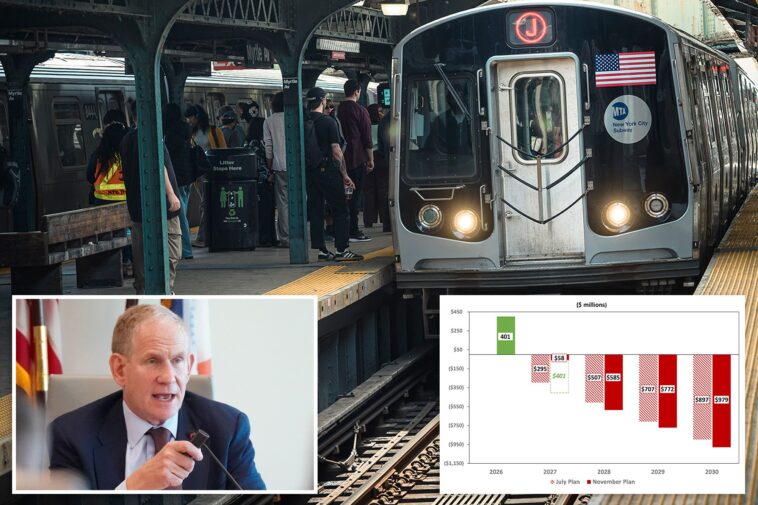
But it still projects a $58 million deficit in 2027 that balloons to nearly $1 billion by 2030 — and officials are planning to hike fares on riders in just a few months to squeeze an extra $141 million.

The MTA hasn’t announced how much subway and bus fares would go up, only that it wants the increases across subways, buses, trains and tolls to add up to 4% more revenue.
Lieber defended the hikes as “small and predictable” but admitted they won’t fix the agency’s money problems.
“Do not mistake this for like solving the MTA’s budget crisis because 2% a year is only less than half of the true inflation that we are experiencing even with the cost savings,” Lieber said after the board meeting. “So it’s small, it’s predictable but it’s not putting on the riders all the additional costs and that’s important as well.”
All the while the MTA was able to cover a $200 million subsidy that Gov. Kathy Hochul let Mayor Zohran Mamdani skip paying for city bus service this year.
Asked Tuesday whether the state would pay the MTA back the $200 million, Hochul said the agency doesn’t need it.

“There’s not a hole,” the governor insisted multiple times of the MTA’s budget when asked by reporters after an unrelated press conference, claiming the $676 million in savings was able to cover the $200 million.
But Lieber the next day at the board meeting contradicted his boss, instead claiming a pension recalculation “freed up some money” to cover the $200 million. He also admitted that “in the long run, we are going to have to pay a little bit more.”
The nonprofit Citizens Budget Commission has slammed the pension recalculation as a “gimmick” that pushes the cost of closing today’s budget gaps onto taxpayers starting in 2033.
Watchdog group Reinvent Albany pointed out that the bus subsidy money the city got to keep could easily cover what riders will be expected to fork over next year in higher fares.
“We note this raid on MTA bus is in the same neighborhood of what New York City transit riders are expected to pay in fare increases over the next 2 years,” said Rachael Fauss, a senior policy adviser at Reinvent Albany. “Raiding dedicated MTA funding meant to support transit service undermines public trust.”
Riders Wednesday railed to MTA board members that they’re the ones getting stuck with Mamdani’s unpaid bus bill.

“I don’t know where they thought they were gonna pull that money out from, but it always comes from the people,” said Jonathan Rivera, 32, a security guard who takes the subway every day.
“It stinks for people who end up commuting a lot,” Zoe Turnpaugh, 31, a grants manager, said. “They ought to give (the $200 million) back, because now it’s falling on people that commute.”
The impending fare hikes, which the November financial plan factored in for March 2027 but Lieber hinted could come in Q2 of next year, come at a time when 1 in 5 riders say they can’t afford the current $3 fare, according to a recent Community Service Society survey.
“That is crazy, because we can barely pay now,” said Lesley Duran, 27, a student who takes the subway three times a week.

Arianna Allen, 31, who works in finance and rides the subway up to four times a day, said getting around is getting more and more expensive.
“If you have a couple places to go throughout the day, you’re spending $12, $15, $20,” she said. “That’s like three, four hours of work for a lot of people.”
The transit agency’s board will ultimately have to approve the hike and its timeline.

The budget presentation showed MTA budget woes were driven by health care, fuel and paratransit costs all climbing much faster than revenue.
The flailing agency has also blown $1.03 billion on overtime through October, cruising past its own projection by $199 million — more than enough to cover next year’s fare hike for subway and bus riders.
By 2030, MTA expenses are projected to be 51% higher than in 2019, while revenue grows just 34% — a gap that has budget hawks pushing for even steeper fare hikes.
The Citizens Budget Commission called for the MTA to raise its fare and toll hikes, which come every two years, to 6% from 4% — even as they acknowledged the increases would be too much for some New Yorkers.
“This would get closer to how fast MTA expenses are growing,” CBC President Andrew Rein said. “While transit is one of New York’s best bargains, fares can still be a challenge for low-income New Yorkers.”