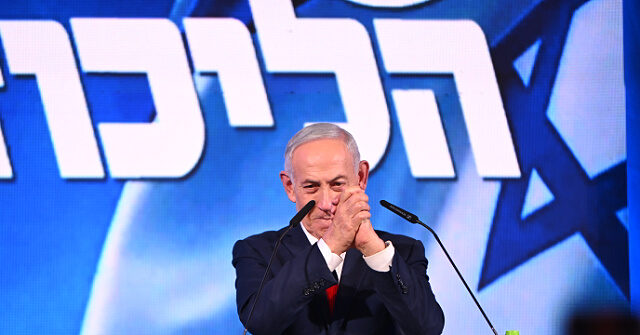
Israeli Prime Minister Benjamin Netanyahu claimed a “clear, decisive majority” among Jewish and Zionist voters early Wednesday, calling for a strong right-wing government as revised election night projections shifted in his favor and declaring a “historic” opportunity alongside President Donald Trump to eliminate the Iranian threat.
Addressing cheering Likud supporters in Jerusalem following Israel’s first parliamentary election since the October 7, 2023, Hamas massacre, Netanyahu asserted a mandate to govern even as exit polls showed neither his bloc nor the opposition securing the 61 seats needed for a majority in the 120-member Knesset.
Netanyahu pointed to what he called a “clear, decisive majority” for the right-wing bloc among Jewish and Zionist voters, arguing that the result demonstrated broad support for a government committed to preserving Israel as a Jewish state.
“We must establish a strong national right-wing government,” he said. “That is what needs to be done.”
Netanyahu’s remarks came after successive revisions to the exit polls erased an early advantage for the Jewish-led opposition, whose leaders had already proclaimed his defeat.
Channel 12’s revised exit poll projected 52 seats for Netanyahu’s bloc, 50 for the Jewish-led opposition, and 18 for Arab parties. Channel 13 and public broadcaster Kan each projected a 51-51 tie between the two principal blocs, with Arab parties holding the remaining 18 seats.
The pro-Netanyahu broadcaster Channel 14 placed his bloc at 60 seats, while i24NEWS projected 55. None of the five exit polls gave either side a clear parliamentary majority.
All five broadcasters projected Likud as Israel’s largest party, with Channels 11, 12, and 13 assigning it 27 seats, ahead of former military chief Gadi Eisenkot’s Yashar party at 21 or 22.
Netanyahu also took aim at Israeli television networks, accusing them of deliberately understating Likud’s support in pre-election polls to discourage voters from turning out.
He accused what he called the “propaganda channels” of projecting Likud at just 18 or 19 seats, alleging that they “knew all along it was a lie.”
Earlier in the evening, Eisenkot had urged Netanyahu to accept defeat and retire from politics, declaring: “A worthy leader would accept the people’s vote of no confidence and announce his retirement from politics today.”
Former Prime Minister Naftali Bennett, whose alliance with opposition leader Yair Lapid was projected to win 12 seats, likewise declared that “Netanyahu has lost, and the October 7 government is going home.”
Netanyahu sharply rejected any attempt to form an alternative government dependent on Arab parties, whose combined representation was projected to rise to approximately 18 seats following a surge in Arab voter turnout.
“We must not, absolutely must not, endanger Israel by establishing a government that relies on anti-Zionist Arab parties,” Netanyahu warned, accusing them of opposing Israel’s existence and supporting Hamas.
Netanyahu also attacked the opposition’s proposed “alliance of those who serve,” accusing its leaders of hypocrisy for campaigning against military service exemptions while considering cooperation with Arab parties whose representatives he said had condemned Israeli soldiers.
He called on Jewish and Zionist political factions to unite, arguing that their cooperation was essential to Israel’s future.
The revised projections nevertheless leave both camps facing difficult coalition negotiations. Under Channel 12’s figures, the Jewish-led opposition’s 50 seats, combined with the seven projected for Mansour Abbas’s Islamist Ra’am party, would produce just 57 — four short of a Knesset majority.
Eisenkot could seek additional support from the Joint List or attempt to draw parties from Netanyahu’s camp into a broader coalition. A Netanyahu-led government would likewise require additional partners unless the final count changes the balance, while a unity arrangement between the rival camps could offer another path. Failure to assemble a workable majority could ultimately force another election.
The unresolved outcome also leaves open the political future of Trump’s preferred Israeli partner, whom the president publicly endorsed twice in the final week of the campaign.
Trump’s endorsements came as Washington and Jerusalem weighed their next moves against Iran following months of military operations that devastated much of Tehran’s military leadership and capabilities but left the confrontation unresolved.
Netanyahu portrayed the military campaigns undertaken during his government as having transformed the regional balance of power, citing the elimination of senior Hamas and Hezbollah leaders, Iran’s supreme leader Ali Khamenei, and the establishment of Israeli security zones in Gaza, Lebanon, and Syria.
“Iran is weaker than ever, and Israel is stronger than ever,” Netanyahu declared.
Yet Netanyahu warned that Iran’s weakened position did not mean the threat to Israel had ended.
“This is not over as long as this fanatical regime exists,” he said, warning that Tehran would continue seeking Israel’s destruction.
Returning to Iran near the end of his speech, Netanyahu warned against allowing Israel’s political divisions to distract from what he described as a rare opportunity to eliminate the threat.
“Israel stands before a historic, once-in-a-lifetime opportunity, together with our partner President Trump, to remove the existential threat from Iran once and for all,” Netanyahu declared.
“We must not, absolutely must not, allow any extraneous considerations to divert us from this sacred mission.”
His remarks came amid fresh reporting that Washington was preparing regional partners for the possibility of renewed military action against Iran following the U.S. midterm elections. The White House has not announced any such operation.
Despite his forceful address, Netanyahu acknowledged that the final outcome remains unsettled, with the nationwide count continuing and hundreds of thousands of special ballots, including votes cast by soldiers and reservists, still to be tallied. He said the final results are expected within the next 48 hours.
Once the results are finalized, President Isaac Herzog will consult the Knesset factions before assigning the task of forming a government to the lawmaker he considers best positioned to assemble a governing coalition.
Netanyahu will remain prime minister until a new government takes office, but his political future will depend not simply on Likud’s standing as Israel’s largest party, but on whether he can assemble the parliamentary support needed to govern.
Joshua Klein is a reporter for Breitbart News. Email him at jklein@breitbart.com. Follow him on Twitter @JoshuaKlein.