
The day that fans of professional baseball have been dreading is rapidly approaching.
As we sit on Wednesday afternoon, we’re just two weeks removed from the expiration of the Collective Bargaining Agreement between the 30 Major League Baseball owners and the MLB Players Association. The last round of CBA negotiations between the two sides started in December 2021 and stretched for nearly 100 days, pushing back the start of the 2022 regular season and requiring several adjustments to the 162-game schedule.
This page may contain affiliate links to legal sports betting partners. If you sign up or place a wager, FOX News may be compensated. This content was created by a team that works independently from the FOX newsroom.
That negotiation was fairly straightforward. There were disagreements between the two sides, as there always is, but seeming agreement about the broad structure of baseball and keeping it in place.
BRYCE HARPER IMPLIES THERE WON’T BE A 2027 MLB SEASON, ADMITS HE ENJOYS OFFSEASON MORE THAN PLAYING
This time? Not so much.
The 30 owners have put their foot down, at least, through public statements, about their commitment to completely reshaping how baseball works. As has been widely reported, this means the introduction of a salary cap and associated floor.
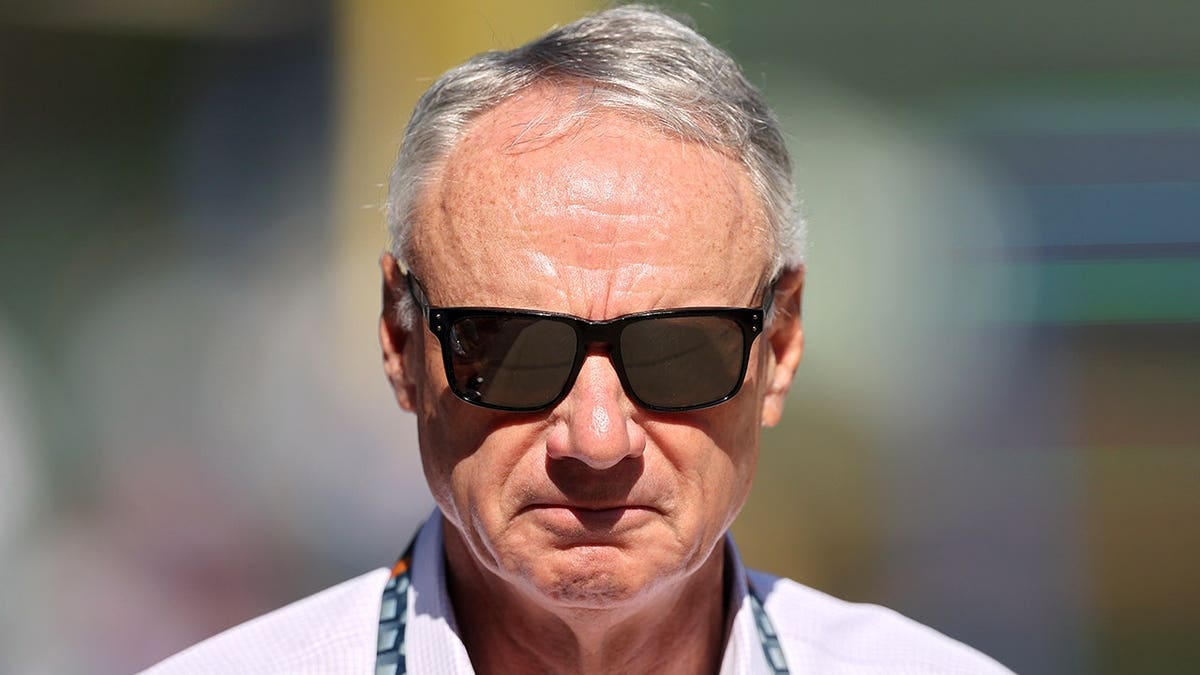
MLB Commissioner Rob Manfred looks on ahead of game one of the National League Wild Card Series between the San Diego Padres and the Chicago Cubs at Wrigley Field in Chicago, Ill., on Sept. 30, 2025. (Michael Reaves/Getty Images)
While most other domestic professional sports leagues have a salary cap, baseball is a holdout in avoiding this form of sports socialism. MLB’s current format already includes revenue sharing, where higher-income teams redistribute their revenue to smaller market teams, and any number of artificial controls on player movement in the early part of their career.
Generally, players are prohibited from reaching the open market for six seasons after their Major League debut. Given that most players reach their physical peak at around 26–27, often, reaching free agency at around 30 means the team that drafted, or signed, and then developed that player already had control of the ascendant stage of their career.
Even that, though, isn’t enough. Because owners are committed to increasing their profits and franchise valuations first and foremost, and because many fans have been misled into thinking that theLos Angeles Dodgers are some sort of baseball-ruining enemy, commissioner Rob Manfred has been adamant that the owners will push for a salary cap.
The players, meanwhile, have been adamant that they will reject any attempt at a cap. And so here we find ourselves, two weeks away from D-Day, with no end in sight.
In fact, on Wednesday, Manfred made some ominous comments about ownership’s resolve at limiting player compensation.
“I will say there’s plenty of room for compromise,” he said Wednesday at a news conference around the owners’ meetings. “But there’s one thing I will not compromise, and that’s the issue that we’re hearing from the vast majority of our fans: They want salary cap and floor, and on that, we will not compromise.”
Manfred, being apparently unaware of how words work, then said that the MLB Players Association needs to compromise with them.
“We made the proposal way back in May,” he added. “Another word for ‘nonstarter’ over months is a refusal to bargain. I think it’s time that the MLBPA needs to realize that this proposal is serious. I’m not suggesting they need to accept it wholecloth. I think they need to look at the proposal and try to find some ways to move to the middle as opposed to making no proposal at all.”

MLB Commissioner Rob Manfred speaks during the Baseball Hall of Fame awards presentation in Cooperstown, N.Y., Saturday, July 26, 2025. (AP Photo/Seth Wenig)
In response, MLBPA head Bruce Meyer issued a statement criticizing Manfred and ownership’s stance.
“There can be no clearer example of the league’s lack of seriousness than their insistence that they will not negotiate over the economics outside of a radical change to the system that would dramatically reduce overall player compensation for all categories of players and strip fundamental rights from players like the ability to have truly guaranteed contracts,” the statement said.
“There should be no illusions about the owners’ true motivation in pushing for this system. They want to make more money in profits and franchise values by artificially suppressing player salaries.”
CLICK HERE FOR MORE OUTKICK SPORTS COVERAGE
Manfred did say that a lockout may not be an inevitability, that he would be ready and willing to work through Thanksgiving to get a deal done.
“A decision on a lockout is one that we’re going to make at the last possible moment,” he said. “We’re going to devote ourselves to the bargaining process. I’m not that big on Thanksgiving as a holiday. We’ll make ourselves available whenever and wherever to bargain in an effort to make an agreement.”
So the league’s stance effectively boils down to, we won’t compromise on the single biggest issue that we’re negotiating over, but the players need to compromise and give up their biggest advantage to make us richer, and we’ll negotiate quickly as long as players agree with what we want. Perfect!
THE CRAIG CARTON SHOW–UNFILTERED, UNAPOLOGETIC AND UNMISSABLE. DOWNLOAD HIS DAILY PODCAST NOW!
Make no mistake, regardless of Manfred’s comments, this is heading towards a lockout. Owners are going to lock players out of team facilities, by choice, on December 2. Because they want to, not because they have to. And fans do share some of the blame.
For whatever reason, the Dodgers’ success in 2024 and 2025 has shortened fan memories, to the point where they apparently forgot that decades ago, it became apparent that there is no formula for winning in the postseason. There is no way to buy a championship, because baseball is too unpredictable. The league’s claims, which were inexplicably lapped up, that small market teams have no “hope” of winning, were proven comprehensively false by the Milwaukee Brewers winning the 2026 World Series in one of the dominant playoff runs in the history of the sport.
Oh, and the team they beat, the Tampa Bay Rays, swept the New York Yankees to get there.
SIGN UP FOR THE DAILY OUTKICK NEWSLETTER
This wasn’t an aberration or outlier; the Rays have reached the World Series twice in the last seven seasons, more than the Yankees, Mets, Red Sox, Giants and Cubs combined over that time frame. Milwaukee has the best winning percentage in baseball from 2025-2026. Cleveland has been one of the most consistent postseason teams in MLB. The Toronto Blue Jays, for all their spending, have not won a World Series. The Philadelphia Phillies, again, with all their spending, have reached the World Series one time over the last 17 seasons and have zero championships in that time frame.
OUTKICK IS NOW AVAILABLE ON THE FOX NEWS APP: CLICK HERE TO DOWNLOAD
Competitive balance in baseball is better than most other major sports, because of its inherent randomness. Fans, though, bought the league’s arguments, and the league is now taking advantage of it by shutting the sport down two weeks from today.
So how long will this last? Is the 2027 season really in jeopardy?
The answer is nobody knows, and yes. The last lockout lasted 99 days, but again, did not involve the level of fundamental disagreement that this negotiation does. Hopefully Manfred’s comments are another negotiating tactic meant to show ownership’s resolve, but if they really are serious about a salary cap, it could mean a lengthy work stoppage that drags into the 2027 season.

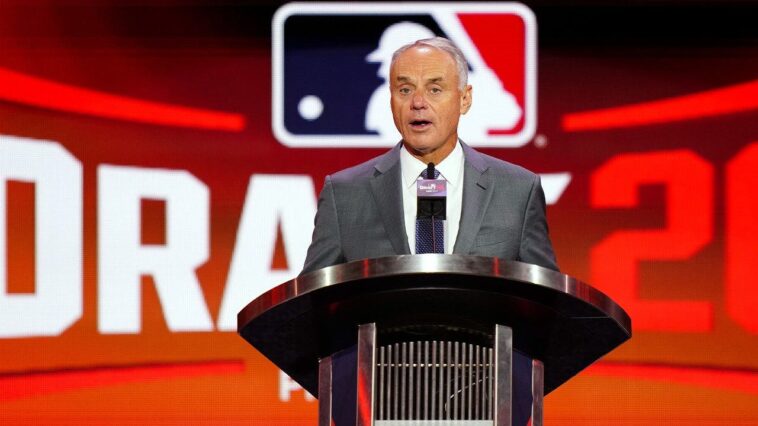
It was a tough start to the MLB Draft for Commissioner Rob Manfred when he butchered first-overall pick Roch Cholowsky’s name. (Photo by Daniel Shirey/MLB Photos via Getty Images)
Players, understandably, do not want to give up the opportunity to earn as much as the market will pay them. Just like any employee with competing job offers wants to negotiate the most they can get in salary. Owners, who do not care one bit about competitive balance, want to take advantage of this current moment to make even more money.
Instead of a “50/50” revenue split, they’d take billions of associated baseball revenue off the top first. For example, saying you’ll share a six-pack of drinks and then taking two out of the package for yourself, and splitting the final four. Why? Because it limits their exposure, increases franchise valuations to compete with the NFL, and generates more profits.
That’s the prerogative. But if they choose to stick to it, they might lose a lot more fans by missing games than they’d lose from not imposing new limitations on player salaries. Two weeks out, there have been little signs of progress, and many signs that the two sides appear just as far apart as they always have.
Not a great sign for baseball.
Ian Miller is a writer at OutKick.