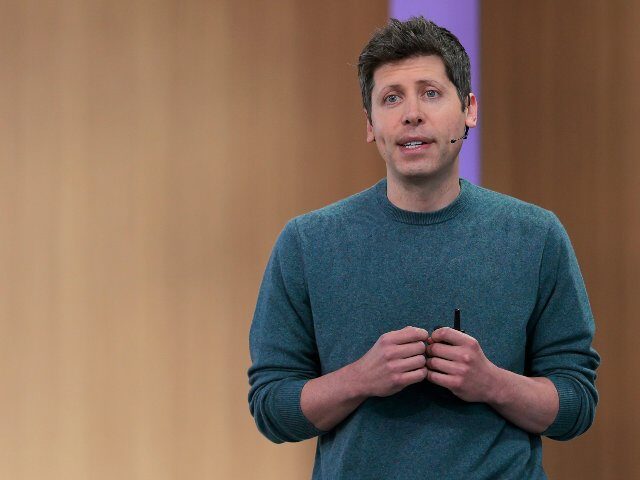
Sam Altman told Decoded by Politico that OpenAI and Anthropic remain far apart on how much risk society should tolerate from AI. According to Altman, the “world should accept some bad things happening for the benefits of this technology.”
The OpenAI chief executive made the comments in an interview published in Monday’s debut edition of Decoded, Politico’s new publication on AI policy, and its companion daily podcast. Decoded co-authors Christine Mui and Brendan Bordelon conducted the interview.
“I think there’s a lot of daylight,” Altman said when asked how his worldview differs from that of Anthropic CEO Dario Amodei. Anthropic has long been seen as the industry’s loudest voice for tighter AI regulation, while OpenAI previously pushed a lighter-touch approach. Altman called it a “lighter-touch regulatory stance,” but said the real gap between the two companies is about tolerance for harm. “We believe that the world should accept some bad things happening for the benefits of this technology and people having the agency,” he said.
Pressed on the regulatory-capture criticism that has dogged Anthropic, including from tech advisers close to President Donald Trump who accuse the company of trying to lock in its market position through regulation, Altman said he understood the logic even though he rejects it. “I disagree, but I understand the perspective of people who are like, ‘This technology is going to get so powerful, and it’s so dangerous, that a single lab in San Francisco should have it and make sure nothing bad happens, and kind of figure out how to dole out the benefits,’” he said. He called that scenario “a completely unacceptable trade-off.”
Altman said he would not accept a bargain that stamped out all misuse of AI if it meant giving up the broader public access he believes the technology should have. “I wouldn’t take a trade of saying, ‘We’ll make sure there’s no major hacks, there’s no misuse of this technology, there’s zero scams, there’s zero all the other bad things that will happen,’” he said. He argued the upside outweighs the damage: “Because I think people will do tremendously, orders of magnitude more, good stuff than bad stuff.”
That tolerance has limits. Altman drew the line at “the really catastrophic risks,” pointing to “a serious loss of control to AI” as an example.
An Anthropic spokesperson, responding to a request for comment, said “regulatory proposals apply only to frontier models.” That defense echoes an exchange Amodei had in August on social media with an investment manager who raised concerns about regulatory capture and the effect of such rules on smaller companies. “Anthropic has always made its policy proposals very carefully,” Amodei wrote at the time. “We try very hard to make proposals that disadvantage (slow down) frontier AI companies while *advantaging* smaller competitors.”
For all the distance Altman drew between the two companies in words, OpenAI’s actual policy positions have shifted toward Anthropic’s in recent months. Altman said he agreed with Amodei’s call last month to slow down development of the most advanced AI models. OpenAI has also backed new state laws imposing stricter safety requirements than it had previously supported, and its lobbyists recently endorsed a bipartisan House proposal that would require top AI companies to embed outside safety evaluators. The shift comes as OpenAI has dealt with high-profile hacking incidents and cases of its own models behaving in unexpected, rogue ways.
AI giants simultaneously release powerful AI models and call for industry regulation, with China adding further complexity to the issue. David Sacks has pointed out that when AI titans like Dario Amodei, Sam Altman, and Elon Musk call for a slowdown, they are not doing so out of altruism, but with the motivation to capture the industry and exclude themselves from antitrust laws — a conflict that President Donald Trump and FTC Chairman Andrew Ferguson recognize. Breitbart News social media director Wynton Hall has written his New York Times bestseller Code Red: The Left, the Right, China, and the Race to Control AI to serve as the definitive guide on how the MAGA movement can create positions on AI that benefit humanity without handing control of our nation to the leftists of Silicon Valley or allowing the Chinese to take over the world.
Read more at Politico here.
Lucas Nolan is a reporter for Breitbart News covering issues of AI, free speech, and online censorship.