
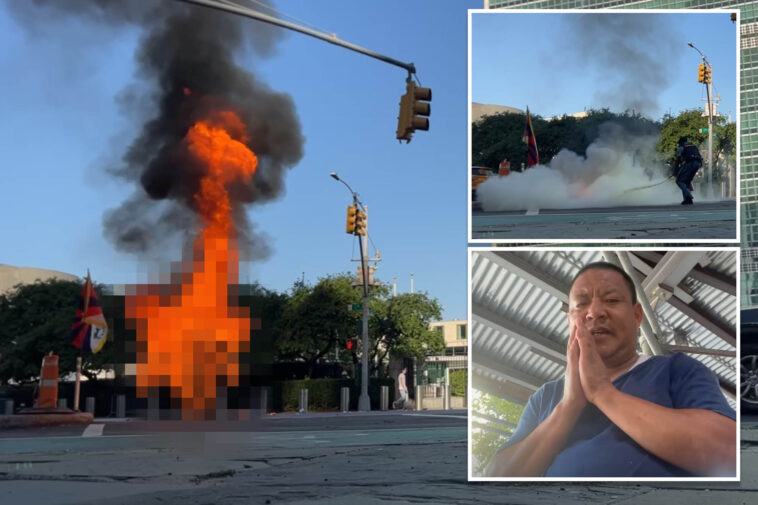

A Tibetan man protesting China’s occupation fatally set himself on fire outside the United Nations headquarters in Manhattan on Thursday evening, capturing the horrifying scene on livestreamed footage.
The protester, identified by a friend as Lobga Rangzen, was dressed in full monastic garb when he planted a Tibetan flag on the sidewalk and then self-immolated along the busy street during the evening rush, according to the video.
Rangzen, who has lived in the US for about 20 years, crumbled to the ground less than a minute after he was engulfed in flames as passing cars honked their horns.

About 15 seconds later, a pair of first responders with fire extinguishers doused the flames.
Rangzen, 42, was taken to Bellevue Hospital, where he was pronounced dead, police said.
The flag was still in place about an hour after the shocking display as cops investigated the scene.
Police were spotted at the scene carrying sheets of paper, one of which said “CHINA OUT OF TIBET” — a slogan commonly associated with the Tibetan Independence Movement, or contemporary “Free Tibet” movement.
Since March 2009, more than 150 people are known to have set themselves on fire in Tibet to protest what they describe as “Chinese occupation,” according to Free Tibet.


The “Free Tibet” movement seeks to recapture sovereignty for the Tibet Autonomous Region, marked by the restoration of power to the Dalai Lama, the highest spiritual leader in Tibetan Buddhism.
“Many of the protesters have shouted slogans while on fire, including calling for the Dalai Lama’s long life and his return to Tibet, for the Panchen Lama to be freed, and for human rights and freedom in Tibet,” Free Tibet says on its official website.
“Severe punishments are handed out to those accused of assisting or encouraging the protesters or sharing information abroad,” Free Tibet continues.
This movement challenges the region’s incorporation into China, which followed the Seventeen Point Agreement in May 1951 — an accord that sought to establish a peaceful transition while the People’s Liberation Army moved into the region.


During the 1990s, the movement gained international visibility through the “Tibetan Freedom Concerts” held in the United States, featuring prominent bands such as U2, the Red Hot Chili Peppers, and Rage Against the Machine.
Prior to the Chinese Communist Party’s rise to power during the Republic of China era, Tibet functioned with de facto autonomy and maintained its own distinct administrative structures.
While many individuals who choose self-immolation are not formally affiliated with Tibetan Buddhist monastic orders — with many coming from secular professions — these public displays remain a significant form of both political and religious resistance.