
Over 3,500 Brazilian voters had their votes deemed “null” in Sunday’s presidential election for having written their preferred candidate as “Six Seven” on their electronic voting machine, the Brazilian outlet Poder 360 reported on Thursday.
Brazilian elections are no stranger to humor or parodies and Sunday’s general elections were no different. However, in addition to the presence of several “joke” or protest candidates, the “Six Seven” social media trend appears to have had a minor appearance in the first round of the presidential election, the results of which automatically triggered an October 25 runoff between conservative Senator Flávio Bolsonaro and incumbent socialist President Luiz Inácio Lula da Silva.
Poder 360 reported that 3,539 of the more than 125 million votes cast in Sunday’s presidential election were for the number “67,” which did not correspond to any of the presidential candidates who appeared in Sunday’s ballot, each one of whom has his or her own number.
Poder 360 pointed out that it is impossible to determine which of the 3,539 “Six Seven” presidential votes cast were entered because of the viral trend, which ones were input as a form of protest, and which ones were genuine mistakes.
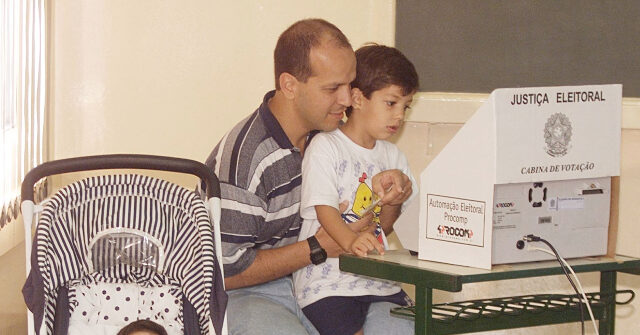
For 30 years, Brazil has used electronic voting machines in its elections. The current iteration of the system requires voters to input the correct ballot number for the candidate that he or she wishes to vote for. In the case of Sunday’s first round presidential election, for example, voters had to input the number “22” to vote for Flávio Bolsonaro of the Liberal Party (PL), or the number “13” to vote for Luiz Inácio Lula da Silva of the ruling far-left Workers’ Party (PT).
Since no presidential candidate was assigned the ballot number “67” in the election, casting a vote under that number effectively rendered the vote null as it was not attributable to any candidate.
The same ballot numbers for Bolsonaro and Lula will be used in the October 25 runoff. On that day, Brazilian voters will have to input “22” to vote for Bolsonaro, or “13” to vote for Lula. Casting a vote under any other number combination in the runoff will result in the vote being counted as “null.” Bolsonaro’s campaign has made extensive efforts to largely showcase the candidate’s number 22 in the ballot in official campaign ads and paraphernalia.
Voting in Brazil is compulsory for adults between the ages of 18 and 70 and optional for 16- and 17-year old minors, as well as for the illiterate. Presenting a valid identification card at the voting station is an indispensable requirement to be able to cast a vote.
In Sunday’s general elections more than 125 million Brazilian voters cast six different votes: for president of the Republic, state governors, first and second senators, and federal Congressmen for their respective states. While voting for a presidential candidate required typing a correct two-digit number, votes for congressmen and senators involved inputting a longer string of numbers per vote.
As such, Brazilian electoral authorities recommended voters bring a small pre-filled list with the numbers of all of the candidates they wished to vote for so as to expedite the process, providing an easy-to-print template to further assist voters. In Sunday’s election more than 20,500 candidates competed in their corresponding races, each with their own distinct ballot number.
Brazil’s voting machines give voters the chance to correct or change their vote before pressing the green button that confirms and finalizes the choice, and the name and image of the inputted candidate are displayed by the machine before the voter presses the green button. The outlet observed that about 1.9 million votes were cast under the number “00,” which is a longtime common practice in Brazil to cast a “null” protest vote. Voters also have the option to cast a “blank” vote that signals no vote to any of the available candidates by pressing the voting machine’s white “blank” button.
Brazilian outlets observed in August that several federal congressional candidates availed themselves of the fact that their corresponding ballot numbers ended in “Six Seven” to make use of the viral social media trend in their campaigns. According to O Globo, some of the candidates performed the gesture associated with the trend to carry out what the outlet described as “farming aura.”
The “Six Seven” gesture linked to the meme, which began spreading on social media in late 2024, has been used by other international politicians, celebrities, and even Pope Leo XIV himself, who has done the gesture or referred to the meme several times in public appearances.
In the case of Brazil, the “Six Seven” meme has gone beyond the social media trend where it came from and has even spawned musical videos. This year, young Brazilian musical artist Laurinha Costa, alongside DJ Cabello and DJ Tchouzen, released a kids’ song named after the viral trend.
Christian K. Caruzo is a Venezuelan writer and documents life under socialism. You can follow him on Twitter here.