
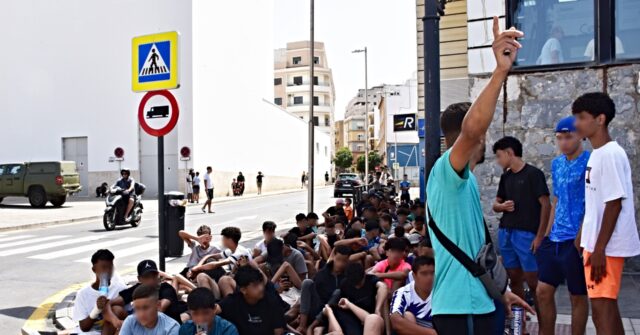
Spain’s socialist government estimates more than 5,000 illegals remain in Ceuta following the recent massive migrant invasion. All remainees are potentially eligible for asylum, a report states.
The amount reportedly includes some 2,500 potential “asylum seekers” and a roughy equal number of unaccompanied minor migrants that would be eligible for protection under Spanish law. The information was disclosed by unnamed government sources to the newspaper El País on Thursday, and comes just days after Spanish government authorities claimed that all migrants who invaded Ceuta will be “sent back.”
Over the past days, Spanish authorities have revised upwards the staggering amount of illegal migrants that invaded Ceuta in late July, going from about 49,000 at the time of the chaotic events to 72,000 last week and lastly, to 80,000 as of this week, according to Spanish Territorial Policy Minister Ángel Víctor Torres. Ceuta is a small autonomous town with about 83,000 inhabitants. Effectively, the exclave saw its population almost double in the span of hours during the dramatic invasion of its territory.
FLASHBACK: Thousands of Illegal Migrants from Morocco Flood into Spanish Territory
Similarly, the amount of remaining illegal migrants in the Spanish exclave has been noticeably revised upwards over the past days. Although Interior Minister Fernando Grande-Marlaska claimed last week that about “2,000” migrants remained in Ceuta post-invasion, the newspaper El País, citing unnamed sources with knowledge on the matter, reports that the Spanish government estimates that about 8,000 migrants remain inside the city’s territory — a significant number that represents ten percent of Ceuta’s population. The government is also reportedly juggling a 7,000 to 9,000 range as a “margin of error.”
Of the total, the sources affirmed, 5,000 would be eligible for asylum or minor protections under Spanish law. Per El País, about 2,500 are sub-Saharan individuals currently dwelling at Ceuta’s El Trampolín beach in Ceuta that can be “susceptible to seek asylum” and, should it come to that, will be allegedly reviewed on a case-by-case.
The other half represents some 2,500 unaccompanied foreign minors that Spanish laws “oblige” to offer protection. Only a small fraction of the minors has so far reportedly requested assistance to return to their corresponding families. The unnamed government sources detailed to El País that 600 of the 2,500 minors are girls, and about 400 are children bellow the age of 13.
“There are increasing numbers of girls and minors of increasingly young ages. Now we must accelerate our efforts to provide care for those entitled to it, given the risk that this emergency situation will drag on,” Spanish Youth Minister Sira Rego told El País.
Per the sources, the remaining 3,000 of the total 8,000 migrants are considered economic migrants, majorly Moroccan adults and nationals of other countries, who would not have any grounds for asylum in Spain and would thus be eligible for deportation.
The government of Spain has not publicly commented on the information reported by El País at press time.
The estimates disclosed by the sources to El País are drastically different from those publicly disclosed by Spanish authorities in recent days. According to reported by Spanish outlets, it was believed that about 1,400 minors remained in Ceuta following the late July invasion. Speaking to a local outlet this week, Moroccan Justice Minister reportedly demanded the safe return of all Moroccan minors currently in Spanish territory, including those who entered Ceuta during the chaotic invasion.
Furthermore, Spanish Foreign Minister José Manuel Albares affirmed this week that all illegal migrants who entered Ceuta will be “sent back,” an assertion he publicly delivered during his visit to the Spanish exclave.
Although the Spanish government is reportedly estimating that “8,000” migrants remain in Ceuta, the amount still falls short from the about 10,000 migrants that, according to the president of Ceuta’s local government, Juan Jesús Vivas, still remain in the city.