
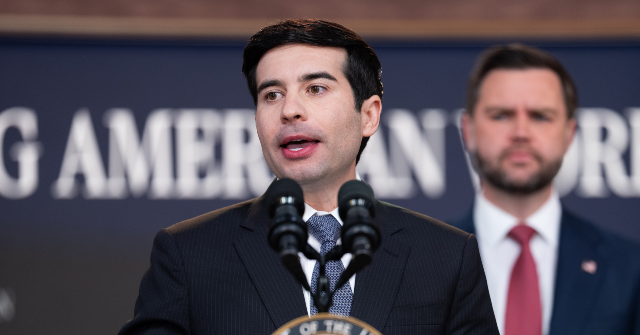
The Labor Department (DOL) will break the fraudulent hiring process that companies now use to exclude many American graduates from the good jobs they secretly give to white-collar H-1B migrants, says President Donald Trump’s labor secretary.
“We’re trying to eliminate the fraud,” Labor Secretary Keith Sonderling said in an interview with America First Legal group:
The Vice President’s task force has allowed us to really dive into this issue of immigration fraud in employment, and what we see there is that employers use some of these [visa] programs… to bring in [migrant] workers [while claiming] “We don’t have American workers here, so we’re just going to bring them in from overseas”…
What they do is that they advertise [jobs] in the middle of the night on the radio, and they put the wrong location for the job in there, or they put requirements in that only that one specific [foreign] worker has… and they also have a different recruitment system [for Americans].
“I think it’s fantastic what Labor Secretary Sonderling is doing, but I’ll believe it when it actually starts making a difference,” said Mark Krikorian, director of the Centre for Immigration Studies. He added:
They’re going to get sued, and one question is: Can they get the rule finalized before January 2029? Also, will he still be allowed to enforce it once it bites some major employers and donors? Because, you know, the reason we don’t have worksite enforcement is because Trump doesn’t want it.
Sonderling’s goal is very ambitious because widespread corporate fraud has frequently been used since the 1990s to ignore American job-seekers as companies convert subordinated foreign workers into long-term employees. With tacit approval from the federal government, this orchestrated, lawyer-enabled fraud has been used to place three million mixed-skill foreign college graduates in white-collar jobs. Many of those jobs are quietly sold by middle managers to foreign migrants in exchange for salary kickbacks, according to Americans and Indians who have seen the process up close.
Without this covert replacement, the 3 million jobs, careers, and fortunes would have upheld millions of American professionals and their marriages, homes, and children — and also birthed new companies as Americans moved from tech jobs into innovation and entrepreneurship. That discarded future would have stabilized the U.S. middle class, moderated U.S. politics, and given Congress a far greater ability to influence the direction of AI technology.
But the fraud was enabled by Congress in 1990, and the resulting white-collar replacement is now a core part of the nation’s economy.
The replacement has crippled the U.S. professional class, inflated Wall Street stocks, created a corps of foreign-born executives, implanted foreign hiring networks, transplanted foreign workplace cultures, fueled the outflow of jobs to India, undermined the reliability of U.S. telecommunication networks, accelerated foreign technological gains, and shriveled U.S. innovation and productivity.
The scale of the problem facing Sonderling is signaled by the establishment media’s decision to ignore Sonderling’s dramatic good-government push. His plan has gotten almost zero interest from powerless or pro-migration reporters in establishment publications, even though Sonderling is intending to benefit their white-collar peers, college roommates, fellow students — and their growing children.
Elite media coverage of worker visas rarely grapples with Americans’ interests, and is routinely skewed towards universities, employers, and migrants, said Kevin Lynn, founder of U.S. Tech Workers, which champions American professionals. Media outlets are complicit, he said:
They report what the people that pay their advertising want them to report — their narrative is “Americans are stupid when it comes to IT, and we have to hire abroad because we can’t find enough Americans.”
It’s why when I tour college universities, I feel these — not angst, the anger. These guys, the kids in college know how they’re getting screwed over. They’re hearing from the graduates how they’re not getting jobs.
“We get better reporting out of India than from reporters from the U.S.,” he added.
A few centrist publications have covered the issue, but their reach is throttled by pro-migration employees inside search and social-media companies. Their covert gag ensures that Google’s news page is only displaying self-serving comments from worried law firms and business outlets.
“You are all but guaranteeing that a lot of these companies cannot sponsor immigrants for permanent residency,” Amber Davis, a lawyer with Waypoint Immigrant USA, told BloombergLaw.com. “The cumulative net effect is to remove high-skilled immigrants from the United States,” he added.
The draft regulation “adds U.S. worker protections,” said K. Edward Raleigh, a partner at the huge Fragomen law firm, adding, “It also makes it a lot more difficult to retain [foreign] talent.”
“Employers that laid off U.S. workers in the same or similar occupation and area within the prior two years would not be permitted to file PERM applications for those [migrants],” said Ogletree Deakins.
“Employers must offer the sponsored job to the affected laid-off U.S. workers at no less than the offered wage and on the application’s terms and conditions,” said Crowell. The language “requiring employers to offer and hire laid-off U.S. workers for positions that are already filled by visa-dependent PERM applicants would inevitably create independent legal risk,” it added.
“The proposal would eliminate the distinction between professional and nonprofessional recruitment,” said Mintz. “The employer representative reviewing and interviewing U.S. worker applicants would be required to be a U.S. worker.”
The new rule would close the “Schedule A” side door used by employers to easily import roughly 20,000 lower-wage subordinated nurses and therapists each year, according to the Boundless law firm. “That could be particularly significant for hospitals and other health care employers… Sponsoring these workers could become more expensive and take considerably longer.”
Sonderling described the fraud, the federal investigation, and the goals of the federal regulations:
The Vice President’s task force has allowed us to really dive into this issue of immigration fraud in employment, and what we see there is that how employers use some of these programs — [such as] the H-1B program — to bring in workers… to say that we don’t have American workers here, so we’re just going to bring them in from overseas. When they do that, what we find is they’re being paid 20 percent to 30 percent less than an American worker in that same position…
A lot of that [legal process] is on the Department of Labor because we’re the front end. Some of our roles are statutory — we have to just stamp them [requests for foreign workers], but… we’re cracking down on that.
…
What we’re doing with the Department of Homeland Security, Department of State, is to make sure that the program [recognizes that] if you really need it [a particular skilled worker], you’re going to pay for it. If you really need this truly extraordinary worker, [then you will pay] $100,000, higher wage rates… But do you really need it for… an entry-level person? So one, it’s framing some of what we can on the fees and regulatory side, too. But then it’s really going after employers…
How we can do that is [by] going after the employer that is bringing in these H-1B workers at the detriment of U.S. workers, and not paying them properly.
So imagine that you know you’re [a visa worker who is] already coming in at a low [pay] rate, and then they pay you $20,000 less. They bench you, and they move you around, and you don’t want to say anything because you’re here. You’re still making more than you would in your home country, and you’re locked to that employer, right? So that’s fraud in itself… not just on the American worker who didn’t get that job, but for that individual who’s in that country as well.
The reform updates the “PERM” regulations that govern when and how an employer can reward a temporary visa migrant with the hugely valuable prize of a permanent green card, he said:
But the real issue has been that the H-1B program is supposed to be really three years, six years with an extension to get that extraordinary talent, and then you go back to your country, and then that job is done.
But it’s become a pathway to citizenship, and that is done through the Department of Labor’s PERM program, which is where… the employer comes to DOL and says, “It’s time to make this person a permanent citizen through a green card process.” That’s completely within the Department of Labor’s control.
When Congress created that program, it put requirements saying, “Okay, now you’re really going to displace American workers [permanently], and if this is a path to a green card, if this is a path to citizenship through that H-1B visa that you came over for that short time, and now you’re saying we need [the visa worker] forever or we can’t compete, well, we [in Congress] need to put some requirements on it. You can’t displace American workers.”
Sonderling continued:
But the regs are so old. It says you just need to advertise in the Sunday newspaper, you need to put in a job order at the state workforce agency, and you’ve got to make sure that nobody was laid off in that position.
So what the companies have done… They’ve completely gamed the system to where they say, “Oh, look, we had this job opening [but] nobody applied,” and it’s true. Nobody submitted an application because the ad ran on a Sunday in a little local newsletter or on the radio on — were on completely different job boards… So we are completely changing that process.
We believe this is the way that’s going to really disincentivize employers from ignoring the American worker, and then also giving American workers for that long-term shot.
Enforcing Congress’ PERM rules will reduce the incentives for foreign workers to accept poor treatment from U.S. employers, and so help Americans enter their career field, he said:
We think that’s going to be a real change, because let’s take a step back. If you’re a foreign worker coming from overseas, you’re going to be less excited about that H-1B opportunity if that won’t turn into eventual citizenship. So if you break that chain of saying, “I’m an H-1B worker, I’m going to get my first three years, [then] my second three years, then I get PERM, and while PERM is pending [I stay in the job for] years and years and years. And by the way, if there’s layoffs during your PERM application, even if you do follow it properly, [and] an American worker applies for that [job], you lose that as well. So we’re really covering all the bases.
That goes back to having a pipeline of talented American workers for those skills, and really working with these large employers that have just had this on autopilot, saying, “Well, it’s not easy anymore. It’s not guaranteed for the worker, and it’s more expensive.” How about workforce training in your local area? How about committing to hiring people from community colleges? How about hiring people from high school and training them yourselves because eventually you’re going to get American workers…
So that’s what we’re doing, and we really believe that’s how American workers are going to get back in…
That was the American dream. But that was taken away when the industries left. There weren’t jobs. When there weren’t jobs, they weren’t teaching these programs in schools. And then the jobs that shifted, they were going to foreign workers or being outsourced, and that left the American worker behind…
Those are the jobs that were lost, and those are the jobs that built this country and made us, you know, the greatest manufacturer in the world, and the greatest producer in the world.
“A lot of people lost faith in the American Dream,” he said.