

Picture Mexican and Colombian cartels using high-speed go-fast boats to flood cocaine and hashish into the U.S. via Florida or California, while U.S. agents chase them in outdated vessels — all while millions of illegal immigrants pour across the border using the same smuggling networks.
Replace the U.S. southern border with Spain’s southern coast, and that’s the crisis unfolding in Europe right now under Prime Minister Pedro Sánchez’s government.
Americans familiar with border security debates at home will recognize the pattern: when politicians deprioritize enforcement, criminals and cartels exploit the vacuum.
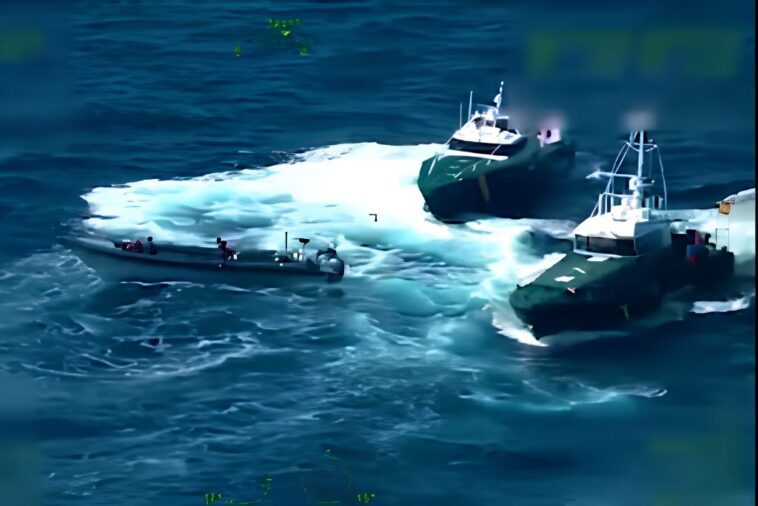
Today, two Guardia Civil officers were killed in the line of duty off Huelva in Andalusia, southern Spain. Three more agents were injured — one seriously — when their patrol boat collided with a narcolancha (a powerful drug-smuggling speedboat) during a dangerous pursuit.
This tragedy is the direct, predictable outcome of chronic underfunding, outdated equipment, and a policy of weakness that has turned Spain into one of Europe’s softest entry points for both narcotics and illegal immigration.
Lamentamos el fallecimiento en acto de servicio de nuestro compañero Germán tras una colisión de dos embarcaciones del Servicio Marítimo de la Guardia Civil mientras perseguían una narcolancha en las costas de Huelva.
Durante la actuación, además del fallecido, dos componentes… pic.twitter.com/0Si8hzMxVf
— Guardia Civil (@guardiacivil) May 8, 2026
Narcolanchas: The Cartels’ High-Speed Weapon
Narcolanchas are semi-rigid inflatable speedboats equipped with multiple massive outboard engines (often exceeding 1,000 horsepower). They race across the Strait of Gibraltar and Spain’s Atlantic coast, carrying tons of hashish from Morocco and cocaine from Latin America. Smugglers use aggressive tactics — ramming, dumping fuel and drug bales to create hazards, and relying on land-based spotters and logistics networks.
The Guardia Civil, Spain’s paramilitary force responsible for border and maritime security (similar to a mix of U.S. Coast Guard and Border Patrol), is left to fight them with aging patrol boats and insufficient support.
How Spain Is Falling Behind While the Rest of Europe Tightens Up
While the broader European Union has pushed for stronger coordinated action — including a new EU Drugs Strategy, enhanced international cooperation via Europol and Frontex, maritime analysis centers, and stricter border measures — Spain under Sánchez stands out as a laggard in practice.
The EU is implementing tighter asylum screening at external borders, faster deportations, and efforts to disrupt trafficking routes. Many member states have shifted toward tougher anti-immigration policies. In contrast, Spain has pursued a more lenient approach: recent mass regularization programs for hundreds of thousands ofillegal immigrants, which critics say signal weakness and encourage further arrivals.
Spain’s geography makes it a natural gateway — close to Morocco and Latin American shipping routes — but poor enforcement has amplified the problem.
The same smuggling networks handling drugs often facilitate illegal migration. Cartels and people-smugglers overlap, using the same boats, routes, and corrupt networks. While overall EU irregular crossings have dropped in early 2026, Spain’s southern coasts remain a high-pressure zone, with Andalusia’s rivers, ports, and long coastline serving as easy entry corridors.
This permissiveness has real consequences: drugs flooding European streets (and indirectly global markets, including the U.S.), overwhelmed services, and heightened security risks.
Spain’s Guardia Civil associations have long complained of inadequate resources, leaving agents “in silos” — isolated and underequipped against increasingly bold and violent criminal groups.
Huelva
8 de mayo de 2026Dos patrulleras de la Guardia Civil perseguían a una narco lancha a 80 millas de la costa de Huelva. Las dos patrulleras han chocado entre ellas, falleciendo un agente, dos agentes graves y otro leve.
Mi más sentido pésame y pronta recuperación pic.twitter.com/9oqh3INpd5
— HONORLEALTADSACRIFICIO (@HONORLEALT53607) May 8, 2026
The Human and Strategic Cost
The fallen officer in Huelva represents the deadly price of political priorities that favor optics over security. While the government offers condolences and vague promises of more investment, agents continue high-risk operations in inferior conditions.
Low-level mules are often caught, but kingpins, logistics providers, fuel suppliers, and money launderers face insufficient pressure.
A real solution demands:
- Immediate deployment of modern high-speed interceptors, helicopters, and technology for maritime units.
- Massive reinforcement of personnel in hotspots like Huelva, Cádiz, and the Guadalquivir.
- Tougher laws targeting the entire narco ecosystem, not just boat drivers.
- Full alignment with stronger EU-wide strategies instead of diverging with softer domestic policies.
- Treating this as a national security emergency — because drug cartels and unchecked immigration networks threaten stability across Europe.
Spain’s weakness is not just a Spanish problem — it undermines Europe’s collective security and contributes to narcotics flows that affect the entire West.
Spain’s Guardia Civil deserves better than being sent into unequal battles. Europe needs robust external borders. Spain, as the frontline state, must stop being the weak link.
Rest in peace to the fallen. Their sacrifice should finally force a policy reset
About The Author
Maria Herrera Mellado
María Herrera Mellado es una abogada y analista política muy respetada. Licenciada en Derecho en EE.UU. y España, también tiene un doctorado en Ciencias Jurídicas y varios títulos de la Universidad de Granada (España), de la Universidad de Arizona y de la Florida International University. Con amplia experiencia en derecho internacional, asesoría en inversiones, representación en inmigración, y protección de la privacidad y lucha anticorrupción, ha asesorado a organizaciones y políticos europeos, estadounidenses e hispanoamericanos. Ha escrito sobre seguridad nacional e inmigración, protección de datos, derecho constitucional, consumo financiero y derecho bancario en revistas internacionales y coescribió libros publicados en Perú y Colombia. Es reconocida por su servicio comunitario en EE.UU. y es considerada una de las mujeres más influyentes de Florida. Es experta en varios idiomas y participa frecuentemente en debates en canales como Univisión, Fox, France 24, Telemundo y es la Editora Jefe de Gateway Hispanic.