
See more of our coverage in your search results.

Take that, ‘burbs!
Students at the city’s largest charter school network scored the highest pass rates on the state’s math and reading tests — outpacing kids from well-heeled suburban school districts like Scarsdale.
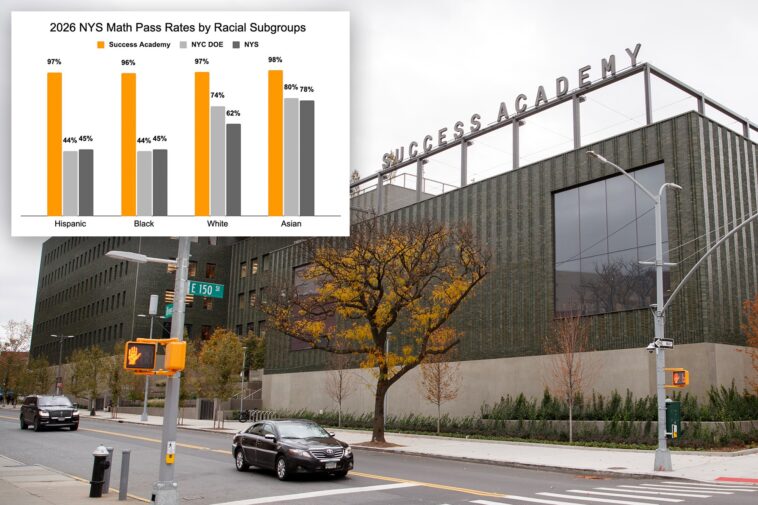
Success Academy, whose students are largely from low-income and black and Latino students, ranked No. 1 in both math and English language arts proficiency for grades 3-8 testing, with students scoring 97% and 92% pass rates, respectively, according to new data.

That outdid students in Scarsdale, which came in second with 93% and 89% proficiency in math and English language arts, according to the newly released test score results compiled by the state Education Department.
By comparison, only about 50% of New York City’s public-school kids were considered proficient in reading, a 6-point drop from the year before, and just 57% made the grade in math, about the same as the previous year.
“These test scores are a victory for our scholars and teachers,” Success Academy founder and CEO Eva Moskowitz said. “We need strong political leaders who will put the needs of children and their families first.

“Our students just proved what’s possible,” Moskowitz said. “Those who have abandoned kids in failing schools have no excuses left.”
Success students’ proficiency numbers also beat out the public schools in elite Westchester County districts Bronxville, Briarcliff Manor and Chappaqua as well as Jericho on Long Island.
Some 85% of Success students are economically disadvantaged and 72% are black and Latino — and both groups scored over 50 points better than their counterparts in traditional public schools, the figure showed.

The rates for the charter school’s black, Latino and economically disadvantaged students topped 90% in both math and reading.
In addition, Success Academy elementary and middle schools claimed 22 of New York City’s top 25 spots in math and 21 of the top 25 in reading, the network reported.
Of the 97% of students who passed the math exam, 74% scored a level 4, the highest level of proficiency.
Similarly, of the 92% who passed the ELA test, 64% scored a level 4.
The city’s largest charter school network, Success boasts enrollment of 22,000 children in 59 elementary, middle, and high schools in Manhattan, Brooklyn, the Bronx and Queens.
One education analyst said Success’ focus on classroom accountability pays dividends for students.
“Success Academy is very focused on classroom instructional practice and constant evaluation of teachers,” said Ray Domanico, a senior fellow at the Manhattan Institute.
By comparison, unionized teachers at traditional public schools are evaluated a few times a year and the reviews are “typically meaningless,” Domanico said.

“There’s a lot that district schools and other charter schools can learn from Success Academy. Poverty and other factors are not an excuse not to deliver a good education for our children,” he added.
Meanwhile, students in all of the city’s more than 280 charter schools combined outscored their counterparts in traditional public schools.
For the first time, 70.6% of charter schools scored proficient on the math exam, up 2% from last year and 13 points higher than the 57% pass rate in traditional or district public schools run by the Department of Education.
On the ELA exams, 62.9% of public charter school students scored proficient, compared to 50.3% in district schools, or nearly 13 points higher. It continues a 15-year trend of charter school students outperforming their traditional public school counterparts on the state’s standardized exams.

“Behind every one of these numbers is a child whose family found a public school that works for them,” said Kevin Elkins, CEO of Great Public Schools New York, a new pro-charter advocacy group.
“No family should need connections, wealth, or luck to find the kind of school that delivers results like these. Unfortunately, that’s too often the case in New York––and we look forward to changing it for all students.”
Charters are publicly funded schools whose students are chosen via random lottery. They
are privately managed and mostly non-union and typically have a longer school day and year than regular public schools.
More than 16% of New York City public school students now attend a charter school.
GPS will lobby next year to persuade the state legislature and Gov. Kathy Hochul to boost funding for charter schools and lift the cap that prevents more of the popular alternative schools from opening in New York City.
The move has been opposed by the influential teachers union which has lobbied the Democrat-dominated state government against changes.
Mayor Zohran Mamdani opposed lifting the charter school cap during his successful campaign for City Hall last year.