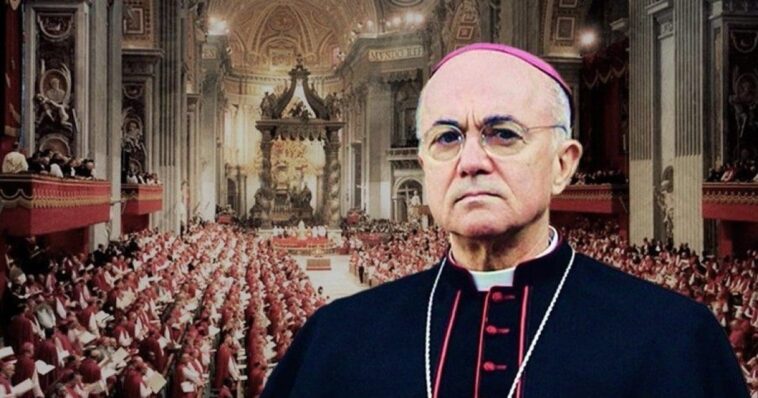
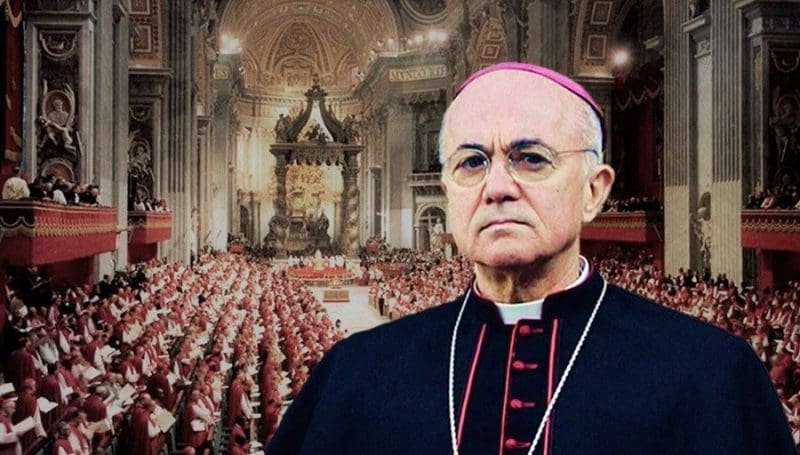
Archbishop Vigano’s letter to Pope Leo was a straightforward list of questions for the new Pope to answer regarding actions by Pope Francis and the direction of the Catholic Church.
by Aldo Maria Valli
The letter to Leo XIV from Monsignor Carlo Maria Viganò [here] has the merit of confronting the Pope with inescapable questions. And since it comes not from a fanatical ideologue but from a faithful servant of the Church, it fully warrants being taken seriously by anyone questioning what has become of a Church that still calls itself Catholic but, in essence, no longer is.
The story of his journey within the Church speaks for Viganò. His was a long career in the service of the Holy See: the diplomatic corps, the Secretariat of State, Nigeria, the Governorate, and the Nunciature to the United States. His efforts to combat corruption in Vatican City are well known to those familiar with that world. His 2018 dossier—accusing Francis and other high-ranking officials of covering up the McCarrick scandal—remains a formidable indictment. The isolation and threats he faced in return demonstrate that he struck a raw nerve.
The archbishop is sincere when he retraces his gradual discovery of the root of the problems. Formed within the post-conciliar Church, he eventually realized that the crisis certainly did not begin with Francis. The time bomb had been ticking long before and exploded with the Second Vatican Council.
That council was not an “aggiornamento”—an updating. It was a revolution. It was a process of subversion, carefully planned and affecting every sector of the Church’s life: doctrine, liturgy, sacraments, discipline, canon law, and ecclesiology. When Viganò describes the post-conciliar Church as an occupation from within—aimed at imposing a theological design different from the previous one—he is simply capturing reality. History confirms it.
The letter has the further merit of exposing all the contradictions of this “new church” born from a coup. There is no problem if a bishop celebrates Mass in rainbow vestments, welcomes bishops and priestesses to the altar, participates in interfaith ceremonies, prohibits the faithful from receiving Holy Communion kneeling and on the tongue, justifies the sin of abortion, advocates for an indiscriminate and reckless welcome of immigrants, places ecology at the center of his preaching, espouses all the causes of the left and the historic enemies of the faith, or commits unspeakable sins and cover up scandals. But if he dares question the Second Vatican Council and its outcomes, he’s out. If he dares to say that Vatican II created a rift and that, based on the facts, it’s impossible to sustain the hermeneutic of continuity, he’s cast out like a plague victim.
And so, a retired apostolic nuncio—who ought to be commended for his service and courage—is forced to beg for a meeting with the Pope. Yet the Pope does not reply.
Rome excommunicated Viganò using a Stalinist method. The Church of dialogue and inclusion brought the axe down on this faithful servant of hers. All this for having questioned Vatican II—a council that sought to be pastoral rather than dogmatic.
Let us reflect on this. Viganò was not excommunicated for denying, for example, transubstantiation, the Virgin Mary’s virginity, or the resurrection of the dead. No. He was cast out for critically analyzing a pastoral council and the path the Church has taken in the wake of that rupture.
The archbishop does not hesitate to describe the Conciliar and synodal Church as apostate, occupied, disfigured, and subversive. And anyone with eyes to see can agree with his analysis.
The archbishop’s letter has the merit of backing into a corner those conservatives who still toy with the hermeneutic of continuity. And the very policy of Rome—according to which adherence to Vatican II, rather than to the Deposit of Faith, is the proof of fidelity—demonstrates that Viganò is right.
When Monsignor Viganò asks Leo XIV to show him where he, as a servant, has contradicted the depositum fidei, he confronts him with a decisive challenge. And perhaps this is precisely the reason why an audience has not yet been granted. The burden of proof lies with the Pope. Can Rome seriously demonstrate that Viganò is a schismatic? Or is it not, in fact, Rome that has excommunicated itself?
Of note in Monsignor Viganò’s letter is the revelation that it was Cardinal Burke—following the publication of the McCarrick report—who advised him to live in secret locations for several years. Also worth highlighting is the reference to the case of Eleuterio Vásquez Gonzales, known in Chiclayo as Father Lute, who was accused of sexually abusing young victims. It is worth recalling that Chiclayo is the Peruvian city linked to the figure of the future Pope Leo XIV, as Robert Prevost served there as bishop for eight years, from 2015 to 2023. As Viganò rightly points out, the Holy See granted Father Lute dismissal from the clerical state without a proper canonical trial, effectively leaving him unpunished; meanwhile, the victims’ canon lawyer, Monsignor Ricardo Coronado Arrascue, was removed from his legal duties, reduced to the lay state, and investigated on the basis of defamatory accusations. Monsignor Viganò states that the details of this affair were documented for him by Monsignor Coronado himself. Is the Holy See, under Prevost, applying the same method used by Bergoglio in the McCarrick case?
The final passages of the letter also deserve to be highlighted.
“I trust,” writes Monsignor Viganò to the Pope, “that Your Holiness will grant me an audience, following the cancellation of the one previously scheduled for last December 11th. I will then be able to communicate to you in person certain matters of the utmost importance regarding my apostolic ministry and the need to ensure its continuity and future.”
Note well: Viganò speaks not only of “matters of the utmost importance” linked to his episcopal ministry but states that they concern the need to ensure “continuity and future” for that ministry.
Finally, the archbishop reiterates “the unconditional intention to fulfill every obligation incumbent upon me as a Successor of the Apostles.”
Are sensational developments in store?