
This article was written by Karen Crouse and published on Sport & State, a new media company founded by Clay Travis that is built around sports, culture, original voices, and live conversation.* * * * *
TEMPE, Ariz. — Molly Miller surveyed the clickbait headline listing three leading candidates for the New York Liberty‘s vacant head-coaching position. The first two names were Teresa Weatherspoon and Dawn Staley, both former WNBA stars who’ve won multiple Olympic gold medals and at least one NCAA championship each.
“Oh my gosh,” she said. “I don’t belong there!”
Weatherspoon and Staley may be women’s basketball stalwarts, but Miller, the second-year head coach of the Arizona State University women’s program, is not to be overlooked. She has swept into prominence like a refreshing gust, writing her legacy at a time when women’s basketball is struggling to define, and expand, its heritage.
The WNBA is coming off another tumultuous season that saw the blurring of lines between athlete, activist, and stories revolving around racial justice and sexual identity overshadowing the product on the floor. The main thing has not been the main thing in women’s basketball for several years. As the league looks for a new commissioner and lays the groundwork for three new franchises, there are worse things to be than a plucky upstart like Miller.
“Women’s basketball has some unprecedented attention,” Miller said. “New players. New markets. Increased commercial value. With growth comes expectations. Now I think the infrastructure has to catch up to the talent and visibility.”
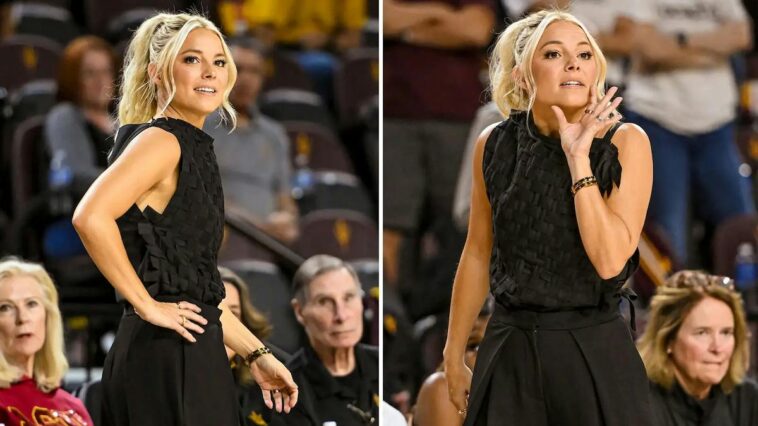
College programs like Miller’s are seeing the trickle-down effect of those new eyeballs. All Miller has to do is crouch in front of the Arizona State bench in her girl boss high heels, and photographs of her fashionable game-day outfit quickly go viral.
View this post on Instagram
A post shared by Sun Devil Women’s Basketball (@sundevilwbb)
Even the bros at Barstool Sports have entered the chat. A recent blog on the site may have led with an appraisal of Miller’s physical appearance, but it segued into an appreciation of her assets as a coach and communicator: “This woman demands excellence and her players to be at their best every single day.” Noting her success in taking programs to the next level, the blogger described Miller as “a miracle worker.”
The author of an article last spring in The Guardian probably would have taken exception to the Barstool blog. The argument would have gone something like this: to spend more than a single sentence on Miller’s physical appeal is reductive, glossing over the substance of her success to dwell on her superficial “straight girl next door” image, or what has come to be known as “pretty privilege.”
Miller, 41, takes a more sanguine view. She’s broadly aware of her viral presence on TikTok, because her players pay attention to such things and keep her in the loop. Of course, Miller is conversant in today’s fastbreak exchange of content. The modern-day coach would be derelict in her duties to bury her head in Xerox paper. She simply chooses not to be overrun by it.
In an age that has turned us all into Pavlov’s dogs, conditioned to react to every ping of our phones or every online post, to express instant outrage at every perceived slight, Miller models for her student-athletes a very different way to act. She models pressing pause, taking a beat. Reflecting instead of reacting.
Miller’s Strong Connection To Modern Players
During a preseason scrimmage at Oregon, Miller was questioning her players’ defensive effort during a timeout when one of ASU’s five transfers, Rashunda Jones, challenged Miller in a disruptive exchange.
Miller benched Jones for the rest of the quarter. What happened next encapsulates why Miller is considered a rising star, a coach coming into her own as the women’s game comes of age, with all the growing pains that entails.
View this post on Instagram
A post shared by Sun Devil Women’s Basketball (@sundevilwbb)
She told Jones, a senior point guard, that they needed to talk over what happened but only after a 24-hour cooling-off period. Jones said she spent the night thinking and praying about how she had become so caught up in her swirl of emotions that she failed her new coach and her teammates who depend on her to be their floor leader.
“I didn’t realize how much impact I had on the team,” Jones said after a practice last week. At her previous stops, at Purdue and Michigan State, she said, “I felt so unheard.”
The 24 hours of reflection afforded Jones the time and space to sit with her breach of conduct. She came to appreciate that before she could be heard, she had to listen. “I realized I had come off as disrespectful,” she said.
When the two finally spoke, Jones apologized, and Miller also acknowledged that her communication could have been better. Miller’s vulnerability, that willingness to model being a flawed person, strengthens her connection to the modern player, who has grown up internalizing stress and pressure and expectations — from parents, from peers, from online posters — and externalizing perfectionism.
“We got on the same page,” Jones said, “and ever since we’ve been good.”
Without knowing that story, Debbie Antonelli, a longtime men’s and women’s college basketball analyst for ESPN, intuited that Miller imbues her teams with the freedom to play, not perform.
“The game is about mistakes, really, and who can minimize them,” Antonelli said. “I think if you see the game through that lens, which I believe Molly does, it just helps her players get better. Because being uncomfortable and making mistakes and learning from them is how all teams usually improve.”
New Expectations, Old-School Approach
Miller is a model for the next iteration of the women’s game as it evolves from a niche sport into mainstream entertainment. She is adaptable, accessible, and big on accountability; easy to look at and edifying to listen to; forward-thinking about growing women’s basketball and old-school in her expectations of her players.
THIS IS THE WOMEN’S BASKETBALL WE LOVE.
Molly Miller, an extraordinary coaching staff, and a program that’s giving fans something special to believe in.
With all the controversy dominating women’s basketball headlines lately, I want to introduce you to something genuinely refreshing.
There’s a remarkable story unfolding in Tempe, Arizona, and it deserves your attention.
Her name is Molly Miller. She’s the head women’s basketball coach at Arizona State, and she’s building something I absolutely love.
Listen to how she describes her program in this interview from Big 12 Media Days.
“We want to be the hardest team to play against, but the easiest team to love.”
Now THAT is a basketball philosophy I can get behind.
In an era when controversy, personal agendas, and endless distractions seem to dominate professional women’s basketball headlines, Miller is building something that reminds me why I fell in love with this game in the first place.
She’s building a basketball PROGRAM.
One founded on relentless effort, accountability, genuine relationships, player development, and a commitment to representing the university with pride.
And when Miller discusses culture, she isn’t reciting some carefully rehearsed slogan.
She explains that culture is established through daily habits. When those habits fall below the standard, she stops practice, addresses the problem, and challenges her players to take ownership of correcting it.
THAT is coaching.
That is leadership.
And that is precisely the kind of environment that develops outstanding basketball players and exceptional young women.
But what makes Arizona State especially intriguing is the remarkable collection of basketball minds Miller has assembled around her.
Let’s start with Stephanie Norman.
If you don’t know her name, you should.
Norman spent 18 seasons helping Jeff Walz transform Louisville into one of the premier programs in women’s college basketball. During that stretch, Louisville made 16 NCAA Tournament appearances, reached eight Elite Eights and four Final Fours, and played for two national championships.
She has helped develop numerous future WNBA players and was inducted into the Assistant Coaches Hall of Fame in 2024.
Now she’s back at her alma mater, serving as associate head coach and director of basketball strategy.
Her résumé would make plenty of head coaches envious.
Think about the wealth of experience she brings to Miller’s staff. Eighteen seasons inside an elite college basketball operation, preparing for championship-caliber opponents, recruiting high-level talent, developing professionals, and understanding exactly what it takes to compete deep into March.
That experience is invaluable to a program trying to establish itself among the nation’s best.
Norman has seen what championship programs look like behind closed doors. She understands the preparation, discipline, accountability, and attention to detail required to sustain that level of excellence.
For a young head coach building a Power Four program, having someone with Norman’s background alongside her is an extraordinary advantage.
Then there’s Jason Glover.
Glover has spent decades coaching and developing basketball players at virtually every level imaginable.
Men’s college basketball. Women’s college basketball. The NBA. The WNBA. The NBA G League.
He has coached professionals, helped design offensive systems, developed young talent, and contributed to winning programs throughout his career.
But one of the most impressive parts of his background rarely receives the attention it deserves.
Glover spent 13 years as executive director of the Nevada Basketball Academy, a nonprofit basketball development organization in Reno that helped more than 30 young athletes earn college scholarships.
He understands the entire developmental process, from identifying potential and teaching fundamentals to preparing young athletes for the demands of college and professional basketball.
He knows what players look like before they become polished prospects, and he understands what it takes to develop them into successful competitors.
Glover also worked alongside Miller at Grand Canyon, helping build a program that went 32-3 in 2024-25, captured conference championships, and reached the NCAA Tournament.
That established chemistry is another enormous advantage.
Miller doesn’t have to wonder whether Glover understands her philosophy or shares her expectations. They’ve already built a championship-winning conference program together.
And now they’re trying to do it again on an even bigger stage.
And then there’s Daniel Barber.
I want to spend a little extra time here because I believe Barber may be one of the most underrated coaches in all of college basketball.
I’ve been around this game for decades. I know an extraordinary number of college recruiters, and I’m familiar with how many of them operate.
Daniel Barber is on another level.
When people evaluate recruiters, they love to point toward the coaches signing the biggest names at the most recognizable universities.
But here’s something those evaluations frequently overlook.
A POWERHOUSE UNIVERSITY DOES NOT AUTOMATICALLY HAVE A POWERHOUSE WOMEN’S BASKETBALL PROGRAM.
Those are two entirely different things.
Barber spent years recruiting at Clemson and Penn State, two prominent universities whose women’s basketball programs were struggling to establish sustained national success.
He didn’t have the luxury of walking into a recruit’s living room representing South Carolina, UConn, or another perennial national championship contender.
He couldn’t simply point toward a trophy case full of recent national championships or a long history of sending players deep into March.
He had to sell potential.
He had to sell development.
He had to sell relationships, opportunity, and a vision for what those programs could eventually become.
And he was remarkably effective at doing it.
At Clemson, Barber helped recruit nationally ranked prospects, including Ruby Whitehorn, the first McDonald’s All-American to join the Tigers’ women’s basketball program.
Whitehorn went on to earn ACC All-Freshman honors before eventually transferring to Tennessee.
Now she’s at Arizona State, reunited with the coach who helped recruit her to Clemson.
But perhaps the most compelling evidence of Barber’s impact on the young women he recruits comes from another player.
Gabby Elliott.
Barber originally recruited Elliott to Clemson, where she earned ACC All-Freshman honors after an outstanding freshman season.
Following her time at Clemson, Elliott transferred to Michigan State, where injuries repeatedly interrupted her basketball career.
Two difficult seasons later, she transferred again.
This time, to Penn State.
Guess who was coaching there?
DANIEL BARBER.
In a February 2025 interview with Penn State’s student newspaper, Barber confirmed that he had been Elliott’s lead recruiter at Clemson.
He also recalled something Elliott told him while she was considering Penn State.
One of the reasons she wanted to come to Penn State was because Barber was there.
Think about that.
After years of college basketball, injuries, rehabilitation, and the challenges of navigating multiple programs, Elliott still placed tremendous value on the relationship she had developed with the coach who originally recruited her out of high school.
And the story gets even better.
When Barber joined Molly Miller’s staff at Arizona State in April 2025, Elliott transferred there for the 2025-26 season.
CLEMSON. PENN STATE. ARIZONA STATE.
THREE DIFFERENT PROGRAMS. THE SAME COACH.
That is remarkable.
Recruiting a talented high school player is one thing. Maintaining that player’s trust through years of college basketball, multiple transfers, difficult seasons, and serious injuries is something entirely different.
And Elliott rewarded that opportunity with an outstanding final college season, earning All-Big 12 honors and honorable mention All-America recognition while helping Arizona State return to the NCAA Tournament.
Now consider Ruby Whitehorn.
Barber helped bring her to Clemson as a nationally celebrated high school prospect. After two seasons with the Tigers and another stop at Tennessee, Whitehorn is also back alongside Barber, this time at Arizona State.
Two exceptionally talented players. Two different basketball journeys. Both reunited with a coach who helped recruit them earlier in their careers.
That tells me something about Daniel Barber that no recruiting ranking ever could.
He builds relationships that endure.
And make no mistake, Barber’s value extends well beyond recruiting.
He’s an exceptional basketball coach and player developer who understands the game, invests in his athletes, and earns their trust.
His ability to recognize talent early, develop meaningful relationships with prospective players and their families, and communicate a compelling vision for their future is among the very best I’ve encountered.
What makes his accomplishments even more impressive is the circumstances under which he’s achieved them.
For years, Barber was convincing outstanding players to invest in programs that were still trying to establish themselves.
Now, for perhaps the first time in his career, he has something truly special to offer.
Molly Miller.
A winning basketball philosophy.
A nationally accomplished coaching staff.
A culture built around accountability, development, and genuine relationships.
And a program already demonstrating that its vision can produce results.
Imagine what someone with Barber’s recruiting abilities can accomplish when the basketball program begins delivering the very things he’s spent his career convincing recruits are possible.
I believe we’re about to find out.
And I wouldn’t be surprised if Daniel Barber’s name eventually becomes much more familiar throughout women’s college basketball.
THE RESULTS ARE ALREADY SHOWING
Miller inherited an Arizona State program coming off a 10-22 season.
In her first year, the Sun Devils went 24-11 and returned to the NCAA Tournament for the first time since 2019.
That is an extraordinary turnaround in a remarkably short period.
And now Arizona State enters Miller’s second season with considerable momentum.
USA Today ranked the Sun Devils’ incoming transfer class fourth nationally, while ESPN ranked their high school recruiting class No. 25.
That’s a remarkable recruiting haul for a program that was struggling to win games just two seasons ago.
And look at how thoughtfully this roster is being constructed.
Miller discusses bringing in multidimensional players who can contribute in different ways. She wants players who can score, rebound, defend, make decisions, and accept evolving responsibilities.
She talks about recruiting players who value hard work, relentless effort, leadership, and being good teammates.
Those qualities are essential to building a program capable of sustaining success.
The supporting staff deserves recognition, too.
Assistant coach Daejah Bernard played for Miller at Drury and brings firsthand knowledge of her expectations and coaching philosophy.
Ashleigh Lopez, the program’s director of player development and recruiting operations, provides another important piece of the infrastructure surrounding these young athletes.
The entire operation appears designed around a shared vision.
Experienced basketball minds. Talented recruiters. Coaches who understand development. Players recruited to fit a particular philosophy.
And a head coach who insists that the culture she talks about is demonstrated through everyday actions.
I find that combination incredibly exciting.
A PROGRAM WORTH WATCHING
I’m not suggesting Arizona State has already arrived among the sport’s established national championship contenders.
There is still basketball to be played, and this team will have to prove itself against the best competition in the country.
But I see a program with the leadership, recruiting foundation, player-development expertise, and competitive philosophy to make a serious statement this season.
I wouldn’t rule out a memorable March run.
More importantly, I see something women’s basketball desperately needs more people talking about.
GOOD CULTURE.
Outstanding coaches teaching the game, building meaningful relationships, developing young women, demanding accountability, and giving fans a team they can genuinely embrace.
There are exceptional women’s basketball programs operating this way all across America. They deserve far more attention than they receive.
And that’s why I wanted to share this story.
If the controversy surrounding the WNBA has left you frustrated or questioning where women’s basketball is headed, I encourage you to look beyond the professional league.
Women’s basketball is filled with remarkable coaches, talented young athletes, and programs doing wonderful things for the game.
Molly Miller and Arizona State are giving us a terrific example.
And with Stephanie Norman, Jason Glover, Daniel Barber, and the rest of this outstanding staff alongside her, I believe something very special is taking shape in Tempe.
Remember what Miller said.
“We want to be the hardest team to play against, but the easiest team to love.”
Coach, you’re off to one heck of a start.
I’ll be watching.
GO SUN DEVILS! 🔱
Video excerpts: 2026 Big 12 Basketball Media Days. Edited for Sports Patriot commentary and analysis.
— Sports Patriot (@SportsPatriotUS) October 23, 2026
Although she is relatively new to the hyper-competitive world of Power 4 basketball, Miller is a proven winner; first as a high school star in Springfield, Mo., where she led her team to two state titles; then as a four-year starter at Division II Drury University, where she played herself into the school’s Hall of Fame; and most recently as a head coach at Drury (six years), Grand Canyon University (five) and ASU, where she is 28-11, including 4-0 this season.
Among active Division I women’s basketball coaches with at least five years’ experience, only the UConn’s Geno Auriemma (.886) and LSU‘s Kim Mulkey (.858) have a better winning percentage than Miller’s .830. To this point, she has prospered without top-shelf recruits, but that may be changing. This week Ontario (Ca.) Christian’s Kaleena Smith, a guard nicknamed “Special K” and the No. 1-ranked high school women’s prospect, announced that she has narrowed her college choices to UCLA, USC and ASU.
Breaking: Kaleena Smith, the No. 1 ranked player in the SC Next 100 for the Class of 2027, is down to Arizona State, UCLA, and USC, she announced. https://t.co/LEMmUCrBwV
— SportsCenter NEXT (@SCNext) November 16, 2026
“She is crystal clear about her direction, her communication, her vision, and I think all those things compiled together probably have helped her in more ways than we can even measure,” Antonelli said.
Miller’s last team at Drury, in 2019-20, compiled a record of 32-0, only to be defeated by COVID-19, which caused the cancellation of the 2020 national championships. Her unbeaten squad had more seniors whom she had coached since they were freshmen (3) than transfers (2).
Eleven of the 15 players on her last team at Grand Canyon, in 2024-25, were seniors or graduate students, and all but one started their collegiate careers at other schools.
“I have to be able to pivot and move with the changes,” Miller said. “However, I believe treating people the right way and creating an environment where our kids thrive, and there’s a pride in being here because the community’s behind them, because the culture’s positive, because they have teammates and coaches who care about them, will create a shift in mentality where they’ll want to stay.”
“Hard work beats talent when talent doesn’t work hard.”
ASU’s Molly Miller is a rock star in women’s college basketball https://t.co/THwGMS5OQ1
— Barstool Sports (@barstoolsports) November 4, 2026
At Arizona State, Miller has leaned into her ability to pluck the right players from the transfer portal to fit the culture she is building. The transfer Jones, a South Bend native who had never lived outside the Midwest, has embraced not just the team-first climate that Miller has created but also Tempe’s mild November temperatures.
“It’s so nice not to have snow on the ground,” she said. “I didn’t realize until I got here but I probably was suffering from seasonal affective disorder every winter.”
Another of ASU’s eight newcomers, Ruby Whitehorn, took a circuitous path to ASU, through Clemson and Tennessee. She was dismissed from the Lady Vols’ team early last season, after her second run-in with the law in as many months.
She was arrested by campus police for possession of marijuana after an earlier arrest for kicking down two doors at a woman’s residence. According to ESPN, Whitehorn told officers she was retrieving her phone and passport from the woman, who took both and locked the door behind her.
She pleaded guilty to two misdemeanors of aggravated trespassing and aggravated burglary in exchange for judicial diversion. Daniel Barber, Miller’s associate head coach and ASU’s recruiting director, was an assistant at Clemson when Whitehorn started her collegiate career there. He vouched for her character, paving the way for Whitehorn to join the team in February.
In a sit-down interview with Sport & State before a practice last week, Miller said, “If we’re all judged on our worst days, wouldn’t that be a horrible thing? I believe in Ruby. I have confidence in Ruby. I’ve had several one-on-one sit-down discussions about her growth, her maturity, her next steps.”
#ASU WBB coach Molly Miller on Ruby Whitehorn https://t.co/3EcCIWbUir
— jeffmetcalfe (@jeffmetcalfe) November 6, 2026
Miller added, “The fact we can give someone like Ruby the opportunity, and the fact she can come out on the other side, that’s my why.”
It should surprise no one that Miller’s “why” for coaching doesn’t revolve around prestige, status – and certainly not viral popularity. This is someone who eschewed Division I offers to play at Division II Drury.
Who spent four years after college not pursuing her coaching ambitions. She toiled instead in the corporate world as a marketing director for the Springfield Neurological and Spine Institute, a job she credits for preparing her for when she became the CEO of her own basketball program, because she learned how to reconcile a budget, recruit primary doctors for referrals, and manage the egos of the twelve neurosurgeons in the company’s employ.
Who didn’t leave Drury the first time a Division I coaching opportunity presented itself.
Who was drawn to the ASU job in no small part because she didn’t have to uproot her husband, Derek, or their two small children, son, Cy, and daughter, Crosby, from the sweet cul-de-sac in the beloved neighborhood they moved to after she started at Grand Canyon.
“What really motivates me is not monetary, it’s not what level I can get to, it’s not status,” Miller said.
It’s her why.
“I am placed here to have an influence as a role model, as a teacher, as a mentor,” she said, “and my mindset is how can I best serve that purpose?”
‘Put Eyes On What We’re Doing’
If your only previous exposure to Miller was on X because her game-day outfits permeated your timeline, that’s cool with her. Click for her outfits, stay for her messaging about her team, her players, and women’s basketball.
“I think head coaches across the country, we just want to amplify our game,” Miller said. “We want to amplify women. We want to amplify the sport. And there’s different avenues to do that. I’m trying to embrace whatever I can to put eyes on what we’re doing.”
The high-energy Sun Devils are fun to watch, and that goes double for Miller, who stalks the sidelines like a high-heeled cheetah, yowling instructions. She may crouch but she rarely sits. Her spot on the bench is referred to as “the ghost chair” because of how rarely it is occupied.
Molly Miller getting her team fired up ahead @SunDevilWBB’s season opener 🏀
@FOX10Phoenix https://t.co/ZJa3oKphAj
— Blake Niemann (@Blakes_Take2) November 3, 2026
Her wardrobe has been a talking point for years. Honestly, a subscription-based clothing rental service is missing a slam-dunk by not making her its spokeswoman.
“At Drury, I’d have fans come up to me and say, ‘I’m coming to the game to see what you’re wearing,’” Miller said with a laugh.
If the basketball brings them back, that’s what Miller’s shooting for.
“I’ve always tried to keep the main thing the main thing,” she said. “I’m a serious basketball coach. I’m a culture builder. I’m a competitor that happens to love fashion.”
The clothes are simply her cover. Everywhere she’s gone, Miller has made it fashionable to win, and that’s why the future of women’s basketball will look better with her in it.