See more of our coverage in your search results.

To celebrate our 225th birthday, The New York Post is highlighting the city’s icons: The people, places and things that make Gotham great.
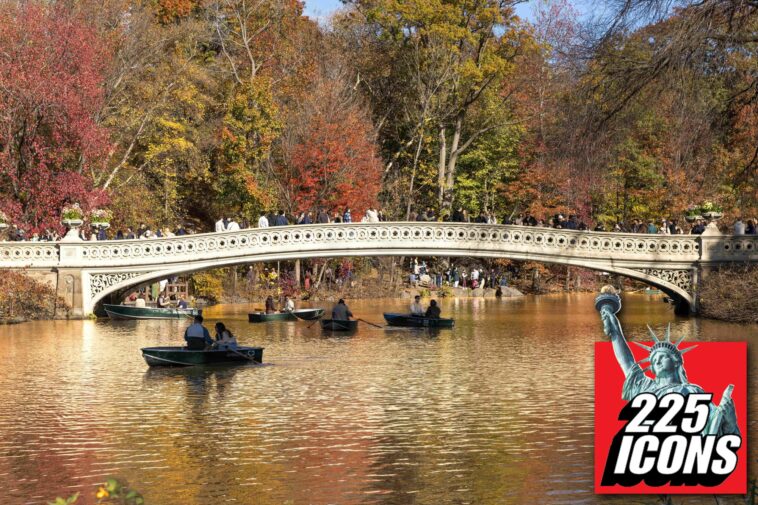
The Bow Bridge
Central Park is the city’s contradiction. Nestled in the perfect parallel street grid of Manhattan, Central Park’s paths never follow a straight line. It’s a maze, on purpose, where your sightlines drop after 100 feet in any direction. Walking in from the traffic of Central Park South, you can easily get turned around, lost in a wilderness wrapped inside an urban sprawl.

The intent of its designers was to rescue you from the bustle. Slow your pace. Make you reflect.
And no where is that moment more poignant, more romantic, than the Bow Bridge.
Architects Calvert Vaux and Jacob Wrey Mould designed 27 arches and bridges inside Central Park, which were built from 1859 to 1866.
The longest was the Bow Bridge, an 87-foot pedestrian span in cast iron that rises and falls almost imperceptibly over the lake. A curve like the bow of an archer, or a violinist.
On the water, rowboats. On the bridge, a bride is having her picture taken. Someone kneels for an engagement. The sunset falls between the apartment towers of the Upper West Side, casting the trees in orange.
You’ve walked one-quarter mile from the world’s biggest traffic jam to arrive here, an oasis of Victorian design.
No place feels so of New York and so un-New York.