
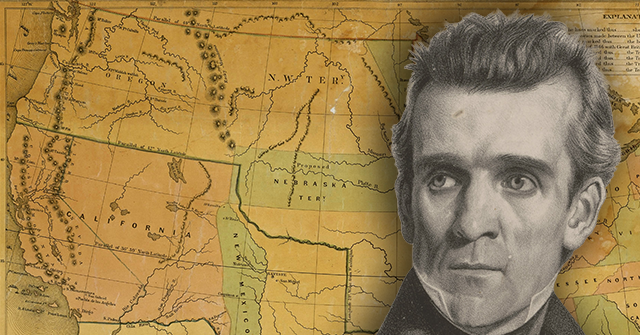
One million two hundred thousand square miles.
That was the amount of territory that was incorporated by the United States under the administration of James K. Polk, the 11th President of the United States, between 1845 and 1849. This amounts to more than one-third of the entire territory of the continental 48 states of America.
When we hear the phrases “coast to coast” or “sea to shining sea,” we must recognize that during the first half of the 19th century, such geographic parameters were merely a dream for men like James K. Polk and the Jacksonian Democrats who supported him. Yet he’s the one who got it done.
Many Americans, including future President Abraham Lincoln, were adamantly opposed to this notion. However, the lawyer from Columbia, Tennessee, stood firm to his vision and accomplished in one four-year term more than many presidents have in two. Here is why we should all, for our nation’s glorious 250th birthday, celebrate the legacy of President Polk.
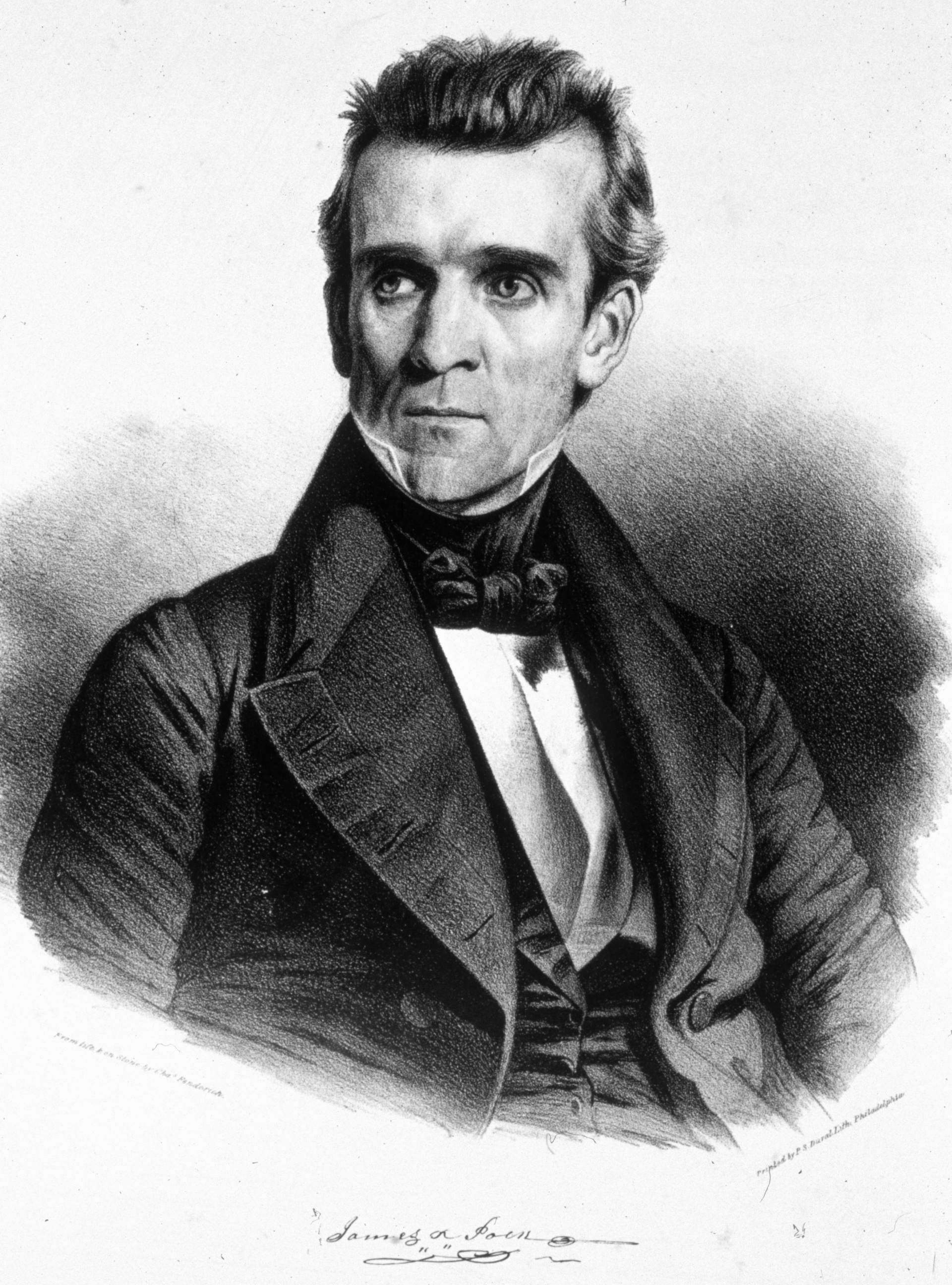
Portrait of James Knox Polk, circa 1840, the 11th president of the United States. (MPI/Getty Images)
Born in North Carolina in 1795, James Knox Polk and his family journeyed across the Appalachians to the frontier of Maury County, Tennessee, when James, the eldest of ten children, was 11. James’ childhood was difficult, as his frail health, compounded by chronic and severe abdominal pain, meant he could not perform any of the manual labor vital to surviving the hardships of frontier life.
At age 17, Polk was subjected to a radical, experimental surgery by Dr. Ephraim McDowell in Kentucky where he was operated upon while upside down to remove the urinary bladder stones that were the cause of his chronic pain. Throughout the excruciating operation, the sickly teenager was only offered brandy to dull the pain. The surgery was ultimately a success, the abdominal pain melted away, and James K. Polk was ready to embark on his career.
After achieving a law degree from the University of North Carolina in 1818, Polk quickly became enthralled by Andrew Jackson and “Old Hickory’s” style of politics and jumped into the political arena himself. In 1823, Polk was elected to the Tennessee House of Representatives, and within two years, he was already in Washington as a member of U.S. House of Representatives.
During this period, Polk married Sarah Childress, a society hostess who complemented James’ shy, bookish nature and eventually became one of the most influential first ladies of the 19th century. The couple had no children, as James’ bladder surgery had likely caused him lifelong infertility.
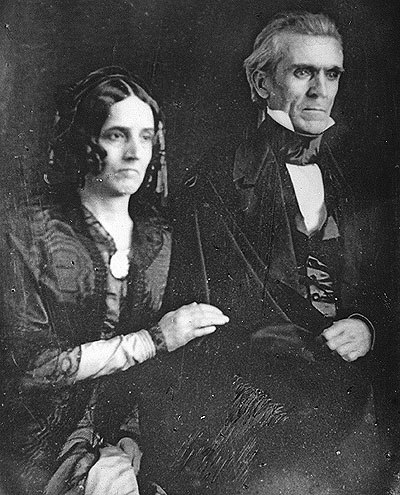
A daguerreotype of James K. Polk and Sarah Childress Polk, circa 1846-49. (Wikimedia Commons)
In Washington, Polk’s close friendship with President Jackson was rewarded by his ascension to the house speakership in 1835. After serving two years as governor of Tennessee from 1839 to 1841, Polk’s greatest achievements were yet to come.
During Polk’s era, America was driven by the concept of “Manifest Destiny,” the belief that the young nation whose population was clustered near the Atlantic coast but was sovereign over a vast and sparsely inhabited territory, was divinely ordained to spread its republican and capitalistic values by acquiring the entire North American continent. The problem was, however, that multiple native tribes, European powers, and the new republic of Mexico stood in the way.
In July 1845, magazine editor John O’Sullivan published an essay coining the phrase “Manifest Destiny” in his Pro-Democratic Party Periodical United States Magazine and Democratic Review. In this essay, alluding to the thousands of American settlers who had flooded into Texas, a recently annexed territory still claimed by Mexico, O’Sullivan declared, “Texas is now ours… and the sweep of our eagle’s wing already includes within its circuit the wide extent of her fair and fertile land.”
With acquisition of land from the Atlantic to Pacific coasts, O’Sullivan argued that the United States could thrive economically and earn its rightful place as a world power.
Today, the concept of Manifest Destiny is controversial among historians, but James K. Polk, a Jacksonian Democrat himself, was an eager devotee of O’Sullivan’s grand vision of an America stretching from coast to coast. Critical to Polk’s victory at the 1844 Democratic Convention and subsequent general election was his bold campaign slogan “54-40 or fight.” The slogan was a reference to another territorial dispute, this time with Great Britain: Oregon and the latitude of the territory’s northern boundary with then Russian-controlled Alaska. While successfully neutralizing his critics who feared that such daring expansionism would eventuate ruinous wars with both Mexico and Britain, Polk won the hearts and minds of the American people and achieved his lifelong dream of the American presidency.
During his inaugural address in March of 1845, Polk was full steam ahead:
As our boundaries have been enlarged and our agricultural population has been spread over a large surface, our federative system has acquired additional strength and security. It may well be doubted whether it would not be in greater danger of overthrow if our present population were confined to the comparatively narrow limits of the original thirteen States than it is now that they are sparsely settled over a more expanded territory. It is confidently believed that our system may be safely extended to the utmost bounds of our territorial limits, and that as it shall be extended the bonds of our Union, so far from being weakened, will become stronger.
The opposition to the Democratic Party at the time was not the Republican Party, but the Whigs, led by the charismatic and sharp-tongued Kentucky politician Henry Clay. The Whigs were strongly pro-legislative supremacy, pro-tariff, divided over slavery (a split which led to the party’s collapse in the 1850s), and opposed to the territorial expansion of the United States.
Clay, whom Polk had defeated in 1844, had warned that Polk and the Democrats’ platform was “seriously charged with an inordinate spirit of territorial aggrandizement” and would cause “the further propagation of slavery” in the United States. Polk, on the other hand, had promised lower tariffs as well as the fulfillment of Manifest Destiny through the annexation of both Oregon from Britain and California from Mexico.
The battle lines were drawn.
In November, President Polk dispatched Democratic congressman John Slidell of Louisiana to Mexico City to negotiate with the Mexican government on the purchase of New Mexico and California. The Mexican Government under President Jose Joaquin de Herrera balked, and Polk subsequently ordered the occupation by general (and future president) Zachary Taylor of disputed territory along the Rio Grande River.
This provocative yet shrewd move by Polk set a trap the Mexicans fell right into when they attacked Taylor’s troops near what is now Bluetown, Texas, on April 25, 1846. After Polk thundered that the Mexicans had “shed American blood on American soil,” Congress overwhelmingly approved a declaration of war on Mexico on May 13.
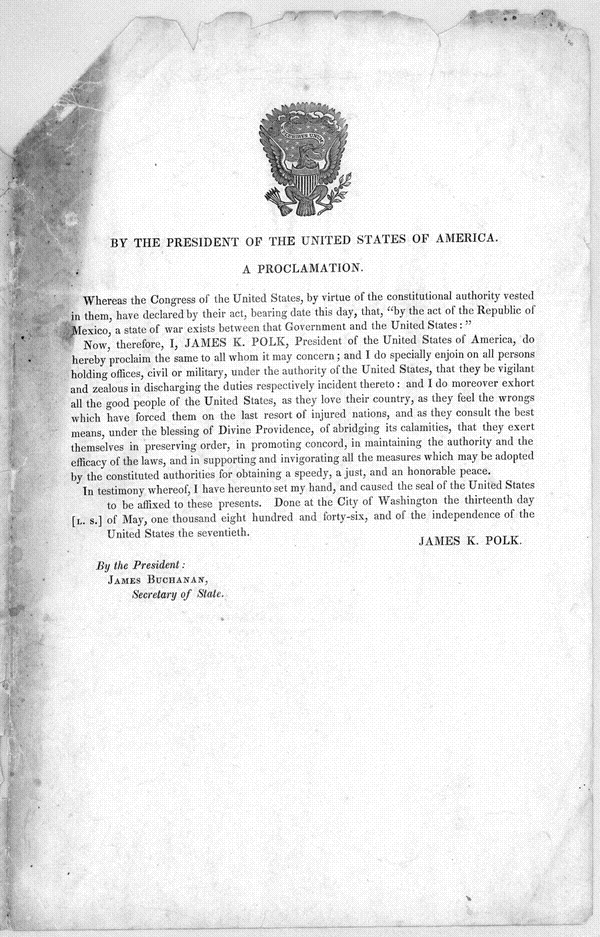
President Polk’s 1846 proclamation of war against Mexico. (Wikimedia Commons)
Meanwhile, as all national resources were directed to the war with the neighbor to the south, Polk was in desperate need of a solution to a long-festering dispute in the north. Like Texas, Oregon was a popular destination for American settlers who journeyed Oregon Trail destined for the boundless opportunities of this largely unknown land. Meanwhile, Britain had limited resources to fight for a backwater territory far from its more critical interests in India and Africa.
Thus, the Oregon dispute was resolved without a war as both sides agreed to extend the already established 49th parallel boundary westwards to the Pacific by signing the Oregon Treaty in June 1846. While Polk was forced to renege on “54-40 or fight,” he had already accomplished one of his core campaign promises, all without a drop of bloodshed.
The Mexican American War had its domestic critics. One of these critics was a young Whig congressman from Illinois named Abraham Lincoln. Lincoln gave a speech in 1848 denouncing the war as “unnecessary and unconstitutional” and warned of the accession of new slave states to the union.
None of this opposition slowed down Taylor’s army, who captured Monterey in September and defeated a threefold numerically superior Mexican Army led by General Antonio Lopez De Santa Anna at the Battle of Buena Vista in February 1847. This victory was a sensation at home, inspiring a new wave of patriotism unparalleled since the war of 1812.
However, when Taylor hesitated to launch a deeper offensive, President Polk ordered General Winfield Scott to mount an even more daring invasion of the Mexican heartland from the port of Veracruz. Following victory after victory—battles that included almost every major future Civil War general—Scott’s Army entered Mexico City on September 14, 1847, and the war was over.
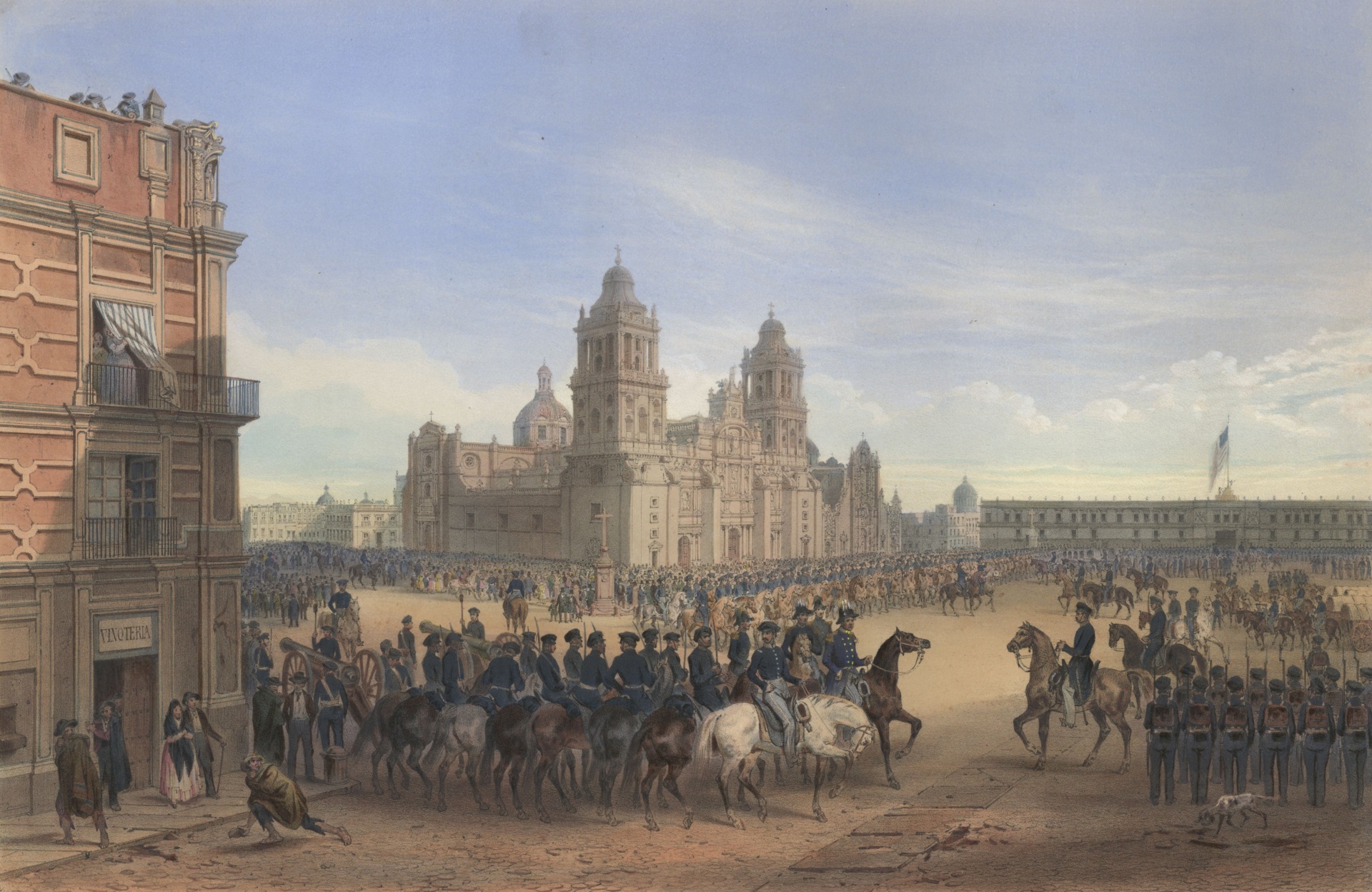
“General Scott’s entrance into Mexico” during the Mexican-American War. Hand-colored lithograph by Adolphe Jean-Baptiste Bayot after a drawing by Carl Nebel, 1851. (Wikimedia Commons)
In the end, both the United States and Mexico signed the Treaty of Guadelupe Hidalgo. Mexico was allowed to keep its sovereignty as a state while ceding more than half its territory—525,000 square miles—to the United States, including all of Alta California and Nuevo Mexico. In just three short years, President Polk had achieved every single one of his campaign promises and nearly doubled the size of the country.
Under Polk’s administration, the United States annexed the entirety of what became the states of Texas, Oregon, Washington, Idaho, California, Nevada, and Utah, almost all of New Mexico and Arizona, as well as parts of Colorado, Oklahoma, Kansas, Montana, and Wyoming—more than 1.2 million square miles. Without James K. Polk, Americans would have never been able to speak the phrases “Coast to Coast” and “From Sea to Shining Sea.”
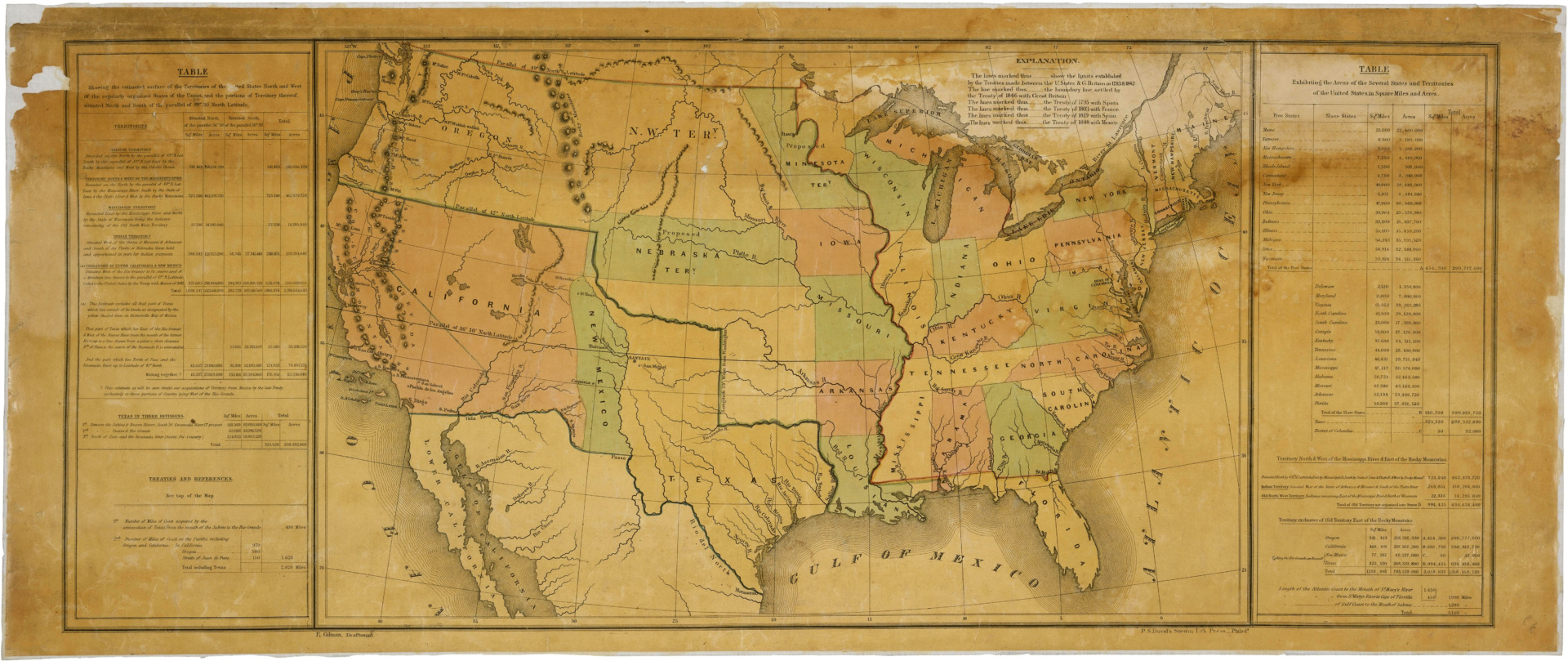
This map accompanied President James K. Polk’s annual message to Congress in December 1848. (HUM Images/Universal Images Group via Getty Images)
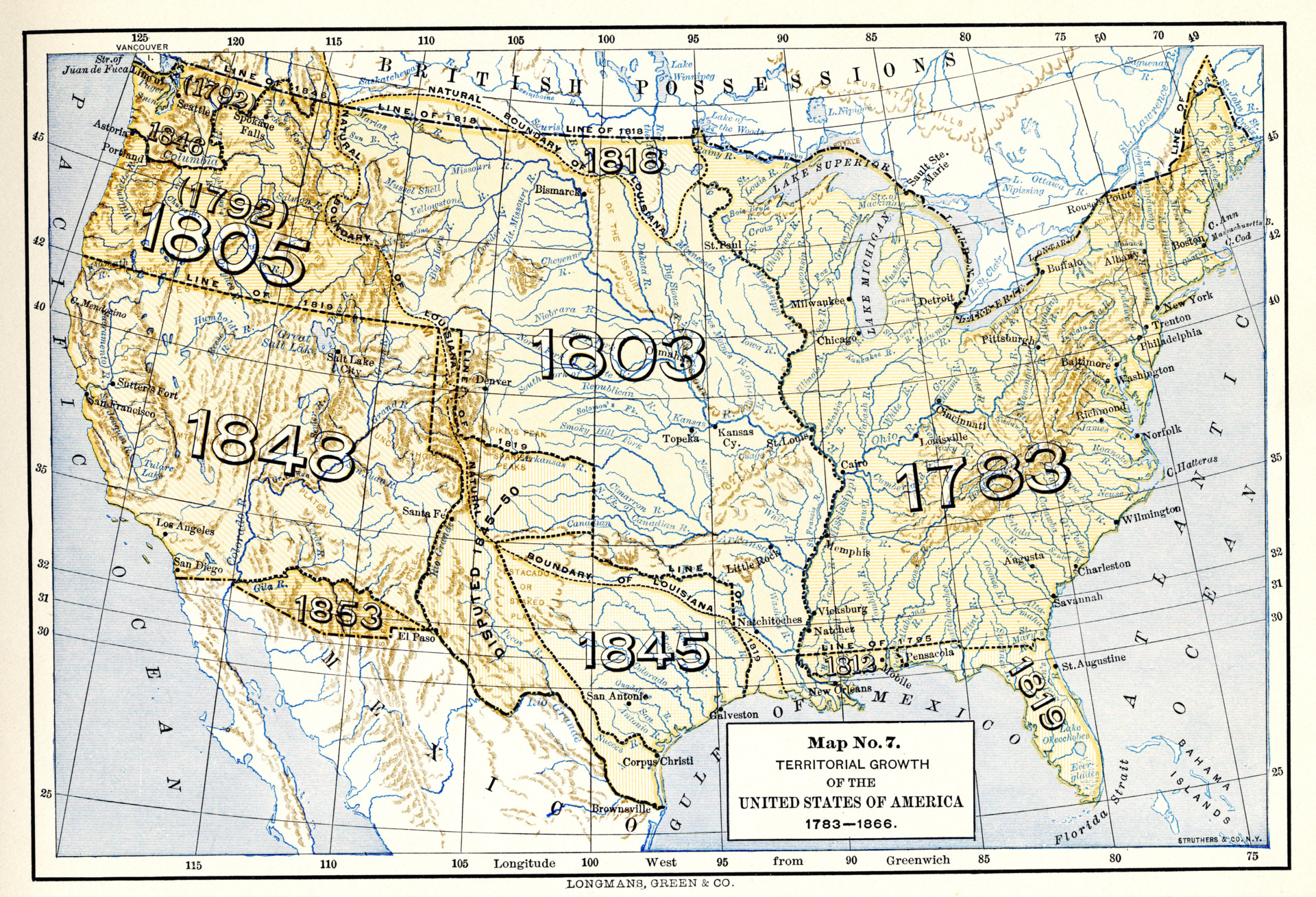
Map of the Territorial Growth of the United States, 1783 – 1866, showing the country’s westward expansion and illustrating the notion of “Manifest Destiny.” Published in 1898 by Longmans, Green, & Co. and engraved by Struthers & Co. (Interim Archives/Getty Images)
While Polk left Washington in 1849 completely exhausted and tragically passed away only three months later from cholera, the 11th President of the United States’ legacy is indisputable. The humble lawyer from frontier Tennessee had elevated the status of his young nation from an insecure coastal state to a continental power that could rival the great powers of Europe.
So today, let us remember this hero of American history, a man who faced relentless and vicious opposition from the Whigs yet was determined to carry out the vision he knew would produce a stronger and more prosperous union.
And if you ever stop by Nashville, where I live, you must pay tribute to James K. Polk at his and his wife Sarah’s graves on the grounds of the Tennessee State Capitol.
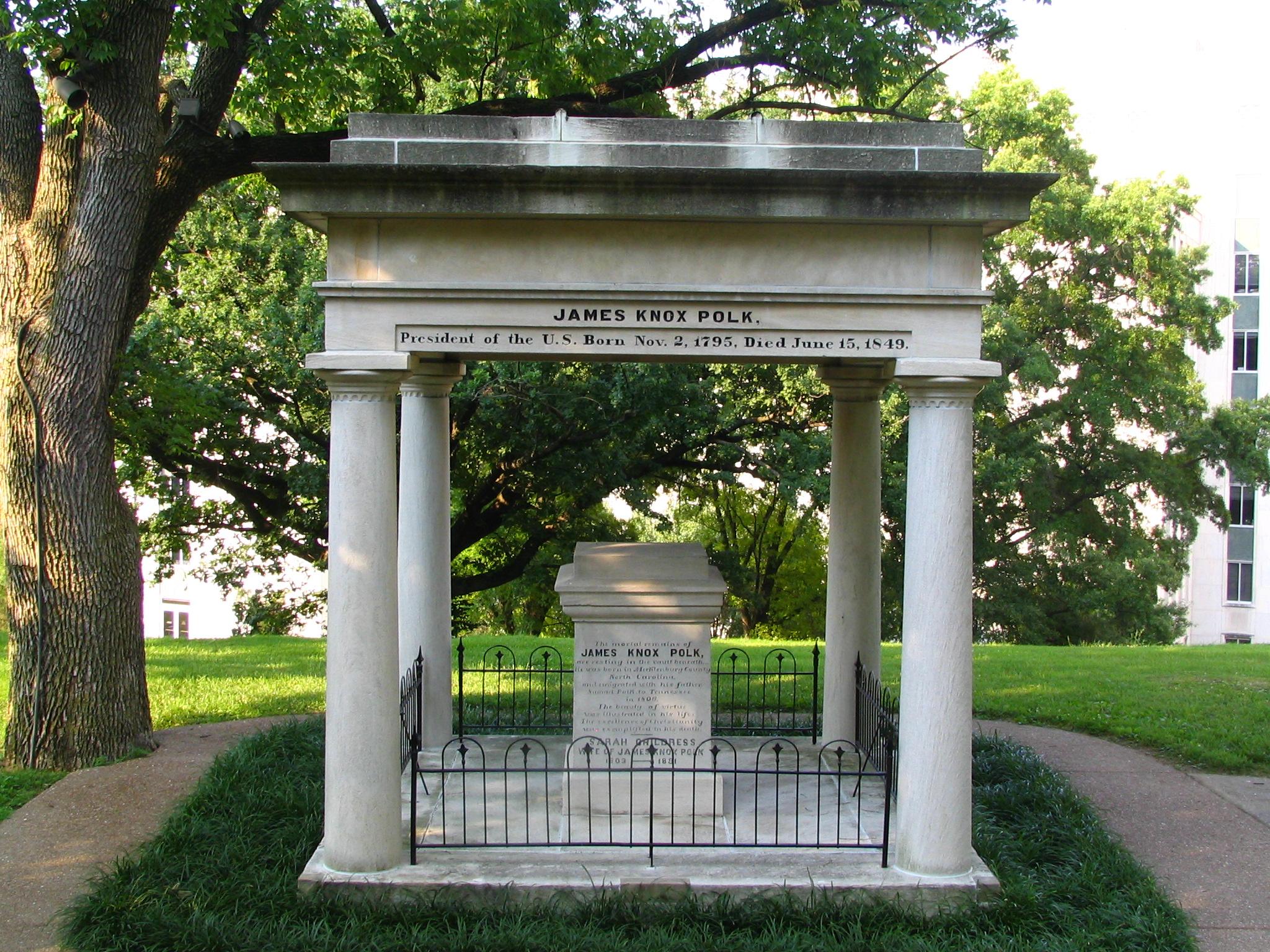
The tombs of President James K. Polk and First Lady Sarah Childress Polk on the grounds of the Tennessee State Capitol in Nashville, Tennessee. (Brent Moore/Flickr)
Samuel Waitt is a geopolitical commentator, author of two books, and the host of Waitt, What? The Podcast. Follow his work at www.waittwhat.com.