
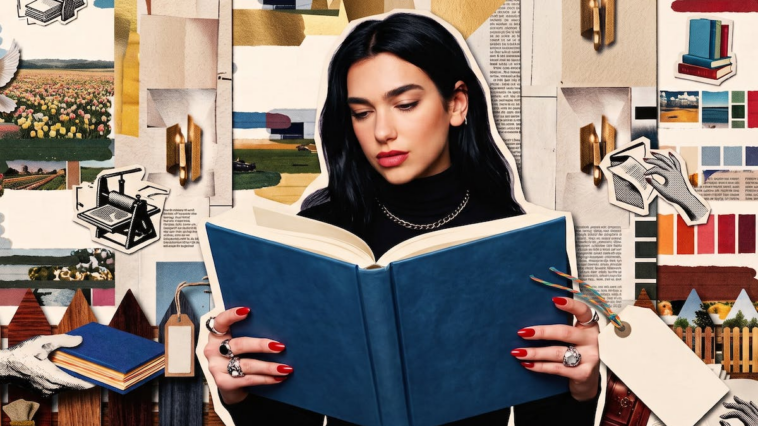
Move over, Leonardo Da Vinci. There’s a new Renaissance humanist on the block — at least, according to the internet. You might know her as the global pop star Dua Lipa, and she wants you to read banned books.
This past week, the “Levitating” singer unveiled her new “Manifesto Library” in Portugal, which features hundreds of books she claims were once banned or otherwise controversial. Posing with a copy of Margaret Atwood’s “The Handmaid’s Tale,” a book that has now sold more than 10 million copies worldwide, she tells her 650K+ “Book Club” followers that her initiative opens up “conversations around censorship, resistance and the importance of preserving voices that challenge power and refuse to be silenced.”
There’s only one problem. None of the books in her library were ever “banned” or “censored” in the first place.
Among the other titles in Dua Lipa’s library are George Orwell’s “1984,” a book that has sold over 30 million copies as of 2024, and J.D. Salinger’s “The Catcher in the Rye,” a novel that is read in virtually every single high school English class across the country. I don’t necessarily disagree with Dua Lipa that we all should read these great books, but calling “1984″ and “The Catcher in the Rye” “banned” books is like calling “Game of Thrones,” one of the world’s most widely watched TV shows, a “banned” show.
As I pointed out the other day on X, you can call anything a “banned book” as long as it was removed from an elementary school library that one time in 1978.
That hasn’t stopped the political Left from co-opting the term “banned books” to create an imaginary controversy around censorship. Slapping the label onto virtually any novel with a remotely political bent, the Left frequently pretends conservatives are responsible for instituting Nazi-era book bans and for silencing leftist voices. Walk into any indie bookstore in a blue state, for instance, and you’ll immediately be met with a “banned books” display featuring carefully curated titles promoting a certain political agenda. One such display making the rounds on X contains Frantz Fanon’s “Black Skin, White Masks” (a far-leftist call to violence against “colonizers”), Sally Rooney’s “Normal People” (a novel she herself has called “Marxist propaganda”), and Maia Kobabe’s “Gender Queer” (I will let that one speak for itself).
Nor is the “banned books” trend a recent invention. Back in 2023, for example, the American Library Association referred to an effort to remove sexually explicit content from school libraries as a demand to “censor library books.” These books, meanwhile (the aforementioned “Gender Queer” among them), contained “graphic depictions of how children can masturbate,” as well as “cartoons of homosexual activity,” according to a Daily Wire report. And while these titles were removed from certain school libraries, they remain widely available for purchase on Amazon or your local bookstore.
One can only conclude that the “banned books” trend is nothing more than a convenient way for leftists to promote books with certain ideological messages over others.
Because the same people crying so vehemently about “banned books” when the books promote leftist ideologies are the very people quietly banning conservative-leaning books from ever hitting our shelves in the first place.
You can lament the removal of “Gender Queer” from an elementary school library all you want, but the fact is that the novel continues to enjoy mainstream institutional backing. The same goes for Sally Rooney’s Marxist BDSM fantasy “Normal People” and Caro Claire Burke’s “Yesteryear,” the internet’s latest literary fad attacking conservative Christian “tradwives.” Other recent celebrated titles include Pulitzer Prize finalist “Stag Dance,” which depicts a “Vegas transfeminine gathering” and NPR’s best book of the year “Bellies,” a trans romance that everyone’s favorite celebrity Elliot Page has called “smart, hilarious, and deeply moving.”
I am not here to argue that these books shouldn’t be published in the first place. But it is undeniable that the publishing industry consciously prioritizes far-leftist stories, creating a homogenous reading culture in which contemporary fiction has become synonymous with far-leftist ideology.
Don’t believe me? Publishing professions can tell you themselves.
Before a book reaches the shelves of your local Barnes and Noble, it must first go through several stages of the editorial process, the first of which entails the procurement of representation from a literary agent. While several non-fiction literary agencies still (thankfully) devote themselves to conservative authors — someone has to publish Ben Shapiro, after all — the fiction world has become so ideologically captured by the “banned books” mob that it is now virtually impossible to get a book with a more “traditional” message published in the first place. I’m not even talking about books with overtly Christian themes or Zionist protagonists, though those are most certainly no-gos. Literary agents now explicitly declare that they will not even consider “dated ideals of partnership or relationship.”
How come the “banned books” advocates are the same people making these lists that effectively ban certain books…? pic.twitter.com/aW3JNcnxFP
— Liza Libes (@pensandpoison) July 15, 2026
I don’t speak leftist very well, but I’m pretty sure that means that this agent won’t look at a book that positively depicts marriage between a man and a woman.
One could argue that if these were just the preferences of a single agent, then we wouldn’t have a problem on our hands. But when an entire literary establishment begins declining certain morals and themes, then an entire publishing institution effectively institutes a soft ban on certain books.
Indeed, other agents decline to review “copaganda,” “protagonists who are aligned with American police or military,” or even “morality stories.” Meanwhile, one independent press warns that book submissions “must have a Muslim protagonist,” while a children’s editor at Hachette requests books that “center marginalized voices, especially related to queer women and femmes.” Editors at Macmillan’s Flatiron — the same imprint that publishes Elliot Page and Joe Biden — request “contemporary fiction that centers Black and queer voices” and “literary fiction that explores music and art, friendship, gender, and progressive politics.”
A single editor’s “preference” for progressive fiction and antipathy towards traditional messages does not constitute a book ban, but when large swaths of literary agents and editors across an entire industry begin parroting the same message, then it becomes clear that conservative fiction — or simply books with traditional moral messages in the vein of “The Brothers Karamazov” or “Anna Karenina” — are no longer welcome on our shelves.
The irony is impossible to ignore: the same people who have built an entire cultural identity around “banned books” are often the very people deciding which books never get the chance to exist in the first place.
No, conservative books aren’t being banned in public squares or ritually burned at the stake. They are simply being filtered out long before they ever get the chance to find an audience in the first place.
Banned books are in. But they’re not the banned books that Dua Lipa wants you to read or the books that do not belong in elementary school libraries. They are the books with great moral messages that we once venerated as a society but whose contemporary iterations will be forever lost on us because they never made it to our shelves.
That’s the book ban that should worry us the most.
***
Liza Libes is a writer and the founder of Pens and Poison. She holds degrees in English from Columbia University and writes about literature and culture at pensandpoison.org. Follow her on X @pensandpoison.
This article is part of Upstream, The Daily Wire’s new home for culture and lifestyle. Real human insight and human stories — from our featured writers to you.