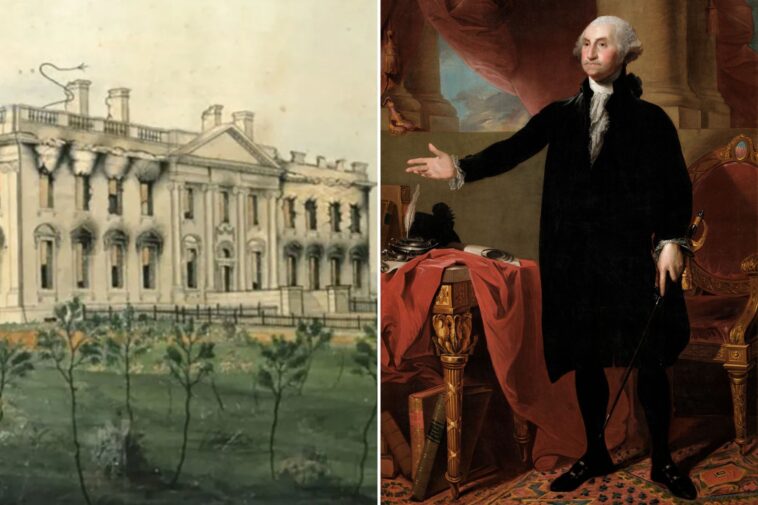
The White House started as a blank canvas for the new nation. Every president — and every first lady — has left a mark on it.
In 1791, George Washington scouted the location for the White House, just up the Potomac River from Mount Vernon, with the master planner Pierre L’Enfant. A year later, Thomas Jefferson tried to design the executive mansion but lost out to architect James Hoban in an anonymous competition. In 1800, Abigail Adams — the first first lady to occupy the half-finished home — hung John’s laundry in the East Room to dry. “There is not a single apartment finished,” she complained. “The great unfinished audience-room I make a drying-room of, to hang up the clothes in.”

In 1814, British troops had their own ideas for remodeling the new presidential seat of power. On Aug. 24 of that year, President James Madison observed the British advance from the front lines in the Battle of Bladensburg. He got word to First Lady Dolley that the enemy was about to take the capital. With just hours to spare, she carried out what she could and hauled it to safety. When the British reached the White House, they set fire to the mansion and burned its interior to the ground. Only the outer walls remained.

Through their acts of bravery, Dolley and others at the White House that day saved a few of its earliest treasures. Among them was Gilbert Stuart’s portrait of George Washington that she removed from its frame, rolled up, and carted away just before the flames arrived.
Today this painting represents the heart of the White House’s decorative collection. It is also the start of “Art For the White House,” the rich story of this “Changing Portrait of America” as told in a new book by the historian Leslie Greene Bowman.

“It’s huge,” Bowman says of the painting as she looks out over Lafayette Square, a block from the Executive Mansion. In 1800, a year after Washington’s death, Congress appropriated $800 for the purchase of Stuart’s 1797 portrait as the first work of art for the White House collection. Today it hangs at the center of the same East Room where Abigail Adams once strung her laundry.

“It’s full length. It has all the trappings of the Grand Manner,” Bowman told The Post, speaking of the painting.

“But look at how [Washington] is dressed. He’s in a black, simple robe, like a magistrate. No crown. No ermine. No scepter. No purple. No brocade… He’s not saying, ‘look at me.’ He’s gesturing. All of this American symbolism is woven into it. This is the Constitution. This is the American Revolution. He stands as a civil servant.”
Bowman speaks from the dining room of the historic Decatur House, the oldest private residence left standing in the president’s neighborhood.

“People at one time thought Stephen Decatur might be president,” Bowman remarked. “He built it as a home for fine entertaining. But he was killed in a duel before he could become president, which was tragic.”
Today Decatur’s home is the headquarters for the White House Historical Association, the organization behind Bowman’s publication and, since its founding in 1962, advisor to the presidential collection. Bowman herself served on the Committee for the Preservation of the White House for nearly 30 years under five presidents and helped the White House acquire important recent additions to its historic holdings.

The White House has always been a work in progress. Along the way, it has seen more presidential intervention and public controversy than many realize.
Following the financial panic of 1837, Martin Van Buren was accused of indulging in “worldly pomp and gorgeous splendor” after redecorating the White House with crystal chandeliers and silver satin wallpaper. In his three-day “Gold Spoon Oration,” the Whig congressman Charles Ogle of Pennsylvania denounced the president as a “Democratic peacock in full court costume,” likely costing him reelection. “Will Americans support their chief servant in a palace as splendid as the Caesars?” Ogle demanded.

“There’s a tightrope between civilian simplicity and conveying the importance of the office,” Bowman told The Post. “There’s an inherent dissonance between what a great nation we are versus the humility of being a civil servant. We don’t want to look like a palace. We don’t want a king. But we do want something to invest our chief executive with this new world order that we’ve created.”
The presidents “were also thinking about European models,” she continues. “They wanted to be accepted on the world stage. And there was the need on the world stage to have a seat of power.”
Every president has arranged his seat in his own way. President Grant put false timbers across the ceiling of the White House and redecorated its interior in the style some derided as “Mississippi riverboat.”
At the turn of the last century, Theodore Roosevelt stripped out such Victorian furnishings and removed his offices from the second floor to a new, “temporary” west wing. He needed more bedroom space for his six children, but some politicians refused to meet him outside the mansion proper.
And then there is the gilded presidency with its staggering suite of golden purchases: a gilded bronze “surtout de table” of bibulous bacchantes, gold mantel clocks depicting the Roman goddess Minerva and the Carthaginian general Hannibal, sculptures of sphinxes and obelisks. Topping it off: a 53-piece set of gilded furnishings by Bellangé of Paris, upholstered by Cartier.

Of course, this all refers to the spending spree of President James Monroe. After the fire of 1814, he became personally involved in selecting replacement furnishings. His lavish, Francophile acquisitions were so controversial that Congress passed legislation requiring future purchases to be American-made “as far as practicable.”
“He gets this French furniture and everybody goes, oh my God,” said Bowman. ”But President Jackson goes on to spend even more money on White House furniture than any previous president.”
Much like the furnishings, the art collection arrived in fits and starts. Starting in the middle of the 19th century, the White House began building up a gallery of presidential portraits of varying quality to accompany Stuart’s Washington. But such art and furnishings could leave the White House just as they came in. In 1867, in what became known as the “Old Clothes Scandal,” Mary Todd Lincoln held an auction to settle the personal debts she incurred redecorating the White House and buying her own gowns, furs, and jewelry.

A century later, aware of such ups and downs, Jacqueline Kennedy focused on the preservation of the White House as never before during her three years as first lady. She also established the safeguards for its endurance that continue today. The White House Historical Association with its scholarly publications, restoration work, and public advocacy was one of her creations. So too legislation dictating the acquisition of new art (only by deceased artists, only through a committee of experts, and only older than 25 years). She also set about restricting the dispersal of unwanted objects under future administrations (anything a president does not hang on the walls goes to the Smithsonian for safekeeping).
Kennedy’s efforts to enrich the White House holdings created a culture of philanthropy that saw the collection double under her brief watch. Art in a range of styles and subjects entered the White House to reflect the breadth of the American experience. “It is a museum-quality collection,” Bowman says of today’s White House, which hundreds of thousands of visitors see each year. “And it completely owes its origins to Jackie Kennedy.”

The White House collection has now grown to over 500 paintings and sculptures. In 2020, First Lady Melania Trump unveiled a major addition by Isamu Noguchi in the Rose Garden. In his second term, president Trump has shown particular interest in the portrait collection, hanging many works salon-style in the Oval Office.
“It hasn’t ever really been static,” said Bruce White, the still-life photographer who has documented such changes at the White House since 1998 (his images are now collected in Bowman’s book). “Every administration shifts the paintings around in the White House when they first come in.”
At the same time, White concludes, “The conversations that are going on today about the house, you could read newspapers in the 19th century and hear the same kind of debates.” When it comes to the art of the presidency, every American has a slightly different picture in mind.