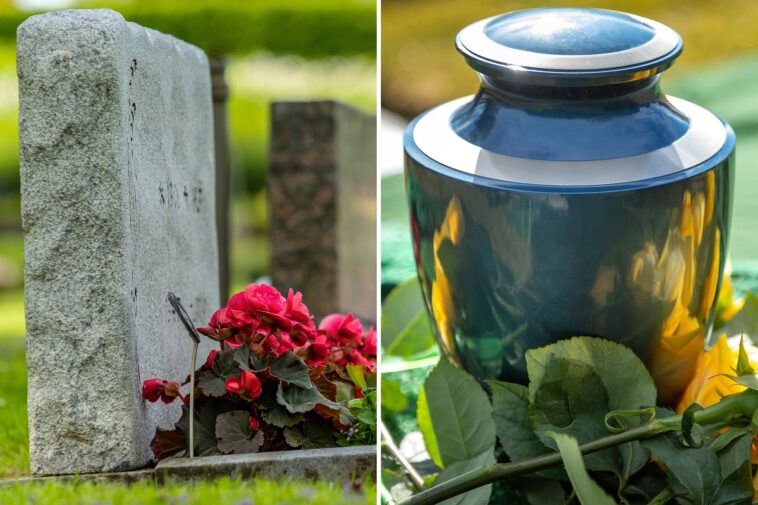
Americans increasingly have a big geographical divide — our final resting place.
While the Northeast and the Deep South have kept up with traditional burial practices, cremation is far more common out west — where family cemeteries and religious affiliation have less deep roots.
Either way, however, more Americans are choosing to be cremated.
The two practices were roughly even in 2015 — but now less than a third of deaths result in traditional burials, according to figures from the National Funeral Directors Association.
In 2025, 63% of US deaths resulted in cremation, while 32% saw a traditional burial, the NFDA reported.

That represents a major change from 48% cremation and 46% burial in 2015, which marked the first time in US history that the national cremation rate exceeded the casketed burial rate.
And that trend is set to continue, with the projected cremation rate set to be 79% by 2045, compared to 15% burials.
High land costs in dense metropolitan areas and coastal cities undoubtedly encourage cremation over casketed ground burial, but this is not the only factor, according to Worland, who has worked in the undertaker industry since joining her hometown funeral home in Indiana.
“Price is honestly only one of the factors,” she said. “Families have more options than they ever had before at any point in history.”
A full service funeral with burial can cost $12,000-$15,000 or more including cemetery plots and headstones, according to the NFDA.
A similar funeral with cremation costs about $6,300 — and cremation alone can run as little as $1,000.

Between 2015 and 2025, several large populous states in the Midwest, Mid-Atlantic, and South, including New York and Texas, crossed the 50% cremation threshold.
The Lone Star State shifted from 41.2% cremation and 50.1% burial in 2015 to 57.5% cremation and 34.8% burial in 2025, according to a comparison of the two reports.
New York went from 41% cremation and 51% burial in 2015, to 57% cremation and 38% burial in 2025.
Ohio, Georgia, Illinois, and Tennessee also saw shifts in that time.
During the same decade, previously high-cremation states on the West Coast, in the Rocky Mountains, and northern New England reached near-universal preference by the 2025 report.
Nevada went from 78% cremation in 2015 to 85% in 2025, according to the reports.
Arizona increased from 67% to 81% cremation in the past 10 years, while Florida, an exception in the Southeast, increased from 63% to 73% cremation.
The only parts of the country that remain majority traditional burial are in the Deep South and Appalachia, although cremation still increased in all of these states during the past decade.
In Mississippi, cremation grew from 19% in 2015 to 38% in 2025, while burials declined from 79% to 61% in the same period.

Alabama and Kentucky saw similar changes in the past decade.
These regional differences can be put down to “generational” shifts, as well as “proximity to family,” Allyse Worland of the NFDA told The Post.
“Sometimes you have families that are living closer together, and it just depends on what the norm, what the culture is, that’s going to take an effect as well,” Worland said.
“It can be highly generational and highly personal to the family, and what the family has traditionally gone with,” she added.
Religion also undoubtedly plays a factor in the geographical variations.
Cremation rates are higher for Americans who don’t have religious affiliation. Regions with lower church attendance, such as the Pacific Northwest, the Mountain West, and Northern New England, embraced cremation early, according to the report.
On the other hand, the Bible Belt and areas with higher Catholic concentrations, such as New York, as well as the western outlier of Utah, maintained higher burial rates.

These include alkaline hydrolysis, also known as water cremation, which involves a chemical process to dispose of the body, as well as natural organic reduction, also referred to as soil transformation or composting, which turns the human remains into soil.
Part of the debate is also that our terms of burial and cremation are too narrow, Worland explained.
“You could also be speaking about a green burial where there is no traditional casket,” she said, adding that some of these methods aren’t yet legal in every state.
“It really depends on a case-by-case basis what the family wants,” Worland said.