
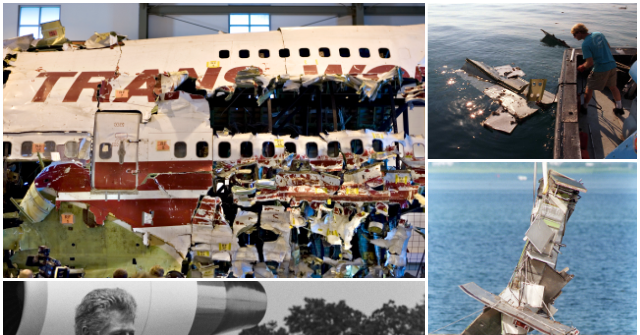
Thirty years after 230 people were killed in the explosion of TWA Flight 800, the federal government still has not come clean. The families deserved honesty. The country deserved transparency. Instead, we are left with shifting explanations, withheld evidence, and newly uncovered documents that raise serious questions about what officials knew—and when they knew it.
And the timing tells its own story. The crash came on July 17, 1996, in the middle of Bill Clinton’s reelection campaign, when the administration had every incentive to smother any suggestion that a terrorist missile had brought down a U.S. airliner off Long Island.
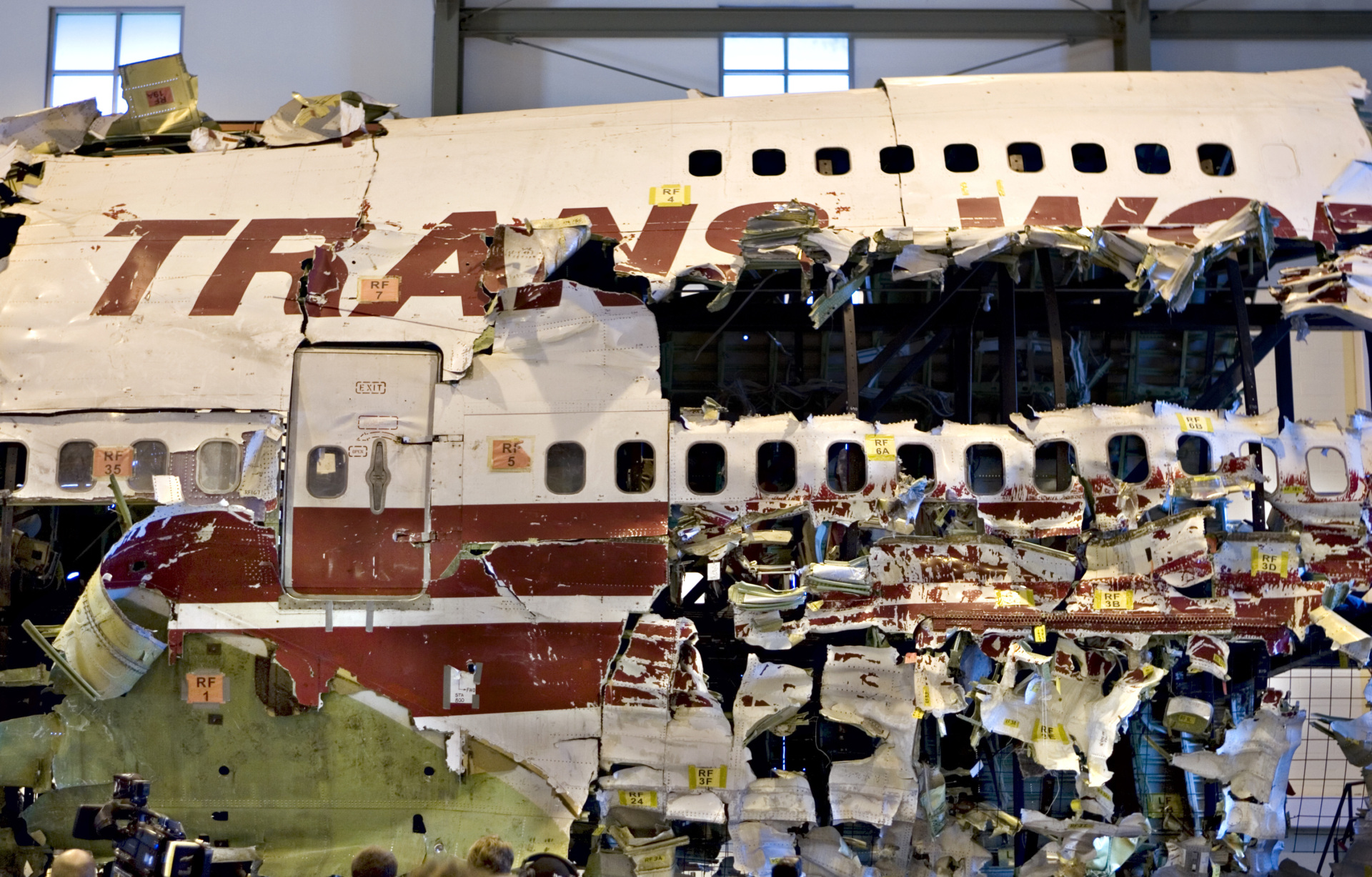
The recovered wreckage of TWA Flight 800 stands reassembled at the National Transportation Safety Board Training Academy in Chantilly, Virginia, on July 16, 2008, where it is used for training new investigators. The Boeing 747 crashed into the Atlantic after passing over Long Island Sound and Long Island, New York in 1996. (AP Photo/J. Scott Applewhite)
Through a Freedom of Information Act investigation, Judicial Watch obtained more than 400 pages of FBI records, including a striking communication sent just days after the disaster. That document states plainly that “FBI headquarters is in receipt of faxes generated from Cairo claiming credit” for the destruction of the aircraft. This was not a rumor or retrospective theory. It was an internal FBI communication, distributed with “IMMEDIATE” priority in the earliest phase of the investigation.
For decades, Americans have been told there was no credible evidence of terrorism. Yet the FBI’s own records show that claims of responsibility from overseas were received and logged in real time. The question is not whether every such claim was legitimate, but whether these leads were fully pursued—and why the public was never meaningfully informed about them.
The same records raise another uncomfortable point. Internal FBI material referenced “a wealth of evidence pointing to a missile strike.” That assessment aligns with what hundreds of eyewitnesses reported—streaks of light rising from the surface toward the aircraft moments before the explosion. In total, 755 witness accounts were gathered, including 183 describing such a streak, with many placing its origin near the horizon. These accounts were effectively sidelined, never tested through full public scrutiny.
Instead, the government settled on a theory centered on a catastrophic fuel tank explosion supposedly caused by a short circuit that was never found and never recreated. After a four‑year investigation, the National Transportation Safety Board determined that the plane crashed due to a flammable fuel‑air mixture in the center wing tank, likely ignited by a short circuit—even though the precise ignition source was never definitively identified. No Boeing 747 before or since has suffered a similar unexplained and catastrophic failure, and the fleet was never grounded for comprehensive inspection.
Equally troubling is the unusual role played by the CIA, which inserted itself into the public narrative by producing a televised animation intended to explain away eyewitness observations. The agency has no formal role in aviation accident investigations, yet it helped shape the public understanding of what occurred. Judicial Watch is still seeking full transparency on that involvement through ongoing litigation described in its lawsuit for related records.
Questions also persist about physical evidence recovered from the wreckage. Traces of explosive materials were attributed to a supposed K-9 training exercise. That explanation lacks documentation, conflicts with the aircraft’s actual movements, and fails basic scrutiny. It appears less like a definitive finding and more like a convenient way to dismiss contradictory evidence.
To bring these issues into the open, Judicial Watch released a new documentary, “Judicial Watch Investigates TWA 800 — 30 Years Later,” which presents the FBI records obtained through FOIA alongside expert analysis and eyewitness accounts. A preview of the documentary, available on YouTube, further highlights these findings. The film lays out a factual record that challenges the completeness—and credibility—of the official narrative.
Watch the documentary:
The American people understand that investigations are complex and that early leads do not always pan out. But they also expect honesty. The newly uncovered FBI document referencing claims of responsibility from Cairo was never part of the public story. Neither was the internal acknowledgment of evidence consistent with a missile strike.
After three decades, the answer is not to defend a contested narrative. The answer is transparency. Release the records. Allow independent review. Follow the evidence wherever it leads. Only then can the country begin to close a chapter that has been defined not by clarity, but by unanswered questions.
Tom Fitton is the President of Judicial Watch.