
See more of our coverage in your search results.

WASHINGTON — Iran is reviewing US-backed proposals on the fate of its nuclear program, as the top American commander in charge of combat operations oddly launched a podcast on Thursday making jokes about eating French fries and retiring to play basketball.
A US official told The Post that Qatari officials have been mediating fresh discussions with Tehran about its nuclear program. At least three meetings on “concrete proposals” have occurred in the past week, The New York Times first reported, with summits in Tehran and Doha.
Trump remained coy about his intentions, telling reporters in the Oval Office: “I would rather not destroy the rest of the country if possible, but maybe I’ll have to. You’ll know soon enough.”
It’s unclear what details the documents may contain. Reuters reported later Thursday that Iran returned a copy of one nuclear proposal to the US via Qatari mediators.
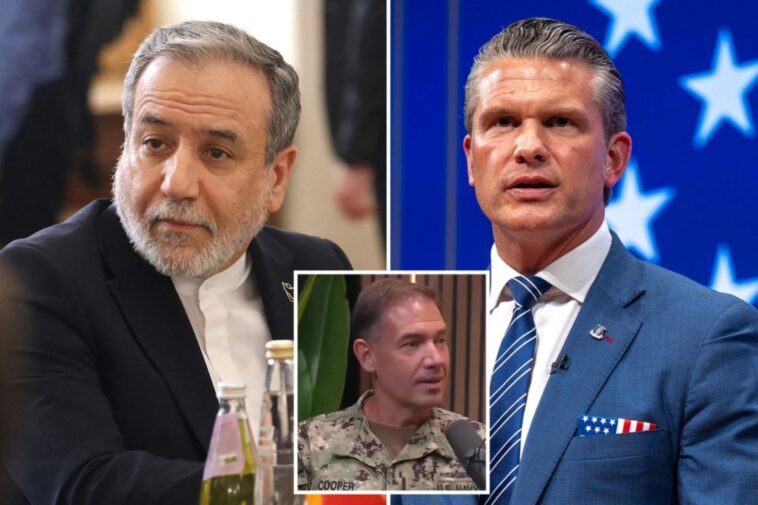
The news emerged as Adm. Brad Cooper, commander of US Central Command, launched the new podcast “Inside CENTCOM” on YouTube featuring light-hearted banter — as Cooper’s head is on the chopping block following Republican midterm election losses driven by the war.

“I never met a French fry I didn’t like, and thus the need to exercise frequently to balance that out,” Cooper confessed — as opponents and proponents of the war alike point to him as a possible fall guy for the longer-than-expected conflict, with focus also on Secretary of War Pete Hegseth.
One source close to the White House blasted Cooper as “awful” and a “total neocon.” A Pentagon source conversely pointed to his past working under first lady Michelle Obama and then-second lady Jill Biden as executive director of the “Joining Forces” military family support program.
“This explains why the war in Iran has been prosecuted like Obama would have prosecuted [it],” the second source said. “It is nuts and explains why it’s gone so badly. Obama would do these pinprick strikes and Cooper essentially did the same thing early on.”
The blame game within the administration has focused mostly on Hegseth, who advocated for launching the war and ultimately oversaw its conduct.

A different administration source told The Post that President Trump, who has been asking allies what to do about the secretary of war, has “gone negative” on Hegseth, saying he overpromised a quick victory, which the president initially told journalists would wrap up in “four weeks or so.”
Hegseth’s top spokesman, Sean Parnell, said Wednesday that he intended to remain through the end of Trump’s term, ruling out an obvious off-ramp taking an appointment to fill the Senate seat of Tennessee Gov.-elect Marsha Blackburn.
If he stays, Hegseth is likely to be impeached by the Democrat-controlled House and put on trial by the Democrat-led Senate for conducting the conflict without congressional authorization.
Hegseth, whose Biden-holdover chief of staff Ricky Buria has stoked constant in-fighting within the administration, defended himself in a video posted to X Thursday, saying: “They attack me, they attack us, because we are effective. It’s not going to work. We will not back down.”
In a further twist sinking Hegseth’s standing within the administration, two social media influencers who worked for the Pentagon earlier this year tweeted Wednesday that Hegseth should run for president in 2028 — against Vice President JD Vance.
Both influencers are no longer working for the Pentagon, a defense official said, with one leaving in July and the other in October.

The Pentagon and CENTCOM press offices did not immediately comment on the in-fighting.
A possible new peace agreement with Iran would build on a Memorandum of Understanding (MOU) signed by Trump and Vance in June. That deal collapsed over disagreements on shipping routes in the Strait of Hormuz.
Iranian parliament speaker Mohammad Ghalibaf, one of the country’s leading negotiators, claimed on X Thursday that Trump “is prepping the next war phase while America teeters on an Israel-First cliff,” despite talks being underway.
Vance has been a key figure in restarting talks with Iranian officials ahead of the 2026 midterms, even as Trump, suggested — until recently — that US war against the mullahs could escalate following Election Day.
The vice president, who blamed the war for Republican election defeats, penned a letter to Iran’s Supreme National Security Council secretary Mohsen Rezaei in late October — with Trump’s blessing — in an effort to resume talks.

“The president and I both feel pretty good about the prospects for potentially coming to a negotiated settlement,” Vance said Monday, referencing both “kinetic” and “non-kinetic” options.
The same day, Trump also batted down the prospect of renewing strikes in the aftermath of the midterm elections.
Several times the president has suggested Pickaxe Mountain, a heavily fortified facility near the Natanz nuclear facility, as a possible target. Trump has also demanded that Iran can’t achieve a nuclear weapon and must dispose of any “nuclear dust” remaining in its stockpiles.
Meanwhile, Iranian leaders like Ayatollah Mojtaba Khamenei issued jeering statements following the elections, with the in-hiding theocrat gloating: “The process of the US’s collapse has accelerated.”
US Central Command hasn’t telegraphed any immediate signs that a return to full-scale attacks on Iran are in the works.
Reps for the White House and Iran’s foreign ministry did not immediately respond to requests for comment.