
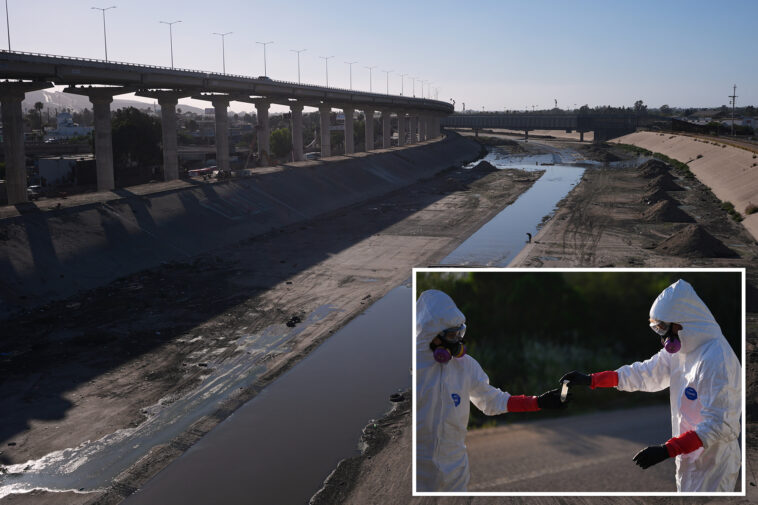

Toxic gas from sewage flowing through the Tijuana River and across the U.S.-Mexico border continues to pollute southern California despite ongoing efforts to clean things up.
Recently, hydrogen sulfide levels in the South Bay exceeded the county’s safety standards and have continued to get even worse in 2026.

Hourly readings of the pollutant at a monitoring station near an elementary school in Nestor, a San Diego neighborhood near the border, exceeded the threshold more than 10% of the time this year, according to data from the San Diego County Air Pollution Control District. That marks a sharp increase from fewer than 2% of readings in 2024.
Researchers have found that the pollution is coming from a part of the river known as the Saturn hotspot, close to Saturn Boulevard in Nestor, according to the San Diego Union-Tribune.
Sign up for the California Morning Report newsletter
California’s top news, sports and entertainment delivered to your inbox every day.
Thanks for signing up!


The findings come as Sen. Steve Padilla, a Democrat representing San Diego, pushes legislation that would require the California Air Resources Board to develop a statewide response effort for hydrogen sulfide and evaluate whether the state’s air quality standards, which date back to 1969, are still valid.
So far this year, millions of gallons of sewage-contaminated water flowing from Mexico have also polluted some of Southern California’s most popular beaches, leading to closures and raising concerns among nearby communities.
Download The California Post App, follow us on social, and subscribe to our newsletters
California Post News: Facebook, Instagram, TikTok, X, YouTube, WhatsApp, LinkedIn
California Post Sports Facebook, Instagram, TikTok, YouTube, X
California Post Opinion
California Post Newsletters: Sign up here!
California Post App: Download here!
Home delivery: Sign up here!
Page Six Hollywood: Sign up here!

Beach warning signs have become a familiar sight in Coronado, where health officials continue urging people to avoid the ocean because of ongoing sewage pollution.
The scale of the pollution is significant. As much as 30 million gallons of sewage-contaminated water can enter the Pacific Ocean from Tijuana each day, according to FOX11.