
See more of our coverage in your search results.

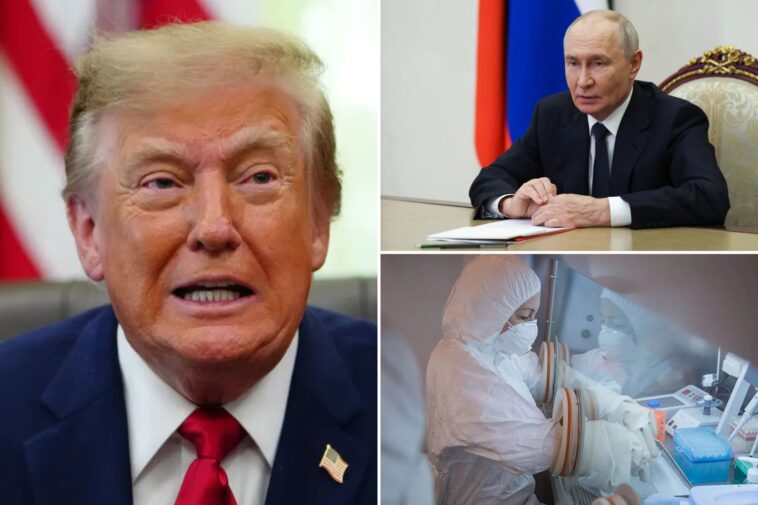
WASHINGTON — President Trump downplayed the possibility that a Russian plague scientist died from a biological weapon in Siberia — saying “we don’t think so” but that “we’re going to find out soon enough.”
Trump said he had just been briefed by US officials and that Russia hasn’t shared much information — as prominent American scientists and security experts raise alarms.
Asked if Daria Shipilova, 28, may have died from a biological weapon, Trump told journalists in the Oval Office, “Well, we don’t think so. We’re going to find out soon enough, but we don’t think so.”

“If you listen to them, it’s under control. You know, people have said that before about other things,” Trump said.
“So we hope it is. They’re very sophisticated, very smart, and they’re saying it’s very much under control.”
Trump acknowledged concerns that Russia’s secrecy is similar to China’s when COVID-19 emerged in 2019 following what the FBI and other US agencies believe was a lab leak of the novel pathogen.
“China didn’t say much, and Russia’s not saying much either. But they do say they have it very much under control,” Trump said.
The president added, “I have a call set up” with Russian President Vladimir Putin to discuss the crisis. He did not say when the call would occur, noting that “today is Vladimir Putin’s birthday” and joking, “I’m sure you’re going to celebrate.”

Trump said Russian officials are “sharing [information] a little bit with our people. We expect them to share it a lot with our people.”
Shipilova died on Friday in a hospital outside Irkutsk, prompting a flurry of speculation that her illness was related to her work at the nearby Anti-Plague Research Institute.
Some early reports said she broke a test tube at work before becoming ill and officials gave mixed messages about whether she died of pneumonic plague, which is almost always fatal unless treated early with antibiotics.


Soviet scientists in the 1980s modified the bacterium responsible for plague, Yersinia pestis, to make it resistant to antibiotics for use as a biological weapon — sparking widespread fear about the case.
“The Russian government surely knows the cause, and likely has a genomic sequence. They are unlikely to share it,” former CDC principal deputy director Nirav Shah wrote on X. “There is speculation that such reticence, coupled with their fire-alarm response, is evidence of something sinister happening (bioweapon gone bad, etc.). At this point, that’s a hypothesis but not much more.”
Harvard public environmental professor Joseph Allen wrote that the Russian government’s public-health response in the area “is disproportionate to what would happen if a lab worker was exposed to plague. That’s the tell” — after appearing on CNN to warn “it feels like they’re hiding something.”

MIT biotechnology professor Kevin Esvelt wrote: “Physical lockdown indicates it cannot be controlled with prophylactic antibiotics, implying engineered pan-resistance or that it isn’t plague at all.”
Marshall Billingslea, a former senior Pentagon and Treasury Department official whose work included overseeing military special operations, said that the region where Shipilova worked was a known locale for Soviet studies of advanced biological weapons.
Start your day with all you need to know
Morning Report delivers the latest news, videos, photos and more.
Thanks for signing up!
“In the 1990s I worked with Ken Alibek, the former No. 2 in the Soviet biological weapons program, after he defected to the US. He claimed that they had engineered a strain of plague that was antibiotic-resistant & that they had worked on plague chimeras (fusing 2 or more pathogens),” Billingsea wrote on X.
“He specifically called out Irkutsk for being involved in the [biological weapons] program. This outbreak is deeply worrisome. This may not be just ‘the plague.’ It may be far worse.”