

A seemingly ever-widening rift between Europe and Trump’s America is emerging as the war with Iran drags on, exposing not only strategic confusion but growing skepticism among America’s closest allies.
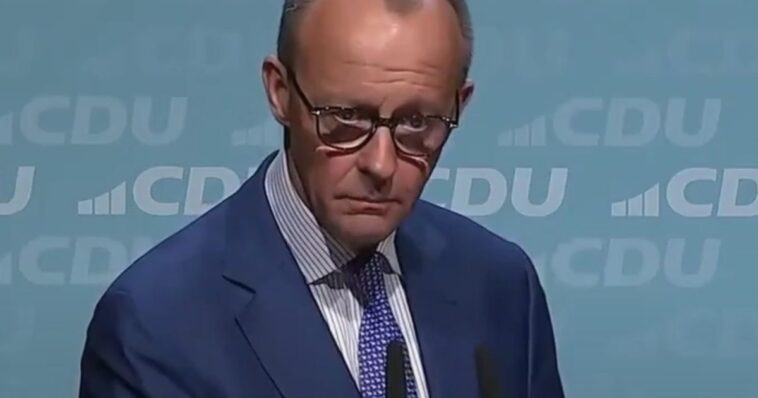
What began as a show of force has increasingly come to resemble a costly stalemate—one that critics, of whom there is no shortage, argue lacks both clarity and direction. At the center of the latest criticism leveled at the direction of Trump is German Chancellor Friedrich Merz, who has sharply questioned his administration’s handling of the conflict.
Speaking publicly to students in Germany, Merz, who leads the center-right Christian Democratic Union (CDU), warned that the United States appears to have entered the war without a viable endgame. “The Iranians are clearly stronger than expected and the Americans clearly have no truly convincing strategy,” he said.
“An entire nation [the United States] is being humiliated by the Iranian leadership, especially by these so-called Revolutionary Guards,” the German Chancellor said, adding that he “hopes that this ends as quickly as possible.”
Merz’s comments reflect a broader unease across Europe, where leaders are now grappling with the economic fallout of a conflict they did not initiate. Energy prices have surged, supply chains have tightened, and the costs are being passed directly to European taxpayers.
Additionally, such language signals a dramatic shift from earlier European support for the campaign. While some leaders initially aligned with Trump’s stated objectives, the prolonged conflict and lack of measurable progress have eroded that backing.
It’s worth noting that Merz was one of the liberal-globalist EU leaders that initially baked Trump’s moves in the Middle East. The disruption of the Strait of Hormuz has proven particularly damaging. As one of the world’s most critical energy chokepoints, its partial closure has driven oil prices above $100 per barrel, intensifying inflation across already fragile European economies.
Merz did not mince words about the consequences. The war, he said, is “costing us a great deal of money,” underscoring the growing frustration among European leaders who feel sidelined in decisions with global repercussions.
At the same time, diplomatic efforts to resolve the conflict appear increasingly chaotic. Planned negotiations between American and Iranian officials have repeatedly stalled, including a high-profile meeting in Islamabad that was abruptly abandoned.
Merz pointed to these failed talks as evidence that America is being outmaneuvered. “The Iranians are obviously very skillful at not negotiating,” he remarked, suggesting that Tehran has effectively dictated the tempo of diplomacy.
Iran, for its part, has adapted its strategy to maximize leverage. By restricting access through the Strait of Hormuz, it has disrupted global energy flows while offering selective concessions tied to reopening the route. One such proposal reportedly prioritized restoring shipping access before addressing broader issues like nuclear policy. This sequencing has raised concerns among diplomats, who question whether it would meaningfully advance long-term security goals.
Meanwhile, Tehran faces mounting internal pressure as economic conditions deteriorate. Inflation is soaring, output is shrinking, and the strain of sanctions and blockades continues to intensify Analysts caution against assuming that economic hardship will force Iran into submission. As one expert noted, the regime has historically demonstrated a willingness to absorb significant pain while shifting the burden onto its population.
This dynamic, without a doubt, complicates America’s approach, which has relied heavily on economic pressure. Critics argue that the strategy underestimates Iran’s resilience while overestimating the effectiveness of sanctions alone.
The broader geopolitical picture is equally complex. Iran has deepened ties with Russia, seeking alternative trade routes and potential support to offset the impact of Western pressure.
Meetings between Iranian and Russian officials have focused on expanding cooperation, particularly through routes that bypass traditional maritime channels. However, these alternatives remain limited in their ability to replace Hormuz.
Despite these constraints, the alignment signals a shift toward a more fragmented global order. Traditional alliances are being tested, while new partnerships emerge in response to shifting power dynamics. Back in Europe, the conflict has reignited debates about sovereignty and strategic autonomy. Many leaders are questioning whether their interests are being adequately represented in decisions driven by President Trump.
Germany, along with other European nations, has resisted calls to involve NATO directly in the conflict. Officials have emphasized that this is “not NATO’s war,” drawing a clear line between alliance commitments and U.S.-led operations. At the same time, Europe is exploring more limited roles, such as securing maritime routes once hostilities subside. Proposals include deploying minesweepers and supporting navigation safety in the Gulf.
However, these efforts remain contingent on a ceasefire that has yet to materialize. Until then, the economic and political costs of the war continue to mount.
The situation also raises deeper questions about the long-term viability of interventionist strategies. Memories of prolonged conflicts in Iraq and Afghanistan loom large, fueling concerns about another drawn-out engagement with uncertain outcomes.
Merz explicitly invoked this risk, warning that the current trajectory could lead to a similar quagmire. For many military analysts, the war has become a case study in the limits of military power when not paired with any kind of coherent strategy. Tactical successes have not translated into strategic clarity, leaving both allies and adversaries uncertain about the path forward.
In America, officials maintain that the United States retains leverage and will not compromise on core objectives. Yet the gap between rhetoric and reality appears to be widening as negotiations falter. The economic implications are also becoming increasingly difficult to ignore. Rising energy costs are feeding into global inflation, affecting everything from transportation to manufacturing.
In Europe, where economies are already under strain, the impact is particularly acute. Businesses face higher operating costs, while households contend with rising prices and declining purchasing power. Ultimately, the conflict has exposed deep fault lines not only between nations but within the Western alliance itself. What was once presented as a unified front now appears fragmented and uncertain.
Ad block users: Some site features may not work correctly while an ad blocker is enabled, because they break scripts and content this website depends on. If you can’t see comments below, for example, please disable your ad blocker.