
See more of our coverage in your search results.

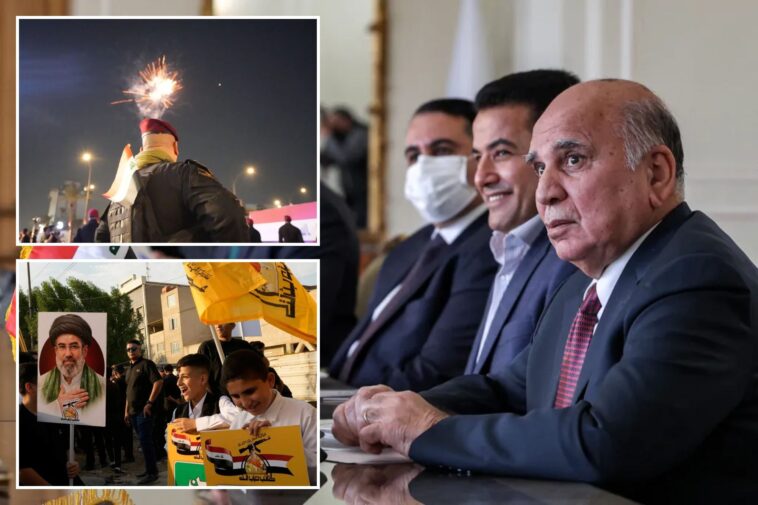
WASHINGTON — Iraq’s foreign minister called his country “a victim” of the US-Iran war Thursday and said Baghdad is reluctant to agree to American requests to sanction Iranian airlines — making the remarks one day after President Trump announced the withdrawal of US troops from Iraq.
“We became a victim of this war — we, Iraq,” foreign minister Fuad Hussein told a small group of reporters at the Iraqi embassy. “Our economy became a victim, but our people also. We have been attacked many times by various countries in the conflict.”
Hussein, visiting Washington to meet with Treasury and State Department leaders, told journalists that “we don’t want to be part of this conflict,” but are willing to help mediate if asked.

Treasury Secretary Scott Bessent is leading “Operation Economic Outcast” to sever Tehran’s business ties with other countries to increase US leverage, but the senior diplomat expressed resistance to cutting off airlines that are a major source of revenue.
“Most of the visitors from Iran to Iraq are coming to the holy places,” Hussein said, ball-parking the annual number of Shiite religious pilgrims to Iraq around 5 million and the number of Iraqi religious pilgrims to Iran around 3 million.
“This is one of the most sensitive issues for us because it has to do with the religious [sites],” he said. “This will create huge problems because at the end it has to do with religious subjects.”
Hussein, a longtime Iraqi politician who is both Kurdish and Shiite, said his country is attempting to maintain good relations with both the US and Iran, but holds each responsible for involving his nation in the more than seven-month war.

“Iraq has been attacked by the countries in conflict — that means for a while the Americans attacked Iraq, but the Iranians also attacked Iraq,” he said.
“We are not part of this war… We are emphasizing on the solution through negotiations and talks but we are not intervening in American politics; this is their own policy.”
“There are common grounds and there are some areas where we have got different opinions,” he added.
“We are trying to enlarge the common ground. That is our mission. We want to have both sides discussing, meeting, negotiating.”

Trump on Wednesday celebrated the departure of US forces from Iraq after more than two decades while touting the new leadership in Baghdad.
“This day is a victory for the United States. It’s a victory for Iraq and a decisive victory over ISIS,” Trump said, praising new prime minister Ali al-Zaidi as a “fantastic guy, a friend of mine and somebody I supported from the very beginning and I fully endorsed.”
Hussein, who has held his post since 2020, described the ISIS threat as continuing, saying that “there are hundreds of ISIS terrorists” in Syria “if not thousands.”
“If they would be capable to cross the border, that would be once again a threat to our security,” he said.
US troops were stationed in Iraq from 2003 to 2011 following the ouster of Saddam Hussein and again since 2014 to battle the Islamic State group.

The Iraqi foreign minister provided more upbeat assessments of his government’s efforts to disarm Iran-backed militia groups and said that oil exports are nearing pre-war levels despite ongoing tensions.
He said that between 2.5 million and 2.6 million barrels per day of Iraqi oil are transiting the Strait of Hormuz “with the American help — and we are thankful to them.”
Another 200,000 barrels per day are flowing through a pipeline to Turkey that resumed operations in March after the war began — with plans to read 700,000 per day.
He said that Iraq is in talks with both Syria and Jordan about new pipeline projects that would bypass the waterway impeded by the war.
Last year, Iraq exported roughly 3.45 million barrels per day of crude oil.
Hussein also revealed that he had just spoken with the Iraqi prime minister and learned that a fifth Iran-backed militia group had agreed to disarm by next summer, leaving two holdouts.