
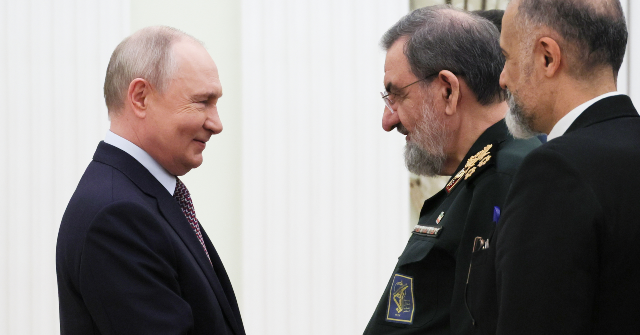
Russian strongman Vladimir Putin welcomed the head of Iran’s Supreme National Security Council, Mohsen Rezaei, to the Kremlin on Thursday, receiving a message allegedly from missing “supreme leader” Mojtaba Khamenei.
Both Iranian state media and the Kremlin news service confirmed the meeting and delivery of the message, but neither offered any details about the secret message. The Kremlin shared the general topics discussed between Rezaei and Putin, but did not offer any specifics or any indication that the Russian leader was offering Iran material support outside of its usual friendly diplomatic and economic relations with Tehran.
A report following the meeting did claim that the Russians had agreed to help resupply Iran with missile launchers, which the country is reportedly in need of after the United States reportedly carried out airstrikes against missile infrastructure on Iran’s Qeshm island this week. Those reports claimed that the missile launchers had already been promised in a years-old bilateral agreement and simply recently delivered rather than constituting an entirely new agreement to send military equipment to Iran.
The state-run Islamic Republic News Agency (IRNA) reported that Rezaei had held a phone conversation with Putin before arriving in Moscow this week in which he “emphasized the importance of continued strategic cooperation between Iran and Russia.” He later allegedly delivered a letter by “Mojtaba Khamenei” to Putin. Khamenei is the son of Ali Khamenei, the former longtime dictator of Iran who was eliminated in an American airstrike in the beginning of Operation Epic Fury in February. The younger Khamenei was swiftly declared the new “supreme leader” but has not been seen in public since, nor has he issued any video or audio messages or been seen in recent photos, leading observers to question whether he is truly in command of the country.
The Kremlin readout of the meeting between Putin and Rezaei closely resembled the IRNA coverage of the event, adding some information about the topics of conversation.
“The discussion focused on the current state of bilateral relations and their development outlook in accordance with the Treaty on Comprehensive Strategic Partnership between Russia and Iran,” the Kremlin shared, “as well as issues on the international and regional agenda, specifically the situation in the Gulf region and the Middle East as a whole.”
Following the meeting in Moscow, on Friday Iranian leaders denied that they would accept any written peace agreement with the United States, demanding “practical steps by Washington.”
“The Islamic Republic of Iran has the right not to be content with paper commitments from the Americans,” Ali Bagheri, a deputy secretary of the National Security Council, was quoted as saying.
Reports about these comments surfaced after a claim that Iran had, in fact, drafted an attempt at an agreement with the United States and sent it to Qatar. Sources speaking to the news agency Reuters claimed that the proposed deal would demand that America end hostilities in exchange for accepting seven demands pertaining to Iran’s illicit nuclear program. This report also echoed comments Rezaei made after his meetings in Moscow.
“On the issue of diplomacy, we have announced seven conditions to the Americans. As long as they do not execute our seven conditions, we will neither open the Strait of Hormuz nor have negotiations,” Rezaei was quoted as saying.
Previous rounds of negotiations with the Iranians have failed in large part, according to American sources, due to Iranian intransigence. President Donald Trump has repeatedly said that he would not accept ongoing Iranian nuclear activities such as uranium enrichment at levels beyond what is necessary for any known civilian energy program. Trump did promise this week that a complete negotiation with Iran would be on the way soon and claimed the leaders of the Islamist regime wanted an agreement “as soon as possible.”
“Iran wants a settlement, as soon as possible. It could happen!” the president wrote in a social media message on Monday.
Russia has maintained routine communications with Iran but has abstained from taking on a major role in the conflict currently disrupting commercial shipping in the Strait of Hormuz, where Iran’s terrorist Islamic Revolutionary Guard Corps (IRGC) have routinely attacked oil tankers and other vessels. In October, Russia’s top diplomat, Foreign Minister Sergey Lavrov, visited Tehran, reportedly to discuss “de-escalation” in the Middle East. He reportedly met not with Khamenei but with the visible leaders of the regime, President Masoud Pezeshkian and Foreign Minister Abbas Araghchi, encouraging “dialogue” to solve the crisis.