
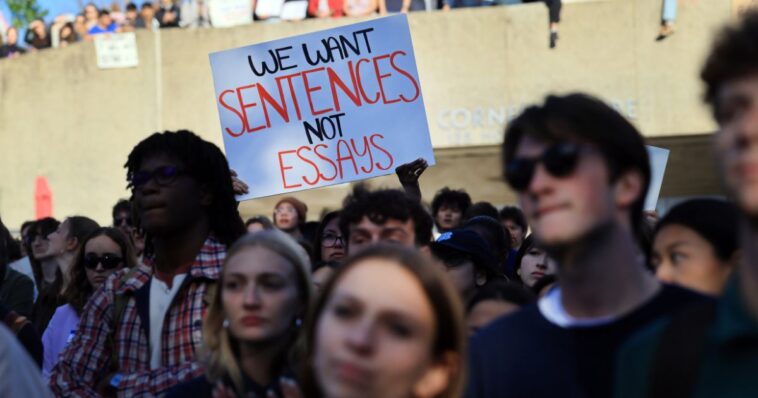

Hundreds of Cornell students participate in a rally against the university’s actions after a student was sexually assaulted at a campus fraternity in 2024, on Oct. 5, 2026, in Ithaca, New York. (Spencer Platt / Getty Images)

By Samuel Proctor October 16, 2026 at 3:26pm
On Wednesday, a Cornell ‘black feminist’ professor was pressed by a reporter on the Jane Doe lawsuit. When her ignorance was revealed, she didn’t try to explain; she tried to escape.
Victoria Xaka, who identifies as a “black feminist sound theorist and abolitionist educator,” addressed the press following a meeting about a new faculty resolution.
You couldn’t even parody this https://t.co/R7GU3WEdp9
— Michael Tracey (@mtracey) October 16, 2026
According to The New York Times, the resolution calls for a vote of no confidence in the university president, Michael Kotlikoff, who is now facing significant pushback over his handling of the Jane Doe case.
Critics are slamming Kotlikoff for not reading the Jane Doe police report and being unaware of the outcome of the criminal case.
The irony? Title IX guidelines specifically caution senior administration members against reviewing this kind of evidence.
Doing so risks evidentiary contamination, stripping the president of the legal neutrality he requires to act as an appellate officer down the line.
Despite this legal reality, the motion’s main sponsor, Professor Paul Ortiz, claimed the Cornell administration had “created a climate or culture of fear that prevents many victims of sexual assault from coming forward.”
In response to these accusations, Kotlikoff has cited his legal duty to remain neutral and has banned all frat parties and social events, as reported by The Cornell Daily Sun.
While speaking with reporters, Xaka called this latest effort “disingenuous.” But it’s not just Ortiz and Xaka pushing back.
“It’s a largely unanimous faculty,” Xaka said.
She was then asked if there was anything else she wanted to share about why the vote was happening. She responded: “I mean… not really. I think the evidence speaks for itself.”
When reporter Michael Tracey pushed her on the evidence, however, everything began to fall apart.
“I don’t know how any of that is relevant,” Xaka said, concerning Jane Doe’s initial text indicating the sexual acts were consensual.
“It’s relevant to whether you believe that the gang rape occurred, right?” Tracey asked.
He was met with a simple negative: “Not for me.”
Xaka went on to say she didn’t get her “information from lawyers,” which Tracey immediately pointed out was incorrect, since the recent civil complaint was “drafted and filed by a lawyer.”
Do you believe that Cornell’s decision-making process is influenced by political ideology?
Xaka rejected that idea, claiming she got the information from the “really remarkable young woman student journalists” at Cornell.
As Tracey tried to explain that the journalists’ information came from a civil complaint, Xaka excused herself from the conversation.
Is this how an Ivy League professor is supposed to act?
One can’t help but question the rigor of the Cornell hiring process.
Beyond concerns about faculty standards, Xaka’s response reveals the fragile nature of academic ideological posturing — quick to issue sweeping moral declarations, yet wholly unprepared to defend them when forced into direct confrontation.
It’s high time we stopped confusing academic titles with intellectual substance and start holding professors accountable for setting a poor example for their students.
Advertise with The Western Journal and reach millions of highly engaged readers, while supporting our work. Advertise Today.
Samuel Proctor is a first year student at Iowa State University, studying political science and writing for the Iowa State Daily. His specialization in political theory and philosophy led him to join The Western Journal in 2026. When not writing, Samuel can be found playing guitar and praising Jesus.