
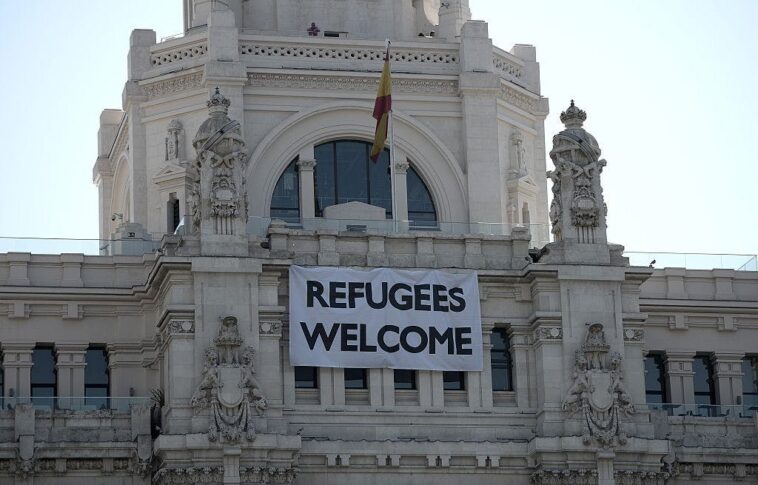
When an interviewer asked an elderly couple vacationing in Spain if they’d open their doors to an illegal immigrant, the husband didn’t hesitate. “Why not?” he declared, beaming with virtue.
But the moment the interviewer called his bluff and brought out a Nigerian musician earning pennies on the street, the warm welcome instantly turned into a cold shoulder. The husband suddenly stammered about having no room on vacation, while his wife flatly cut in with a firm “No, no, no.”
That viral confrontation captures a dynamic researchers call the “abstract versus proximate” gap. It’s the ultimate “Not In My Backyard” syndrome: people love playing the humanitarian on paper, but panic when reality suddenly lands on their doorstep.
The translated exchange went like this:
Interviewer: We’re asking people if they would take in an illegal immigrant.
Husband: Well, that would be a good system, sure, why not?
Interviewer: Could you see yourself, for example, taking in…?
Husband: Why not?
Interviewer: But, since the system can no longer absorb that level of immigration…
Husband: Well, I wouldn’t mind.
Interviewer: You wouldn’t mind?
Husband: I wouldn’t mind.
Interviewer: Look, I’m going to introduce you to a friend, okay? Sony. … Where are you from?
Sony: Nigeria.
Interviewer: From Nigeria. Okay, look, Sony here from Nigeria has been here for a very short time and is playing the guitar. … He earns in five minutes, five cents, ten cents — and with that, you can’t live. How much can you make a day with the guitar?
Sony: Well, from 20… It depends on the people; since it’s Christmas. You can make 30, 25 … enough to eat and live — that’s it; that’s what you have to do.
Interviewer: The problem is that Sony doesn’t have housing, so we’re asking people if they could take him into their home right now for a month.
Husband: In Andalusia?
Wife: With 30 euros, he’d have plenty to cover a place to sleep.
Interviewer: Since you so kindly said you’d be capable taking him in, you can do it, no?
Husband: Of course.
Interviewer: Would you take him now?
Husband: Where would I put him? We’re here on vacation.
Interviewer: It doesn’t have to be here. The important thing is that he has a roof over his head.
Wife: No, no, no,
Husband: I can’t.
Funniest thing I’ve watched this week.
Boomers in Spain get asked if they’d accept a migrant into their home. They say yes. Chad offers them one. And instantly, they change their mind. pic.twitter.com/2ruX39i0Mh
— Casey Krol (@CaseyKrol) August 26, 2026
A landmark Science Advances study found this exact pattern, demonstrating that citizens overwhelmingly back refugee resettlement in principle, right up until the placement hits their own zip code. It stated:
Our findings highlight a collective action problem: Participants are consistently less supportive of resettlement within their own communities than resettlement elsewhere in the country. This pattern holds across all measured demographic, political, and geographic subsamples within our data.
In Spain, that tension has already boiled over into real-world chaos, from the anti-migrant riots in Torre-Pacheco to furious protests outside reception centers in Alcalá de Henares.
Whether it’s taking an illegal immigrant into your spare room or sending millions to a terror-tainted agency, virtue signaling always crumbles when faced with the hard truth.