
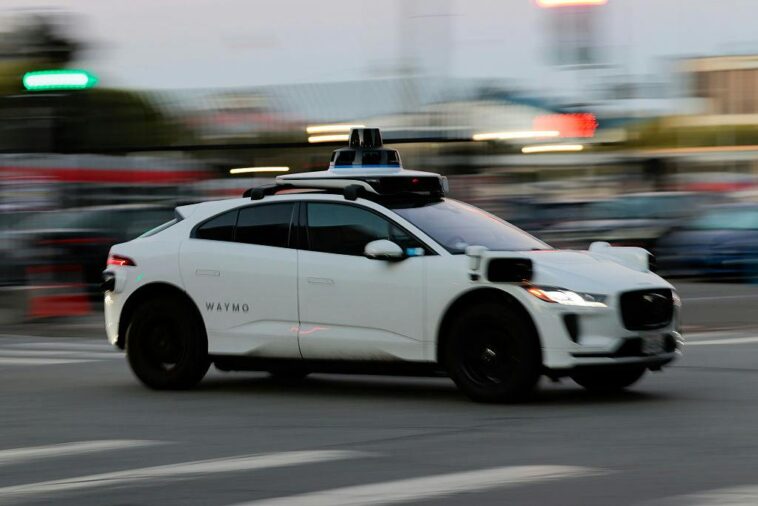
Waymo has temporarily banned its self-driving cars from all freeways nationwide after California officials ordered the company to take action following reports of its robotaxis driving into construction zones.
Last week, the California Department of Motor Vehicles ordered Waymo to prohibit its vehicles from driving on freeways throughout the state, calling it “an imminent hazard to public safety,” The New York Times reported. According to the outlet, the DMV directive pointed to an incident on Highway 101 where three robotaxis entered a closed construction zone and another incident involving the California Highway Patrol.
Waymo responded by barring its self-driving cars from using freeways everywhere, the company said Tuesday.
Chris Pappas, a Waymo spokesman, said the company immediately complied with the California order and expanded the pause to the other cities that use the service, including Phoenix, Miami, and Austin. He said Waymo would use the time to evaluate its vehicles’ performance. In his statement, Pappas noted the construction zone incidents “did not involve any injuries or collisions.”
A widely circulated video from a November 6 incident shows California Highway Patrol officers trying to slow traffic on Interstate 280 in San Francisco while a Waymo vehicle attempted to pass them.
Matthew Wansley, a law professor at Yeshiva University’s Cardozo School of Law, told the Times that self-driving cars on highways are “actually a simpler driving environment than local roads” because there are fewer factors to consider, like pedestrians or cyclists.
However, he said unusual circumstances, such as construction zones or police activity, can be harder to handle on freeways where high speeds make a situation more dangerous.
“When you are doing it at highway speeds, the margin for error is a lot lower,” he said. “It’s very hard to kill someone at 25 miles per hour. It’s very easy to kill someone at 65 miles per hour.”
Philip Koopman, a professor emeritus at Carnegie Mellon University and an expert on self-driving cars, said that he thinks the temporary ban was the right choice, though it hurts one key industry for Waymo’s business.
“Pulling them back from freeways is more of a firm hand than we’ve seen before, which is a good thing because these are concerning incidents,” he said.
“Highways are an issue because they really need to get to airports, and if you can’t go on highways, that’s a real problem for the airport business,” Koopman said. “That’s a huge fraction of the value they can unlock.”
The California DMV said the restriction will end once Waymo proves to the department that it has corrected the issues, according to a spokesman.
This is the second time Waymo has banned its robotaxis from using freeways this year. The first occurrence came in May after a string of construction zone incidents in Arizona and California.