In a time of national dislocation, America needs what President Ronald Reagan once delivered in his own day: renewed military power joined to a free-market economy and the first principles that make our country exceptional.
In the late 1970s, our country struggled with a multitude of problems: increasing public debt; high interest rates; a general gloom from a highly unpopular war and widespread, sometimes violent sociopolitical division; intrusive government overreach; and external dangers that pressed upon America’s interests on a global scale.
President Jimmy Carter failed to rise to the moment, and Reagan won the 1980 presidential election in a landslide. He ran on a steadfast belief in American exceptionalism: that our system was better than any other, that constitutionally rooted conservatism should be the foundation for government policies, and that the U.S. had to stand its ground to protect our country and way of life against the Soviet Union and its ilk. The same holds true today.
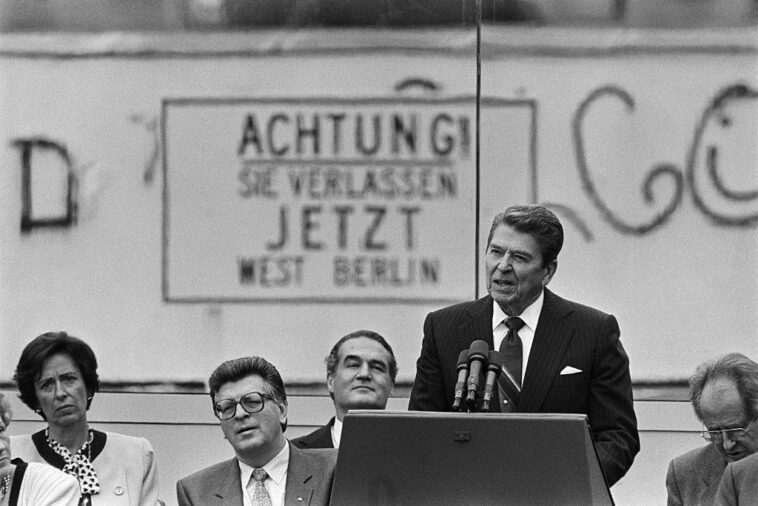
November 9, 2026, was the 37th anniversary of the fall of the Berlin Wall and the crumbling of a brutally oppressive regime in East Germany, which heralded the collapse of the Soviet Union just two years later. Reagan’s rebuilding of our military, the largest peacetime commitment to defense in our history, was only part of the answer to the existential threat posed by the USSR. He combined renewed military power with an unshakeable belief in a free-market economy unmolested by government control and in the first principles that have made America exceptional for two and a half centuries.
The Institute for National Security at Advancing American Freedom will advance America’s interests through those same principles.
Military power alone means little without a robust economy to sustain it and a legal architecture that advances the moral principles that have made America what it is. Whether facing Iran, hell-bent on a nuclear capability with which to threaten the Middle East and much of the Western world, or Communist China, which seeks to be the dominant force worldwide, the United States must harness the totality of its strengths: its free-enterprise economy, its allies and partners, and its culture of individual sovereignty under a government that serves our citizens rather than dictates how they live.
Iran threatens not just the energy on which much of the world depends (though happily, not the U.S.) but also the existence of Israel, which offers the Middle East the freedom and opportunity America has shown the world. Russia, in its brutal assault on Ukraine, has resurrected the specter of hegemonic totalitarianism in Europe, America’s partner for a
century. Just as Putin did not stop his aggression with Georgia or Eastern Ukraine, there is no reason to think he will stop now. A broader European war would have massive consequences for America’s economy and call into serious question whether America remains a trustworthy ally.
Ukraine must win this war and, with the military help of the U.S. and more comprehensive support from our NATO partners, decisively show Putin that he cannot impose his will on a free people.
Meanwhile, China seeks to displace the U.S. as the leading global power through its machinations country by country, region by region, and in international rule-making bodies; through its relentless theft of intellectual property; and through its manipulation of individuals in key technology sectors (here Nvidia’s Jensen Huang serves as the latest high-profile example), and of organizations that shape trade, economic policy, and diplomacy.
If China succeeds, it will threaten Lincoln’s America: “the last best hope of earth.” Earlier in the same message to Congress, on December 1, 1862, Lincoln wrote: “The dogmas of the quiet past, are inadequate to the stormy present. … As our case is new, so we must think anew, and act anew.”
The United States either has the ability and will to secure its place in world affairs, or it does not. Asserting that it does, without addressing the many factors that make it so, compounds the risk to every American’s future. Washington’s defense and foreign policy community typically falls short by neglecting how the pillars of American power reinforce one another. Our work at AAF, through the Institute for National Security, will fill that gap.
***
Dakota Wood is Vice President of the Institute for National Security at Advancing American Freedom. A retired Marine Corps officer, he was for many years the editor of The Heritage Foundation’s Index of U.S. Military Strength.