This article is part of Upstream, The Daily Wire’s new home for culture and lifestyle. Real human insight and human stories — from our featured writers to you.
***
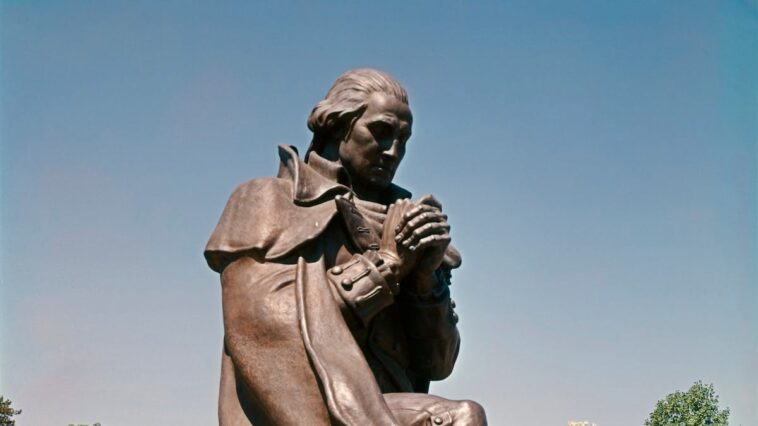
You’ve seen George Washington bravely crossing the Delaware, posing for a portrait as he stretches out his arm to welcome the future, and staring solemnly on the $1 bill. But one common — and contested — motif finds him doing something totally different: kneeling on the ground in prayer.
Arnold Friberg painted one such image, “The Prayer at Valley Forge,” for America’s bicentennial celebration in 1976. Now at America’s 250th, it’s making critics furious.
“A scene inspired by the winter at Valley Forge has become more prominent in the Trump era, along with claims that the United States was founded as a Christian nation,” warned the New York Times last month.
Thanks to President Donald Trump, a culture writer for the paper suggests, “the image of Washington at prayer, some scholars say, has gone from being a patriotic commonplace to a politically charged statement.”
“Conservative Christians love this painting of George Washington,” NPR sneered less than two weeks later. “The event it depicts may not have happened.”
There is no shortage of iconic paintings that depict historical moments merely imagined by the artist, though the idea that Washington might visibly pray for his army at a low point in the revolution is not so ridiculous.
Historian Thomas A. Tweed is doubtful, though he concedes that this particular mythos does match the man Washington was.
“Parson Weems, Washington’s early biographer, concocted that story — as well as the yarn about George and the cherry tree — to establish the moral character and personal piety of the first president and, thereby, advance a particular view of national belonging and church-state relations,” Tweed wrote. “There is some truth in the claim, and in the images. Washington did pray, though perhaps not the way Weems described, and he did attend church services, though not on Communion Sunday. Washington was not a conventional Christian, but he also wasn’t a church-hating atheist.”
Notably, NPR’s report repeated the first half of that quote, but not the second.
“It is the duty of all nations to acknowledge the Providence of Almighty God, to obey His will, to be grateful for His benefits, and humbly to implore His protection and favor.” —George Washington, 1789 pic.twitter.com/i4i9HLJvfk
— U.S. Department of Labor (@USDOL) December 27, 2025
Casting doubt on the validity of the image of Washington in prayer has become something of an elite pastime. In this context, a new play at the Museum of the Bible becomes even more powerful.
Running through Friday, the one-man play “A General’s Prayer” finds George Washington alone at camp in Valley Forge, poring over a package of letters and keepsakes from his wife, Martha, and debating how to implore Congress for more funds for his sick and half-clothed troops. Played by James Denton of “Desperate Housewives” fame, Washington is verbally processing his legacy in this war, his responsibility to his troops, and his relationship to the divine — all while speaking directly to the audience, whom he calls “my anonymous confessors.”
The 70-minute play is punctuated by Washington’s self-deprecating humor; “I do wonder if history might mostly paint me as a man who stands upright in boats,” he muses. This Washington is not the legend of history books. He’s vulnerable, approachable, a man who stands amid a snowy encampment mourning his comrades and recalling his near-death experience in battle as he asks, “For what had I been saved?”
The name of the play may set off Christian nationalism alarm bells for those who always hope to hear them, but the play’s primary focus is not so much the general’s faith as it is his struggle to wrangle his passions, guide his troops, and be seen as a man who, though he didn’t feel so himself, was stoic in the face of tragedy.
Near the end of the play, Washington pauses stage right for a silent prayer, posing as he appears in the much-maligned paintings. When he returns, he says a prayer for the nation and appeals to the audience to remember and protect our founding ideals.
In a discussion at the end of opening night, playwright Dean Batali told the audience that the owners of Friberg’s painting, First Freedom Art Company, commissioned him to create a play about it.
“I just didn’t want to do, necessarily, a flag-waving, simple play,” he said. “And I certainly didn’t want to do a whole play about a guy just praying. So I tried to make it about the struggle that maybe is relatable to all of us, and what it takes to bring us to our knees.”
His goal, he added, was “also to talk about the country in a way that wasn’t just making us proud of ourselves just for the sake of being proud,” but suggesting that “maybe we have something to live up to.”
This used to be the kind of thing we could all support. The image of George Washington kneeling in prayer at Valley Forge may not be literally accurate, but the legend is true in spirit, an interpretation legacy media outlets would also like to debunk if they could. The idea that our Founding Fathers looked to a higher power for guidance, and that we would serve our country well by doing the same today, may not seem like a radical one. But to today’s critics, “A General’s Prayer” may be more transgressive than anything running on Broadway.