
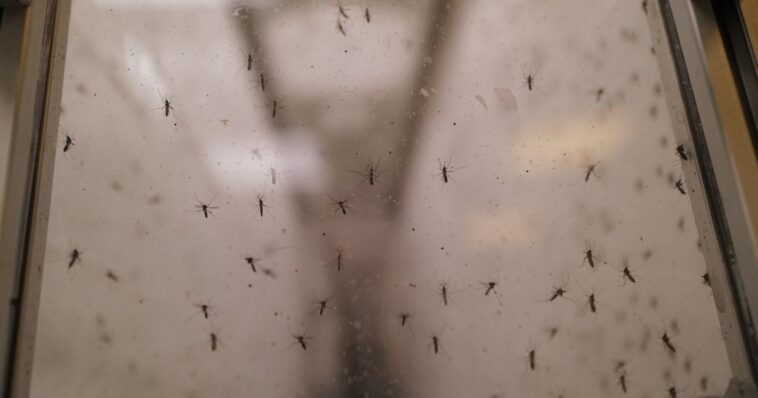

A photograph shows mosquitoes at the Terratis company facilities in Montellier, France, on June 5, 2026. (Sylvain Thomas – AFP / Getty Images)

By Michael Austin June 13, 2026 at 6:30am
Google is requesting permission from the U.S. government to release a total of 32 million mosquitos into California and Florida, in the hopes of eventually decreasing the bug’s population.
The technology firm’s Debug program essentially relies on sterilized mosquitos to crowd out breeding from fertile insects, causing a decline in mosquito counts.
The U.S. Environmental Protection Agency is reviewing a proposal to release 16 million mosquitos in each of two consecutive years, per a report from The Guardian.
“Bad mosquitoes spread disease. Good mosquitoes can stop them,” Google’s website contended.
“Debug is a group of scientists and engineers developing technology to raise and release sterile mosquitoes to eliminate the ones that carry disease.”
Google noted that mosquitos are actually the most lethal animal on the planet, killing more people “than every other animal combined.”
“Most of these diseases don’t have effective vaccines or treatments. Attacking mosquitoes with pesticides is unsustainable because they’re becoming less effective over time and can be toxic,” Google said.
“Clearing standing water is not enough because people can never find all the places that mosquitoes breed. We need a new approach.”
The bugs getting released into the wild have a bacteria called wolbachia, which is naturally occurring and renders males unable to breed.
The mosquito population gets smaller as the infected males try mating with females and her eggs fail to hatch.
“Male mosquitoes can’t bite or spread disease, so good bugs will stop bad ones from reproducing,” Google explained.
“Over time, there will be fewer and fewer bad mosquitoes.”
Other projects have used sterile insects to similar ends.
The Guardian reported that using wolbachia to stop male mosquitos from breeding has been used for about 15 years.
Google is especially targeting the Aedes aegypti species.
It carries diseases like Zika, yellow fever, and chikungunya, which render “hundreds of millions of people sick every year,” the company said.
There are neither chemicals nor toxins involved, while the experiment does not require genetic modification.
“Debug is off to a good start, but there is still plenty to do. We look forward to working with communities to show that by releasing enough good bugs Debug can have a real impact on mosquito populations and disease,” Google said.
“Eventually, we hope to help millions of people live longer, healthier lives.”
Advertise with The Western Journal and reach millions of highly engaged readers, while supporting our work. Advertise Today.
Michael wrote for several entertainment news outlets before joining The Western Journal in 2020. He now serves as Managing Editor, which involves managing the editorial team and operations, guiding the publication’s editorial direction, and writing, editing, curating and assigning stories as needed.
Birthplace
Ames, Iowa
Nationality
American
Education
Iowa State University
Topics of Expertise
Cultural Politics, Pop Culture, Christian-Conservatism