
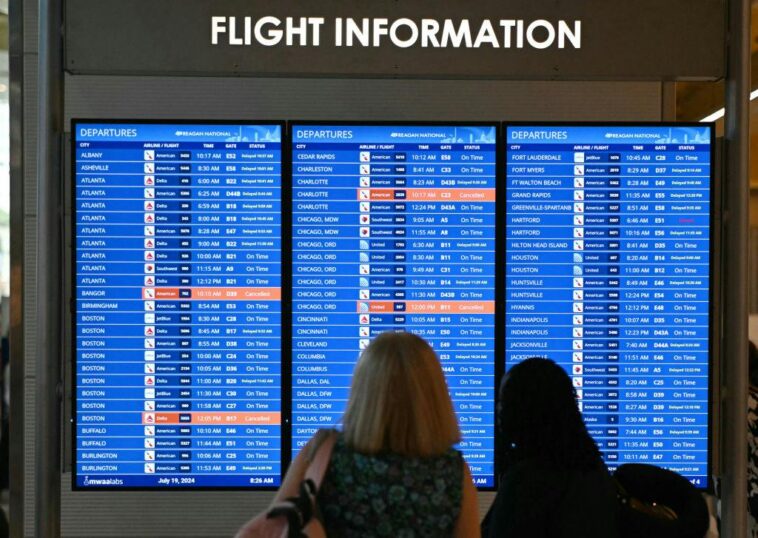
As Thanksgiving nears, America should be grateful for an unlikely disruptive force this year: technology outages.
What began as a singular incident with Microsoft products soon cascaded into every major sector of American life. The Federal Aviation Administration’s air-traffic communications, major banks, the NSA’s internal network, and Apple services all failed within roughly a week. Industry leaders quickly ruled out cyberattacks, but assigning a cause is unlikely to satisfy millions of consumers whose lives revolve around these services.
For all the security and information modernity provides, the November outages remind us that we’re always at the edge of instability. We shouldn’t confuse digital convenience with resilience, and freedom requires occasional friction. That understanding can redefine our relationship with these systems and prepare us for the next stoppage.
We often treat technology as an extension of personal will. Americans streamline many tasks — messaging, hailing rides, taking meetings, and investigating public records — into fewer systems for ease of use. To most people, the infrastructure undergirding those actions is invisible, prompting no second thought as they integrate more of their routines into the device. As 90% of U.S. adults use the Internet daily, we’ve embraced the Internet as a tool, not a replacement, for retaining our autonomy in an increasingly dysfunctional world.
That accessibility has concealed our fragility. If these heralded systems fail, we learn how close they are and how much autonomy we’ve ceded to them. Downed routers this month left thousands of passengers stranded, guests locked out of hotels, and panic-buying at stores nationwide. When we can’t retrieve our agency of navigation, payment, and verification, pure freedom becomes scarce in a technological republic. If abstract networks are one short circuit away from becoming a lived public experience, then independence must become a virtue, not a luxury.
From our country’s inception, the American ethos has promoted self-reliance. In 1777, John Adams wrote to his son that “a Taste for Literature and a Turn for Business, united in the same Person, never fails to make a great Man.” Excellence requires both cultivated knowledge and practical application. That character produced ambitious citizens, ones who would invent digital, interlinked systems two centuries later. Gifted individuals saw limitless opportunity in commerce, media, and intelligence, and pushed the online space far beyond its initial conceptions.
To use these systems confidently is different from knowing their intricacies, chokepoints, and when their outputs deserve scrutiny. Today, 69% of workers believe in their digital skills, even as half the population can’t grasp fundamentals about artificial intelligence. We’ve become “masters” of machinery we don’t understand, and this gap may explain why, as AI progresses, fewer Americans believe their talent and creative standing matter. The answer isn’t surrendering judgment to technology, but developing parallel judgment to survive outside them.
The November outages call on us to reclaim practical agency. Half of Americans can’t travel without GPS or don’t carry cash, with only 31% keeping physical records at home or in their office. We must respond to electronic breakdowns with real-world redundancy: backups, fallbacks, and alternative resources that preserve our capacity to act. We aren’t building systems off-screen out of survivalist instinct, but demonstrating mature technological citizenship by knowing their limits. As Adams suggests, we must combine curiosity with competence in both realms to avoid atrophy altogether.
This sense of preparedness can also reinvigorate prudence in the American people. When servers stopped working, Americans’ gut reactions were to flood Costco and sell tech stocks en masse. Notions of a doomsday economy play on fears of broader collapse and wiped out all NASDAQ gains for the year. However, a prudent citizen knows neither to deny danger nor be paralyzed by it. They can distinguish inconvenience from emergency through sober information-seeking so they can respond in proportion to the actual risk. This self-reliance can strengthen community responsibility and temperance, making people less likely to make impulsive choices that harm others.
The outages, for all the frustration they generated, sparked an unignorable and mass endorsement of attentiveness. Techno-optimism means we can create extraordinary systems while having the wisdom and contingencies to thrive in their absence. Should there be more bumps ahead, let’s not retreat from modernity, but find sustainable ways to inhabit it all.
***
Alex Rosado is an independent writer and a Young Voices senior contributor. The views expressed in this article are solely those of the author and do not represent those of any workplace or affiliate organization.