
See more of our coverage in your search results.

A young endangered right whale swimming north along the New Jersey/New York coastline faced a perilous obstacle course — an ocean crowded with massive ships that could kill it in an instant.
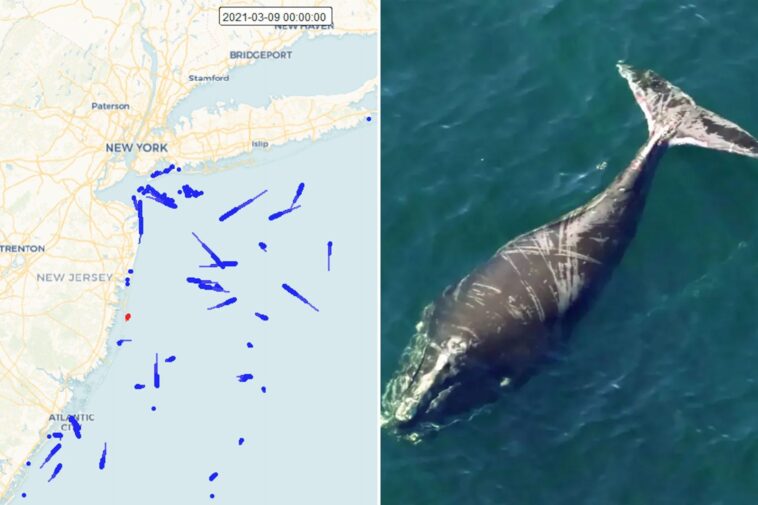
The 1-year-old North Atlantic female right whale #5042 — fitted with a satellite tag and represented by the red dot in this video map — illustrates a terrifying reality.
“Unless humans take measures to preserve the species, they are destined to extinction,” according to the National Oceanic and Atmospheric Administration (NOAA).

As the whale traveled north through the busy waters in 2021, its path crossed a nautical highway of commercial shipping traffic.
But the picture doesn’t even show all the ships.
Only vessels equipped with Automatic Identification Systems (AIS) are represented, meaning other boats sharing the whale’s waters are missing from the visualization.
As of 2026, there are only 380 right whales left in the wild. By the early 1890s, commercial whalers had hunted them to the brink of extinction.
Although whaling was outlawed in the US in 1972 and worldwide in 1986, they have never recovered to pre-whaling numbers, and still face many man-made dangers.
Entanglements in fishing gear and vessel strikes are the leading causes of death today.


For right whales especially, the ships can be deadly. The giants frequently swim at the ocean’s surface, putting them directly in the vessels’ path.
Making matters worse, their dark bodies and lack of dorsal fins make them extremely difficult for boat operators to spot, particularly in rough seas, bad weather or at twilight.
Start your day with all you need to know
Morning Report delivers the latest news, videos, photos and more.
Thanks for signing up!
To reduce the danger to the mammals, federal regulations require most vessels 65 feet or longer to travel no faster than 10 knots — 11.5 mph — in designated areas along the East Coast.
In waters near the entrances to New York and New Jersey ports, the mandatory restrictions run from Nov. 1 through April 30.
“Together with other technologies, such as satellite detection, tagging, and aerial and vessel surveys, we are advancing North Atlantic right whale recovery,” said a NOAA spokesperson.