
This article is part of Upstream, The Daily Wire’s new home for culture and lifestyle. Real human insight and human stories — from our featured writers to you.
***
Something seems to be changing in American culture. Some have described it as a “vibe shift,” like a tangible sensation of spiritual change in the air, perhaps not all that different from the way a sailor might sense when the winds are about to turn. But last month, new data came out that give a specific shape to one key dimension of this shift. The polls point to an unprecedented spiritual reversal happening with young men in America, and one that has turned very suddenly.
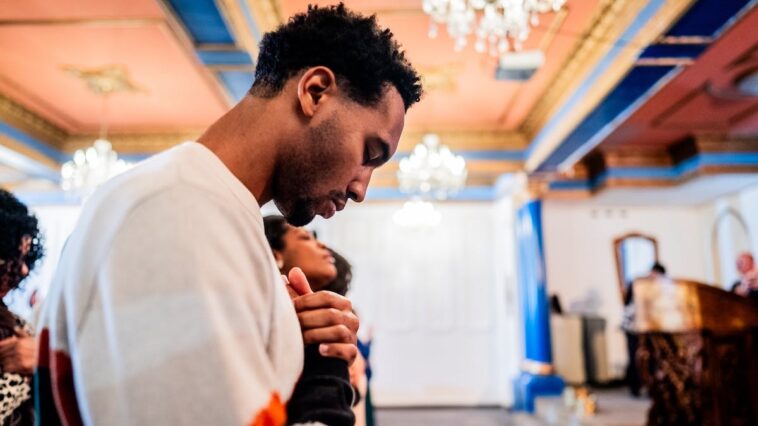
Gallup released numbers in April showing that the share of American men ages 18 to 29 who say religion is “very important to them” jumped from 28% to 42% between 2023 and 2025. That’s a 14-point swing in two years — a 50% proportional increase, and the single largest shift in our lifetime on how young men relate to religion. This vibe shift erased a nearly 25-year decline in religious interest in just two years.
While the change is statistically unprecedented, if you have been watching the culture rather than the polls, none of this should surprise you. The polls are just catching up.
The statistical decline of traditional religious participation and the rise of those who claim to believe in “nothing at all” began in the mid-1990s. The New Atheist decade that followed made a specific wager: Strip away “superstitious” beliefs of our bygone religious past, and civilization will march onward in an unfettered path of progress. But by the 2010s, as we moved into an era of intense cultural tumult dubbed the “Great Awokening,” it was obvious we were not getting that promised utopian outcome from our anti-religious experiment.
What we got instead was a “meaning crisis” and a generation of young men who grew up feeling the weight of hopelessness. They watched as deaths of despair skyrocketed, institutional trust declined, and civilization slowly descended into ruin as Marxist and postmodern ideologies rushed to fill the religious vacuum.
They were handed a world stripped of the timeless guiding stories upon which everything good in American culture had been built, and they were told that all guiding stories — including the stories of scripture — were just propaganda power plays or backwards superstitions. The colloquial phrase for the result was simply “the young men are not okay.”
What the data now suggest is that a critical mass of young men have decided this anti-God experiment has run long enough. Young men are tired of not being okay.
The early signals were everywhere. Jordan Peterson sold out theaters lecturing on Bible stories with millions more watching on YouTube, hungry for someone to show them a story that could give their lives meaningful direction. Tom Holland’s “Dominion” became the book that thoughtful young men discussed in dorm rooms, with its thesis that the moral foundations of the modern West — human dignity, universal rights, concern for the downtrodden — is Christianity all the way down, whether we remember it or not. Justin Brierley, who spent 15 years hosting debates between Christians and the New Atheists, began to notice that young men weren’t listening to the New Atheists anymore. He covered the precipitous decline of New Atheism’s influence in “The Surprising Rebirth of Belief in God.”
If anyone has been paying attention to the most popular podcaster on the planet, they’d notice a similar religious arc happening with Joe Rogan. Not that long ago, Rogan sounded like the average red-blooded American male of the old cultural moment: bemused by traditional religion and comfortable with the assumption that faith was something smart people had outgrown. In the last several years, his posture has shifted so visibly it has become a running theme of his show. Guest after guest, from biblical scholars such as Wesley Huff to Christ-curious comedians, get invited to wrestle seriously with the question of God rather than brush it aside. In 2025, Rogan himself started attending church, something I predicted would happen in 2024.
There were other signs in pop culture that, in strange ways, hinted at a coming spiritual turn. In late 2023, young men started playing old Creed songs again without an ounce of cynical irony — songs drenched in a sincere, hungry religiosity the 2000s had trained everyone to mock. In 2024, Creed had its highest-grossing year as a band, propelled primarily by young men who were too young to listen to the band’s religiously tinged albums when they first came out.
The popular stories that filled our screens began to reflect the ache men had for a positive vision of male heroism rooted in sacrificial love and the pursuit of something bigger than oneself. They made “Top Gun: Maverick” and “F1″ enormous hits — films that refuse the postmodern move of telling you the male hero is an oppressive force of the patriarchy. More recently, they embraced “A Knight of the Seven Kingdoms,” a story about an earnest young man who wants, with his whole heart, to be genuinely good in a franchise famous for insisting that wanting to be good is how you get killed. They cheered for “Project Hail Mary,” whose “hopecore” message is built on a man named Grace laying down his life for the sake of the world.
None of these pop culture signposts are as explicitly “religious” as a Sunday school lesson, but what do they all have in common? They show that young men are hungry for hope, meaning, and purpose in their lives. They reflect a shift from the spiritual “closedness” of the last two decades to a fresh spiritual openness, and a growing appetite for timeless religious themes of virtue, sacrifice, and the quest for a higher purpose.
Is this a full-blown religious revival? Revival probably isn’t the best word to describe what’s happened. Young men’s interest in traditional religion has spiked, and some have started to fill the church pews. I suspect more will follow. What it does point to should be encouraging for anyone who cares about the future of America.
Young men are increasingly willing, in numbers now measurable, to entertain the possibility that the religious wisdom we had discarded was something we needed, but did not see the need for until we tried to live without it.
For 25 years, the trend line pointed in one direction, and even some of the most devoted church-going observers assumed it would keep tailing downward. It did not. It broke. In the span of a few short years, a generation of young men looked around at the trajectory of an anti-God culture and, with something like collective intuition, decided they had had enough.
***
Paul Anleitner is a cultural theologian whose work focuses on the role of culture and story in our quest for meaning. He is the author of “Based on a True Story: Vibe Shifts, the End of Deconstruction, and the Reboot of Meaning.”