
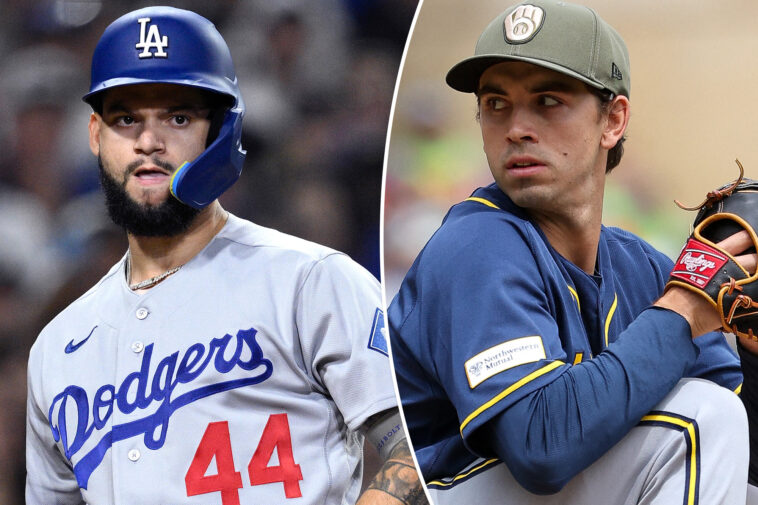
MILWAUKEE — It was either the most sophisticated code for relaying pitch signs. Or, more likely, the most obvious attempt to distract the pitcher with a bluff.
In the top of the fourth inning Saturday, Andy Pages was not being subtle once he reached second base on a double.

Almost every time Brewers left-hander Robert Gasser threw a pitch, the young Dodgers slugger was doing something with his hands that looked like a signal to the batter.
This is an age-old — and, to be clear, completely legal — part of gamesmanship in baseball. If a baserunner can get a read on the type of pitch that’s about to be thrown, there are any number of ways they can alert their teammate at the plate.
Over the last couple years, Pages in particular has made the practice a common routine. Rarely does he get to second base without doing something. It doesn’t even matter if he actually knows what’s coming.
“We’re gonna do everything we can in those situations,” Pages, who has been involved in pitch-tipping situations previously this year and even during last October’s National League Division Series, said through an interpreter.
“When you’re at second base, there’s times where they’re doing stuff, and you could tell that they have some stuff. But sometimes, you’re doing stuff to distract the pitcher as well.”
Saturday, upon further review, appeared to be a case of the latter.
While Pages made a variety of hand motions before eight of the 10 pitches Gasser threw as he stood at second, there did not seem to be much of a pattern correlating with his supposed signs.
During an at-bat by Will Smith, Pages extended his left arm as Gasser threw a changeup, which Smith swung at and lined to center field for an out. When Kyle Tucker came up next, Pages tapped his helmet with his right hand before four different pitches, each of which turned out to be four different pitch types. Tucker took all of them to draw a walk.
The reason Saturday got so much attention is because of what happened next.
With Teoscar Hernández up, Pages did a right-handed helmet tap before a sweeper. Swing and miss. He then did a left-handed helmet tap and arm extension before a changeup. Called strike.

Finally, in an 0-2 count, Pages went back to just stretching out his left arm before another sweeper from Gasser.
This time, Hernández connected for a go-ahead three-run home run, flipping the momentum in the Dodgers’ eventual 11-3 win.
After the game, Brewers manager Pat Murphy said he believed Pages had caught Gasser tipping, telling reporters that “it was pretty evident that maybe they did [have something] at second base,” according to the Milwaukee Journal Sentinel.
However, in an interview with The California Post on Sunday morning, Pages indicated his signals were simply a ruse.
When asked if he should get an assist for Hernández’s blast, he chuckled and said: “No, not on that one.”
The truth, of course, might be somewhere in the middle. If Pages genuinely was getting reads off Gasser — he stared into the pitcher’s glove as he gripped the ball — it wouldn’t much benefit him to say so publicly.
“There’s times where I will take credit [for relaying the right pitch],” Pages quipped.
But Saturday, even his manager agreed, wasn’t one of them.
“There, honestly, I don’t think we had the signs,” Dave Roberts said. “Teo took a good swing, and it wasn’t really a great pitch. But I’m honestly not certain.”
Either way, such uncertainty is all Pages is usually after.
Whether he has a read or not, there’s no better way to get in pitchers’ heads than making them think he might.
“It’s part of the competition, doing stuff like that, just distracting the pitcher, kind of getting him out of rhythm,” Pages said. “Whether he leaves pitches over the plate or not, that has nothing to do with it. It’s part of the competition, just kind of going back and forth with the pitcher, as well.”
Roberts said he has embraced Pages’ penchant for trying to fluster pitchers.
“If you can make a pitcher feel like you’ve got their signs,” he said, “you’ve already won.”
The only caveat?
“There’s certain times when you want the runner to kind of be more still, to not distract the hitter, because you don’t want that, either,” Roberts said. “But, yeah, I like the way [he] is engaged and trying to get an advantage for the hitter.”
Granted, how much this all helps the Dodgers is another unclear question.
There isn’t much difference in their stats between when it’s Pages at second base (.286 average, .400 slugging percentage, 25% whiff rate this season) or one of his typically less-demonstrative teammates (.269 average, .427 slugging percentage, 25% whiff rate in all at-bats with a runner occupying the bag — good numbers but hardly statistical outliers).
Still, when Gasser was asked about the situation Saturday night, he said he noticed Pages’ gesticulations behind him.
Regardless of if he was actually tipping, that alone represented mission accomplished.
“Whether you have [a read on the pitches] or disguise to act like you have them,” Roberts said, “that’s the gamesmanship part of it.”