
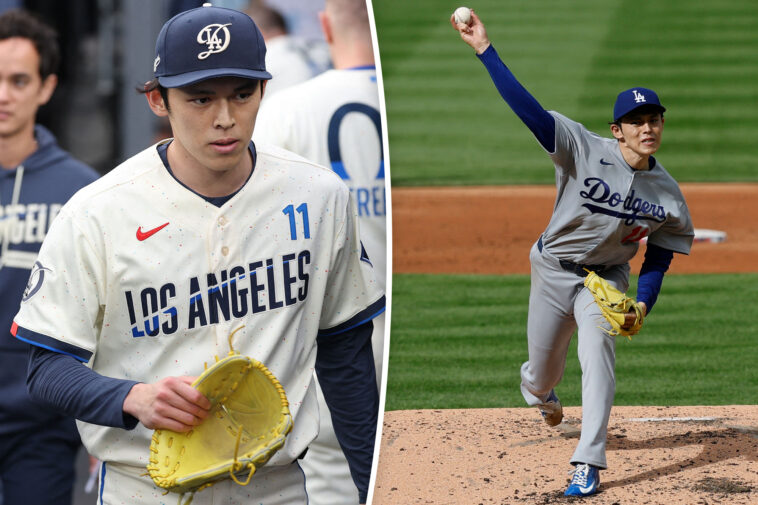
He’s called off the search.
Roki Sasaki has abandoned his efforts to find Roki Sasaki.
Sasaki returned to the mound a new pitcher on Saturday, a non-verbal acknowledgement that the Roki Sasaki of three or four years ago is gone, possibly forever.
For anyone who watched Sasaki dominate the Japanese league as a 20- or 21-year-old, the way he pitched in the Dodgers’ 12-4 victory over the Chicago Cubs had to evoke feelings of sadness.

A dream was dying in real time.
The pitcher with the 100-mph fastball and vanishing forkball who looked destined to become Japan’s first Cy Young Award winner was replaced by a pragmatist who sacrificed his best weapons in a desperate effort to just remain in the Dodgers’ rotation.
The diminished velocity and command of his fastball has required the 24-year-old Sasaki to search for a new pitch to get ahead in counts, and that pitch on this day was a harder-thrown version of his forkball. In doing so, Sasaki dropped his signature pitch, a slower forkball with an extremely low spin rate that moved as unpredictably as a knuckler.
The adjustments helped him pitch five-plus innings and earn his first win of the season, but that wasn’t Roki Sasaki.
From certain vantage points, that was a welcome development. Sasaki joined the Dodgers with a clear vision of who he was as a pitcher, and that made him resistant at times to the organization’s ideas. Dave Roberts, the Dodgers’ ever-positive manager, viewed the changes implemented by the second-year right-hander as a sign of increased maturity.
“With a player you don’t know and you don’t have a lot of history with, you gotta play that balancing act of building trust and letting them find their way a little bit while keeping an eye on what you feel are opportunities to get better,” Roberts said. “I think our [coaching] staff has done a really good job of that. So not really pushing things on him, but he’s certainly much more open.
“And to do that in the middle of the season and change the profile of a certain pitch which has been your bread-and-butter pitch is a lot of trust and growth for Roki.”
Sasaki allowed three homers and was charged with four runs and seven hits in five-plus innings, but he didn’t walk anyone until the sixth inning, leading Roberts to declare the start as his best of the season.

The shift in approach was noticeable, as 48 of the 99 pitches Sasaki threw were splitters. The splitters were thrown with an average speed of 90.8 mph, almost 6 mph faster than in previous starts.
“I think that my No. 1 problem hasn’t been my fastball but rather the percentage of forkballs I’ve been able to throw over the plate,” Sasaki said in Japanese.
By reducing the vertical break of the pitch, Sasaki made it easier to control – but also not as lethal. With two outs in the third inning and a runner on second base, Sasaki threw a splitter to Michael Busch that was knocked into right field for a run-scoring single.
And while being able to throw a splitter for a strike made his fastball more effective, Sasaki couldn’t generate the necessary velocity or movement on his four seamer to just blow it by hitters. In the second inning, he tried to sneak a fastball by Seiya Suzuki after throwing three consecutive splitters, only to have Suzuki blast it into the left-field stands. The homer he gave up to Miguel Amaya in the fifth inning was also on a fastball.
Sasaki didn’t throw any pitch faster than 98.5 mph.
But what else could throw? The slider he added this season was also hit, Moises Ballesteros launching one over the wall in right-center field.
Sasaki said he was delighted to register his first win but also made it clear he felt that he was bailed out by his team.
Regarding the standing ovation he received when he was replaced by Jack Dreyer with two runners on in the sixth inning, Sasaki said, “I gave up four runs today, and it was the kind of game in which I was saved by the lineup and relievers. But the fact the fans would still cheer for me like that made me feel, ‘I’ll do my best next time.’”
He wasn’t in denial. With a 6.35 earned-run average, he couldn’t be.
Asked if he could ever throw the ball again the way he did in Japan, Sasaki replied, “How you pitch changes year-to-year, and it can be different within a year depending on the day,” he said. “You have to prioritize increasing the quality of your pitches. Once you do that, you see how hitters respond. I think you have to focus on raising the level of your performances.”
He didn’t answer the question, but he didn’t have to. The truth was in the game he just pitched.