See more of our coverage in your search results.

The Raiders should send the Rams a thank-you card.
Nothing extravagant. Certainly nothing that suggests they intend to be gracious hosts Sunday at Allegiant Stadium.
Just a little acknowledgment that sometimes the people who stand in the way of what you want inadvertently help you find exactly what you need.
In the Raiders’ case, that turned out to be Las Vegas. And a magnificent stadium that looks like someone took the franchise’s personality, poured it into an architectural drawing and built it just off the Strip.

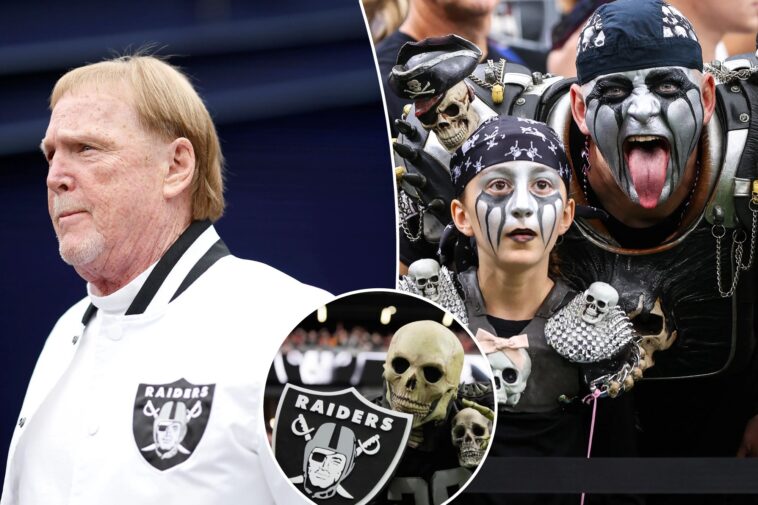
Their home. Their identity. Their town, at least when it comes to the NFL.
Getting here required swallowing a bitter pill. But with the Rams arriving Sunday for their first game at Allegiant Stadium, preseason or regular season, the Raiders can appreciate how that disappointment helped change their future.
They wanted Los Angeles.
They might have gotten something better.
To understand how, rewind to 2015, when three NFL franchises were searching for stadium solutions and Los Angeles was the biggest prize on the board.
The Rams had an escape hatch in St. Louis. The Edward Jones Dome had failed to satisfy the first-tier stadium requirements in their lease, allowing them to shift to a year-to-year arrangement and pursue a return to Southern California.
Rams owner Stan Kroenke, a land developer at heart, had his eye on 298 acres in Inglewood, on which he would build a state-of-the-art stadium and surround it with a massive mixed-use master-planned district.

The Raiders were stuck trying to make an increasingly untenable stadium situation work in Oakland. The Chargers were fighting their own seemingly endless battle to secure a new home in San Diego.
Eventually, the Raiders and Chargers joined forces on a proposed shared stadium in Carson.
Two AFC West rivals, united by necessity.
What followed was a yearlong soap opera of competing proposals, shifting alliances and powerful owners trying to determine who would get access to the country’s second-largest market.
Kroenke had the money and the development vision to deliver something far beyond a football stadium in Inglewood. His project offered the NFL a destination, a showcase and a solution to a Los Angeles problem that had dragged on for two decades.
But solving Kroenke’s problem also meant figuring out what to do with the Raiders and Chargers.
Sign up for the California Morning Report newsletter
The biggest news, opinion and culture shaping California right now.
Thanks for signing up!
A two-team stadium offered a way forward.
And from a football perspective, the obvious pairing was sitting right there.
Rams and Raiders.
NFC and AFC.
Two proud franchises with deep Los Angeles roots, established followings and enough cultural differences to create a fascinating civic rivalry.

Think USC and UCLA, with fewer recruiting arguments and considerably more silver and black.
The same Raiders popularity that made the pairing compelling, though, also made it complicated for the Rams. Building a spectacular stadium is one thing. Sharing it with a franchise capable of commanding so much of the hometown attention is another.
Ultimately, the NFL approved the Rams’ move and gave the Chargers the first option to join them. The Raiders were left waiting, with an opportunity contingent on the Chargers passing.
Imagine being Mark Davis.
Your stadium situation remained unresolved. Your preferred relocation plan had fallen apart. And your next move depended, in part, on someone else’s decision.

It looked like a defeat.
Then Las Vegas emerged as a real possibility.
What followed took considerable work, political support and a substantial public investment. Nevada and the Raiders assembled the partnership Oakland could not, creating a stadium agreement that transformed the franchise’s financial future while giving Las Vegas a major new stage.
The Raiders got their long-sought home. Las Vegas got an NFL team and a building capable of attracting events far beyond the football schedule.
The difference for the Raiders went beyond a new address.
For years, their stadium predicament had defined so much of their existence. Every conversation about their future seemed to come with a question mark.

Las Vegas replaced that uncertainty with permanence.
And an identity that requires no explanation.
Look at Allegiant Stadium. The dark exterior. The silver-and-black sensibility. The unmistakable connection between the building and the franchise playing inside it.
There is no need to negotiate whose personality the place should reflect.
Life in Los Angeles could have been good. The Raiders would have reconnected with a passionate fan base and played in a spectacular stadium.
But they would have shared that NFL home, its identity and its place in the market with the Rams.

In Las Vegas, they have something entirely their own.
None of that wins Sunday’s game. Financial success does not block a pass rusher, fix the running game or close out a fourth-quarter lead. The Raiders still have plenty to prove where it matters most to their fans.
But the Rams’ visit offers a reason to appreciate the strange route that brought them here.
The Raiders can spend Sunday trying to send their guests home unhappy.
Before kickoff, though, a small, begrudging thank-you would be appropriate.
Thanks for leaving us out.
We found our way home.