
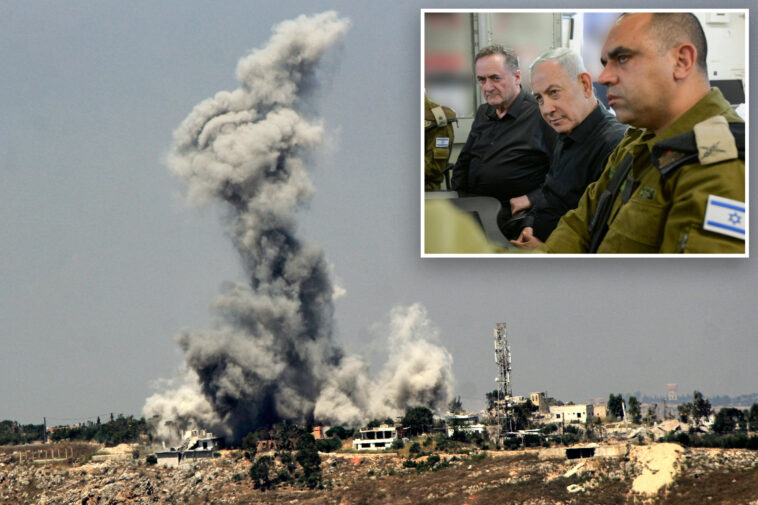
Prime Minister Benjamin Netanyahu and Defense Minister Israel Katz said on Monday they had ordered the Israel Defense Forces to strike Hezbollah terror targets in Beirut’s Dahiyeh suburbs, citing repeated violations of the ceasefire with Lebanon.
The Dahiyeh district in Beirut’s southern suburbs is a major Hezbollah stronghold, where the Iranian-backed terrorist organization maintains significant “military” and political infrastructure.
“There will not be a situation in which Hezbollah attacks our cities and our citizens while its terror headquarters in Beirut, in Dahiyeh, remain off-limits,” Netanyahu said in a statement shared by the Prime Minister’s Office.
“We are continuing to deepen our operations on the ground in Southern Lebanon, eliminating Hezbollah strongholds. Hezbollah is on the run. We are determined to restore security to the residents of the north, just as we did for the residents of the south,” the premier stated.

Katz said, “The rule for Dahiyeh in Beirut is the same as for the communities of northern Israel—if there is no quiet in the north, there will be no quiet in Beirut.
“We will not allow a situation in which our communities and citizens are harmed while calm is maintained in Beirut,” he reiterated.
Rocket alerts sounded in multiple areas across northern Israel on Sunday, including in Haifa’s Krayot bayside suburbs, in the first advance warning there since the April 17 ceasefire agreement with Beirut.
Emergency services responded to several incidents on Sunday, including a fire in Tel Dan Nature Reserve caused by a rocket impact, which was brought under control without casualties. In Moshav Beit Hillel, near Kiryat Shmona, rescue forces handled a direct strike on a structure; no one was trapped, though crews secured a gas leak and disconnected electricity sources.
Hezbollah renewed its rocket and drone attacks on Israel on March 2, following the targeted killing of Iranian Supreme Leader Ali Khamenei on the first day of “Operation Roaring Lion” on Feb. 28.
In response, Israel launched a broad aerial campaign against Hezbollah targets and expanded military operations in Southern Lebanon aimed at preventing cross-border attacks on Israeli communities.
Prime Minister Benjamin Netanyahu on April 26 accused Hezbollah of “essentially disintegrating” the fragile ceasefire with Lebanon, which was extended for another 45 days last month.

“Therefore, as far as we are concerned, what obligates us is the security of Israel, the security of our soldiers, and the security of our communities,” the prime minister said. “We are acting vigorously according to the rules we agreed upon with the United States, and incidentally, with Lebanon as well.”
The IDF has been advancing deeper into Lebanon for several days after crossing the Litani River, and is now some 5 kilometers, or 3 miles, from Nabatieh, a major urban center and Hezbollah stronghold.
Jerusalem’s control of the Beaufort Ridge in southeastern Lebanon for the first time since 2000 is “an expression of correcting old national sins and distorted perceptions,” Finance Minister Bezalel Smotrich said on Sunday.
The Israeli government promised the residents of the north lasting security, and “we are acting with determination to achieve this,” the senior Cabinet minister tweeted in Hebrew.
Following the developments in Lebanon, Iranian Foreign Ministry spokesman Esmaeil Baghaei told reporters in Tehran that the Islamic regime would take “all measures to support Lebanon and the resistance against the Zionist regime’s illegal aggression.
“We insist that a ceasefire in Lebanon is an essential condition for any deal [with the United States] aimed at ending the war,” the spokesman declared.
Iranian Foreign Minister Abbas Araghchi subsequently warned that the U.S. and Israel would be held responsible for “any violation” of the temporary ceasefire, including in Lebanon.

“For immediate attention: The ceasefire between Iran and the U.S. is unequivocally a ceasefire on all fronts, including in Lebanon,” Araghchi claimed in a post on X.
“Its violation on one front is a violation of the ceasefire on all fronts,” he threatened. “The U.S. and Israel are responsible for the consequences of any violation.”
Meanwhile, Secretary of State Marco Rubio spoke separately with Netanyahu and Lebanese President Joseph Aoun and proposed a plan to allow for “gradual de-escalation,” a U.S. official told Reuters on Sunday.
Washington has proposed that as a first step, Hezbollah would stop all attacks on Israel, and in return, the Jewish state would refrain from hitting Beirut, the official said.
“This would create space for gradual de-escalation and an effective cessation of hostilities,” according to the official.

The official stressed that the Trump administration did not expect Israel to absorb ongoing attacks on its civilians by Hezbollah.
Aoun’s office had issued a readout of the call on Friday, stressing “the need to make every possible effort to achieve a ceasefire, considering it the essential gateway to any subsequent step.”
Rubio during the call “reaffirmed the U.S. administration’s commitment to continuing its efforts to consolidate the outcomes of previous meetings in Washington” aimed at achieving a truce, according to Aoun.
Start your day with all you need to know
Morning Report delivers the latest news, videos, photos and more.
Thanks for signing up!
Hezbollah Secretary-General Naim Qassem has repeatedly urged Aoun to leave the negotiations with Jerusalem, denouncing them as “futile and humiliating” in an April 13 statement.
Hezbollah “will neither calm down nor surrender, and the battlefield will speak,” the top terrorist warned, calling on Aoun to “confront the [Israeli] aggression together; afterward, we can agree on the future.”