
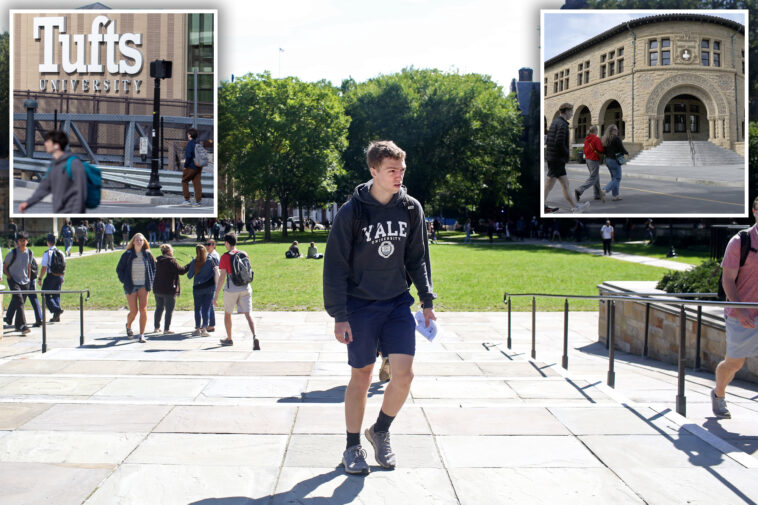
Moscow is criminalizing the American dream — blacklisting more than a dozen elite US universities and making it illegal for Russians to so much as contact them.
In a sweeping crackdown, Russia’s General Prosecutor’s office has branded 19 top American schools as “undesirable” and turned what used to be a dream — studying abroad — into a legal nightmare, according to the Moscow Times.
The latest target of the Russian Undesirable Organizations law, which was signed by Russian Prime Minister Vladimir Putin in May 2015, is Stanford University, which was added to the Kremlin hate list on April 7. The school joins Tufts University and earlier additions like UC Berkeley, George Washington University, and Yale University.

The hostility stems from Russian officials who claim the universities — once symbols of prestige where Russian students routinely came and went on exchange programs — are part of a broader campaign to limit foreign influence in its academic and civic space.
Critics argue this legal framework is being used to deter engagement with global academia and isolate Russian scholars from international networks, according to MSN.
“Yale University was recognized as an undesirable organization at my request,” lawmaker Andrei Lugovoy said on the Russian state television show Evening With Vladimir Solovyov. “Nothing like this has happened before. And we believe it is the right thing to do.”
The prosecutor’s office paid special attention to Yale’s School of Global Affairs, which the Russians claim conducts “training opposition leaders of foreign countries.”

Tufts University and its prestigious Fletcher School of Law and Diplomacy have also been blasted by Russian prosecutors as “anti-Russian propaganda tools” that “radicalize” the country’s citizens, according to the Moscow Times.
The crackdown has taken on a sharper edge since Russia’s invasion of Ukraine in 2022.
“By openly expressing solidarity with the Kyiv regime, these institutions purposefully conduct various events where they broadcast distorted and unreliable information about Russia,” the prosecutor’s office said.

Russian prosecutors also accuse the schools of undermining “traditional values” — pointing to support for LGBTQ+ rights and criticism of the Kremlin.
A law that took effect March 1, went even further — banning films that portray Russia as anything less than morally superior or which contain LGBTQ+ content, which the Kremlin criminalized in 2022.
Under the university crackdown, the consequences for ordinary Russians are severe. Under the “undesirable” law, anyone linked to these institutions — including students — faces up to four years in prison. The Liberty Forward advocacy group estimates between 2,000 and 3,000 Russians are already at legal risk, and the real number may be higher.

For thousands of young Russians, the choice is stark: stay abroad and never go home, or return and face arrest.
“I didn’t know I was leaving forever,” a Russian student at Yale told the Moscow Times. “Now emigration is not really my choice — it’s just a reality.”
As of April 10, Russia’s Ministry of Justice had declared 346 overseas and international organizations “undesirable.” And there is no sign it plans to stop, even though no one has been arrested yet.

“The work continues. Tasks to strengthen national security and purge collaborators and the infrastructure that serves them have been placed under special control,” Andrey Lugovoy, deputy of the State Duma, the lower house of the Russian parliament, wrote on his Telegram channel in late 2025.
Along with US universities, the “undesirable” list also includes Greenpeace, the Clooney Foundation for Justice, and the Elton John AIDS Foundation.
Mikhail Zygar, a Russian journalist who has criticized the Russian government and its invasion of Ukraine, was forced into exile after his channel — the last independent television show in Russia — was designated “undesirable” in 2022.
“All Russians, Russian students, all people who live in Russia, will be barred from applying to the university, because according to Russian law about undesirable organizations, it’s a criminal offense,” Zygar told Yale News. “If any Yale student comes to Russia, he or she actually could be officially accused of collaborating with the undesirable organization, which is a crime.”