Archaeologists from the ancient ruined site of Pompeii have used AI to digitally generate a portrait of one of the 2,000 people who died during the volcanic eruption that destroyed the Roman city.
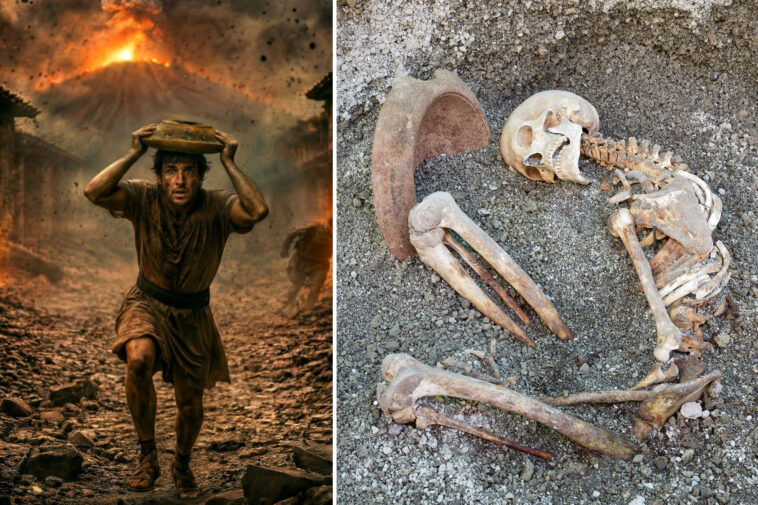
The remarkable digital reconstruction, released by the Pompeii Archaeological Park Monday, features a man using a bowl-like object to shield his head while attempting to flee against the flaming backdrop of Mount Vesuvius during the eruption that left the city in ruins in AD 79.

The reconstruction is based on one of two sets of human remains found by archeologists outside the walls of the ancient ruined city in Italy.
Pompeii, which is now a UNESCO World Heritage Site, was rediscovered in the 18th century and contains the remains of thousands of buildings and its inhabitants that were preserved in remarkable detail after the city was buried under feet of ash and pumice from the eruption.
The historic male remains were found by archeologists next to a terracotta mortar, which researchers believe the man used as a shield from falling debris.
The portrait reconstruction is in line with ancient accounts — including those of Roman writer Pliny the Younger — that detail Pompeii residents using a variety of objects to protect themselves from dangerous falling debris and ash.
Archeologists believe the man in the digital portrait died early in the two-day disaster during a heavy fall of volcanic debris.


The man was also found alongside an oil lamp, a small iron ring and 10 bronze coins — offering astonishing insight into his final moments before the catastrophe, as well as what life in Pompeii was like some 2,000 years ago.
The digital reconstruction was created using AI and photo-editing software designed to translate skeletal and archaeological data into impressive human likeness.
“The vastness of archaeological data is now such that only with the help of artificial intelligence will we be able to adequately protect and enhance them,” Pompeii park director Gabriel Zuchtriegel said in a statement.
“If used well, AI can contribute to a renewal of classical studies.”

Pompeii Archaeological Park and the University of Padua worked in collaboration to generate the AI reconstruction as part of their ongoing project to make archeological research more accessible to the public.
The project aims to give the public greater access to more emotionally engaging archeological discoveries while maintaining a scientific foundation, researchers said.
With Post wires