“I pride myself on being ahead of the curve,” bestselling author Brad Thor told The Post in an exclusive interview.
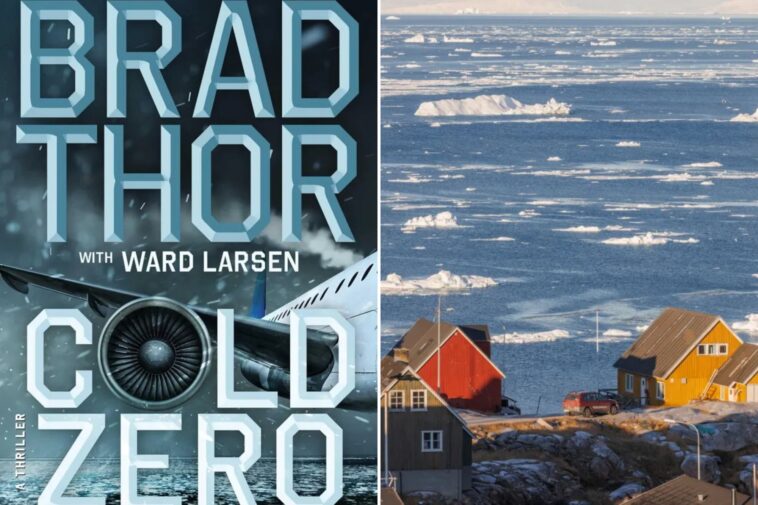
Over the past two decades, Thor, 56, has written two dozen thrillers — including “The Last Patriot” and “Backlash” — that have focused on emerging security threats just before they migrate from think tanks and intelligence briefings to the front pages. His latest book, “Cold Zero” (Atria/Emily Bestler Books; Feb. 10), co-written with Ward Larsen, imagines a world in which global powers converge on the Arctic in a desperate race for military advantage, transforming the frozen north from a geographic afterthought into the planet’s most dangerous flashpoint.

That premise might have once felt safely speculative, but, these days, it no longer does. “Cold Zero” hits bookstores just weeks after President Trump revived his push to gain US sovereignty over parts of Greenland.
“IF WE DON’T [get Greenland], RUSSIA OR CHINA WILL, AND THAT IS NOT GOING TO HAPPEN!” Trump proclaimed on Truth Social last month.
The timing with the book’s release, Thor insists, was unintentional. “It was already done,” he said of his manuscript. But the collision between his fiction and breaking news has been a recurring theme in his career. It’s a precarious position. Lock in too many specifics and the book ages badly; stay too vague and the stakes feel abstract.
“I don’t want somebody to pick up one of my books ten years from now and say, ‘Well, I already know how this ends because I remember what happened in the real world,’ ” he said. “From a business standpoint, you want your books to have a long, long life and to entertain people. They’re supposed to be an escape.”
The Arctic, and Greenland in particular, has become a persistent point of fascination in his work. He first explored the region in his 2021 Scot Harvath novel “Black Ice,” which examined Russian-Chinese cooperation in the northern sea route. “Cold Zero” marks his return to the frozen north as climate change and great-power competition have made the region increasingly strategic.
The new books begins with a simple but destabilizing premise: A commercial airliner is sabotaged midflight over the Arctic, crashing near the North Pole and stranding its survivors in one of the most inhospitable environments on Earth.

The incident sparks an international race, not to rescue passengers, but to reach the wreckage first. Aboard the aircraft is a Chinese defector carrying an advanced artificial intelligence–based military technology with the potential to upend the global balance of power, drawing the CIA, Chinese intelligence services and other actors into a confrontation that threatens to spiral far beyond the frozen north.
Thor chose to co-write the book with Ward Larsen, 62, a decorated Air Force veteran and USA Today bestselling author, specifically for his aviation expertise.
“Ward flies — or he flew as a fighter pilot — one of my favorite military aircraft, the A-10 Warthog,” he explained.

As with his previous novels, Thor’s research process relied heavily on firsthand sources. He has long cultivated relationships with active and former members of the military and intelligence community, and “Cold Zero” was no exception.
“I know a Navy SEAL who became an instructor for cold weather warfare and trains up in Alaska,” said Thor. “He’s been an excellent resource.”
To research his 2009 book, “The Apostle,” Thor embedded with US special operations forces in Afghanistan, but his insistence on realism has sometimes drawn criticism.
For “Black Ice,” Thor cited a US Navy white paper published during the first Trump administration. It noted that Arctic sea ice is melting earlier in the spring and refreezing later in the fall, creating longer operational windows for commercial and military traffic. Some readers accused him of having a political agenda.

“I had a couple of people complaining that I was pushing climate change,” Thor said. “But I was using a Navy assessment. That was the source.”
For him, the episode highlighted how difficult it has become to discuss observable realities once they acquire ideological charge. But it also underscored why he writes the way he does.
“I think I’m an outlier in that politics, particularly geopolitics, is like sports to me,” he said. “Politics is my baseball. I love that stuff. So I try to make it interesting in my books. I try to point out, ‘This is why this part of the world is important. This is why this relationship with this country is important.’ You know, when I started writing novels, Finland and Sweden were not in NATO. Now they are. It’s amazing how much has changed on the global stage.”

What concerns Thor most about the current moment is not rival superpowers, but rather domestic polarization. “We’re no longer able to think like Americans. We’re only able to think like Republicans or Democrats,” he said. “You don’t see a Ronald Reagan and a Tip O’Neill going out and having drinks to talk about issues.”
When asked about America’s greatest national security weakness, Thor’s answer is immediate and unequivocal.
“It’s social media. I have relatives who are in Facebook groups with like-minded people. They silo themselves off,” he said. “They surround themselves with people who think like they do and they don’t get any pushback. They let their guard down. And those places are where the Chinese, the North Koreans, the Iranians and the Russians move in to push disinformation.”

Thor’s view of the Arctic situation is informed by infrastructure realities that rarely make headlines. “All you have to do is look at the icebreaker fleet,” he said. “We have two functioning icebreakers, one of which is committed to resupplying research stations in Antarctica.”
He contrasts this with China’s capabilities — the latest reports show they have at least five, with possibly more under construction. “And they don’t even have any claims to the Arctic,” he exclaimed. “It’s crazy.”
He mentions Robert O’Brien, Trump’s last national security advisor in his first term and a close friend of Thor’s, who “was working very hard on at least leasing icebreakers for the United States and doing a bright red postcard stripe on the side of them, getting a skiff somewhere inside so that we could beef up our fleet. Robert and others in that first Trump administration said, ‘OK, this is a big deal. We’ve got to build these icebreakers.’ ”
Thor is skeptical about whether diplomacy in the Arctic is still viable. “It’s hard to predict what’s going to happen next, particularly when it comes to global powers,” he said. “But if we’re going to see any bullets traded back and forth between us and the Russians and China, I actually think the Arctic could be one of the first places that happens.”